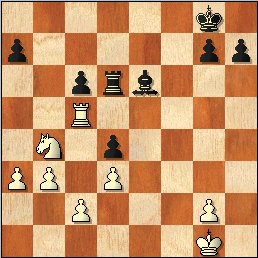
1.e4 c5 2.Nf3 Nc6 3.Bb5 One day, I intend to teach all people to play Open Sicilian's; I really can't stand these dull Rossolimo systems. 3...e6 4.Bxc6 bxc6 5.d3 d5 6.Qe2 Ne7 7.Nc3 Ng6 8.0-0 Be7 9.Bd2 0-0 10.a3 d4 11.Na4 e5 12.h3 Ba6 13.b3 Qc7 14.h4 Nxh4 15.Nxh4 Bxh4 16.Nxc5 Bc8 The exchange of the h for c-pawns will only benefit white if he can keep his knight on c5 for an extended period of time. To this end, he should probably try something like 17.c3 here, and put a rook on the c-file if the oppurtunity arises. 17.f4?! Qe7 Now the attack on the knight allows black to prepare other plans. 18.Na4?! 18.Qh5 or 18.b4 were both superior to the text, as now the queen on e2 is vulnerable. 18...exf4 19.Bxf4 f5 Very energetic. White still needs his knight in play if he is going to counter blacks plans, so 20.b4 should once again come into consideration here. 20.Bd2 Qe5 The advance of the white f and h pawns has left dark square weaknesses around his king, which black now aims to exploit. This first attempt leads only to a repetition, but he soon finds another path. 21.Bf4 Qe7 22.Bd2 Bg5 23.Bb4 This looks tempting, but I expect black's next came as a surprise. 23...Qf6!? 24.Rf3? Not a good reaction; exchanging with 24.Bxf8 was best, and is probably just level. Curiously, black eschews the chance to grab material here. 24...Re8 There was nothing that I could see that was wrong with 24...Be3+ 25.Rxe3 dxe3, when the attack on the a1 rook leaves black an exchange for a pawn up. Still, keeping the pressure on forces white to be more accurate. 25.Bd2 Bxd2 26.Qxd2 Qg6 27.exf5 Bxf5 28.Raf1 Be6 29.Qf4 Now the ominous build-up on the f-file gives white enough play, such that the poor placement of his knight is irrelevant. 29...Rad8 30.Rg3 Qf7 31.Nc5 Bd5 32.Qxf7+ Bxf7 33.Rgf3 Bd5 34.R3f2 Re7 35.Na6 Rf7 (=) A draw looks fair here, but white is looking for more. 36.Rxf7 Bxf7 37.Rf5 Be6?! Not the best - to hold the balance, black mus t activate his own rook with 37...Re8 38.Rc5 Rd6 39.Nb4 Diagram