
NEWS >
Related on discoveries, crime, supernatural and other
topics.
Natural...
Happening....
Supernatural....
Crime... Discoveries...
Unexplainable....
 A
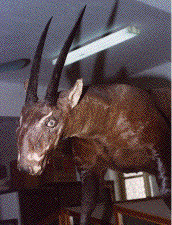
new species of deer discovered in Vietnam >>
A
new species of deer discovered in Vietnam >>
Sao La taken in its habitat
This is the first of the new mammal species discovered. First found
in Vu Quang forest reserve, which is in Ha Tinh province of north central
Vietnam. Specimens are also known from Nghe An province just to the north,
and it is suspected from Thua Thien-Hue province and Dak Lak in the southern
central highlands. Based on this information, we believe that Pseudoryx
nghetinhensis has a wider distribution in the forest area.
more
photos will be in the photo page>>
UP>>
The
Bunyip Encounter description >> 
The dated encounter of the
Bunyip>>
In 1847 a young herdsmen saw a Long-necked Bunyip grazing
while he was looking for some cows in a flooded area. A local settler,
George Hobler, reported the young herdsman's story to the Sydney Morning
Herald. The description below show Hobler's report.
| "It was about as big as a
six months' old calf, of a dark brown colour, a long neck, and long pointed
head; it had large ears which pricked up when it perceived him (the herdsmen);
had a thick mane of hair from the head down the neck, and two large tusks.
He turned to run away, and this creature equally alarmed ran off too, and
from glance he took at it he describes it as having an awkward shambling
gallop; the forequarters of the animal were very large in proportion to
the hindquarters, and it had a large tail." |
In 1872, three men watched a dog faced bunyip swimming
in the Midgeon Lagoon, New South Wale for about half an hour. One of the
men gave the below first-hand description to the Wagga Wagga advertisers.
| Half as long again as an ordinary
retriever dog; the hair all over its body was jet-black and shining, its
coat was very long, the hair spreading out on the surface of the water
for about 5 inches, and floating loosely as the creature rose and fell
by its own motion. I could not detect any tail, and the hair about its
head was too long and glossy to admit of my seeing its eyes; the ears were
well marked. |
Information for this news is obtained from www.cryptozoology.com
UP>>
The
look into the rare Cape lion of Africa >> 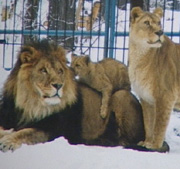
The Cape lion is said to
be extinct since 1850.They have been hunted for trophies or shot by lifestock
owners to protect their animals.But now a lion called Simon found in a
Siberian zoo named Novosibrisk has the charachteristics of a Cape lion
with the black colored mane and hair that covers his body.
Cape lion's facts >>
• The Cape lion is bigger than the Kruger and Kalahari
lions that are common in game reserves of sub-Saharan Africa.
• The Cape lion resembles the extremely rare Barbary lion
of northern Africa but has shorter legs and a darker and smoother mane.
• The cubs of Cape lions are covered in brown spots, which
fade as the animals grow older. Cape lions develop their manes earlier
than most lions; eventually these distinctive black manes extend down the
back and over the belly
• The Cape lion is thought to have once roamed freely
on the slopes of Table Mountain in Cape Town. Today, Table Mountain—1,086
meters (3,563 feet) high and named for its flat top—is a popular tourist
attraction, visited by 600,000 people a year. Elephants and rhinos also
once lived on the mountain
• Jan van Riebeeck, who settled the Cape in 1652, commissioned
the building of the Castle of Good Hope to protect the Cape's original
European residents from hungry Cape lions and other threats. The first
castle was built of wood, but was replaced by a stone building that was
started in 1666 and took 30 years to complete. The castle still stands
today and is the oldest building in Cape Town.
information in this news is obtained from www.nationalgeographic.com
UP>>
US:
Web: Column: Attack Of The Killer Tomato Cops >>
Ever think
about taking up gardening? When I say forget about it, you might wonder
why. After all, according to Vita Sackville-West, "The man who has planted
a garden feels that he has done something for the good of the world." Sure,
but the trouble isn't well-meaning sodbusters and seed-tossers, it's "well-meaning"
drug warriors.
Cops have a hard enough time
distinguishing between marijuana and hemp plants ( one will get you high,
the other won't ); now they're diversifying their ignorance to include
standard garden produce something Glen Coberly found out the hard
way.........
While sorting through his
tomato vines last week, an unmarked, dark-green helicopter buzzed overhead,
followed moments later by scads of flatfoots brandishing firearms, ordering
Coberly and a visiting friend to hit the dirt like dropped sacks of potatoes.
"They had their guns out,"
said Coberly, quoted in the July 20 Middlesex, Va., Daily Press.
Within minutes, one officer
was introducing the two to Ms. Miranda, while another inspected the contraband
crop. A Homer Simpson "Doh!" could probably be heard for miles because
they found no cannabis, just juicy red tomatoes. Going from sativa to salad
is bad news for a drug bust.
The Daily Press headlined
the snafu, "Drug agents ketchup to wrong suspects: Tomato vines, pot similar
from the air."
Sure enough, flying over
Middlesex County to scope out pot plantations, one member of the helicopter
crew said the tomatoes looked like marijuana because "the color was right."
The officer, according to the Daily Press, asked not to be named because
he was working undercover.
Piffle.
He didn't want to be named
because he's a chowderhead. Confusing tomatoes with dope does not look
good on a resume and worse on the 6 o'clock news. Getting publicly
tagged, "Joe Schmoe, the officer who mistook tomatoes for marijuana," might
be a career-inhibiting move ( though, considering this is the government
we're talking about here, probably not ).
Middlesex County Sheriff
Guy Abbot apologized before leaving the scene, saying later, "[W]e're not
perfect; we make mistakes."
Without doubt, this mistake
can be blamed on bad policing. The Keystoners should have double-checked
before raiding. Triple-checked. It's not like the suspect's going to flush
the whole crop down the toilet, thus requiring ( or excusing ) a "dynamic
entry" or no-knock-style raid. Besides, the day after the raid the same
officer who explained that tomatoes look like pot from the air because
of the color admitted that the hue could have been obscured by the cloudy
skies.
Catch that? On an overcast
day, we treat word from an airborne officer like gospel. What is this,
Saturday morning cartoons?
Before police rush in like
Power Rangers, I would hope they'd use better recon than some guy in a
chopper with less than great visibility. Neither the AP nor Daily Press
articles filed on the incident confirm any police fact-checking before
going off half-cocked.
Kid Icarus spots some leafy
stuff, and it's gung-ho, Geronimo!
Worse, this was a major operation.
The antidrug team that descended upon Coberly involved the National Guard,
state police and a local narcotics taskforce. What if Coberly was showing
his friend a pistol or rifle at the time of the raid? People who own guns
do that sort of thing. Let's say he's just bought a new shotgun and the
two are talking about duck hunting: "Hold on, let me show you my new Remington."
He'd run inside while his
friend picks a few tomatoes and then hear the "whump-whump-whump" of the
chopper get closer as he stepped outside, looking up to spy the bird circling
overhead.
Maybe by then the police
have already converged on the house, running out back, where the chopper
pilot tells them their suspect is armed, shouting: "Drop the gun!"
Police raids not being common
occurrences during produce-picking sessions, Coberly might spin around
"What?" a bit confused, gun still in hand.
Which do you think he'd sense
first? The physical shock of the 9mm. slug penetrating his body or the
audible register of the pistol? Many bullets, interestingly enough, move
quicker than the speed of sound.
And, in reality, it wouldn't
even have to be a gun. In high-stress situations, police get less than
keen with distinguishing weapons from whatever else. Remember Amadou Diallo,
shot multiple times by New York police for brandishing a loaded wallet?
In "Shakedown: How the Government Screws You From A to Z," James Bovard
recounts the case of Erdman Bascomb, killed by Seattle cops when they stormed
his apartment and shot him, thinking the TV remote in his hand was a gun.
You might want to consult
the props department, but for the tomato raid, a garden hoe would probably
suffice just fine.
Sure the shooting would be
justifiable. They always are. The guy had a gun, maybe; of course, the
police had to fire. What else do you expect them to do, get shot?
A better question is to ask
why they showed up in the first place.
What fewer and fewer people
seem to expect from police is police work. Investigation is the science
of evidence collection and proper interpretations of that evidence. A few
flyovers in overcast skies looking at a plant that can only be distinguished
by its color ( and just think about how many other plants besides tomatoes
share the same shade of green as do cannabis plants ) is hardly good evidence
collection, and, given the conditions, worse interpretation is inevitable.
Given that, what we should
expect before police rush in endangering their own lives and, even
more importantly, the lives of citizens that are innocent until proven
guilty is a little verification. They should have verified what the
chopper said, peeked over the fence, or something, for pity's sake. Instead
they stormed in, armed, to arrest a guy for growing salsa ingredients.
"We're just trying to do
our best to protect citizens," said Abbott. Yeah? Well, how about looking
before you leap, next time? That's sure a start.
And as for the rest of us,
always be wary of people looking to do "something for the good of the world,"
especially drug warriors.
Source: WorldNetDaily (US Web)
Copyright: 2001WorldNetDaily.com,
Inc.
UP>>
Illegal
Animal Market Trives >>
Mexican authorities fail to sway vendors
By Marion Lloyd, Globe Correspondent, 7/29/2001
HARCO CERCADO, Mexico - Clad in grimy, hand-me-down clothes
and crippled by arthritis, 75-year-old Kasimira Garcia seems the unlikeliest
of criminals.
But that's the point.
Like dozens of other women who pawn their illegal wares
along this three-mile stretch of Mexico's Highway 57, Garcia's pitiful
appearance is her best protection against the law.
The row of sun-bleached stalls 50 miles north of the
central desert outpost of San Luis Potosi serves as Mexico's main market
for endangered animals. Everything from great horned owls to threatened
cascabel rattlesnakes is openly for sale. And rarer, highly endangered
animals such as golden eagles and desert tortoises can be ordered from
other vendors in the village of Charco Cercado.
Prices can range from as little as $2 for a yellow-winged
Calandria lark to $10,000 for a golden eagle, according to wildlife specialists.
Observers say the shabby roadside market is the public
face of a multimillion-dollar industry in Mexico that rivals drug smuggling
in terms of its easy profits. Endangered animals plucked dead or alive
from the jungles of southern Chiapas state to the sandy plains of Baja
California are brought here for export to markets as far away as New York
City and China.
But while environmental officials are aware of the problem,
they say they are no match for these fiercely independent desert residents,
who after more than 30 years have become experts in civil disobedience.
''There is a certain degree of ungovernability,'' said
Diana Ponce Nava, deputy director for natural resources in Mexico's Federal
Environment Secretariat.
Ponce Nava added that every time authorities have tried
to confiscate the animals, the residents have responded by taking up arms
against police and pushing their women and children onto the front line.
''The raids become little wars,'' she said. ''We want to enforce the law.
But we don't want to draw blood.''
The community has a history as a smuggling hub. A devastating
drought in the early 1950s forced residents to abandon farming and turn
to other sources of income. They began by trading animals for food and
clothing, and later, in the 1970s, moved into full-scale retail.
The lack of tough wildlife protection laws has also allowed
their trade to go virtually unchallenged. Mexico didn't create its federal
environmental protection agency until 1994. And authorities lacked the
power to jail violators until Congress passed the country's first detailed
wildlife protection law last fall.
Government efforts over the last 20 years to provide
job alternatives have had little impact. Officials have tried one idea
after another - including donating hundreds of goats for a proposed cheese
farm - but the locals refuse to end their illicit businesses.
''It's very difficult to eradicate in a short time period
a practice that that goes back more than 30 years,'' said Ponce Nava. ''We
have to convince people that poverty is not an excuse to commit crimes.''
Nearly all of Charco Cercado's 1,000 residents know they're
breaking the law, but they say there's little else for them to eke out
a living.
''We do what we have to to survive. It's not our fault,''
said Paulina Jarameyo, 31, as she looked at a pair of great horned owls
sweltering in their roadside cage. Their price: about $18 each.
Although environmental activists acknowledge the residents'
economic situation, they say that these hard-luck stories are usually an
excuse for illegal trade and that women like Jarameyo often exaggerate
their plight by dressing shabbily.
''It's all a sham. They don't want to stop selling animals
because they know it's good business,'' said Humberto Fernandez Borja,
director of the Mexico City-based organization Conservacion Humana, which
is fighting the trafficking of other endangered species like cacti from
the surrounding Chihuahua Desert. ''The alternatives are there. They just
aren't as profitable.''
In reality, wildlife experts said, the profits from the
sale of endangered animals are often greater than those for drugs. A parrot
bought for $5 in the jungles of Chiapas can sell for as much as $1,500
on the streets of New York. Mexico is also the world's leading supplier
of endangered cacti and reptiles.
''It's a mega-diverse country, which makes Mexico very
attractive to those who traffic in wildlife,'' Borja added. ''It's a very,
very big problem.''
This story ran on page A11 of the Boston Globe on 7/29/2001.
This news is taken from www.bostonglobe.com
UP>>
Home
>>
mail the author at [email protected] for more information or
comments