The “Bell Spaceship Paradox” with a Twist.
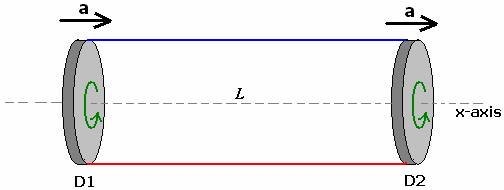
Setup:
Two disks (D1 and D2) are oriented perpendicular to the x-axis of an inertial
reference frame K. The disks are separated by a distance L.
There are two elastic threads (represented by the blue and red lines) stretched
between the disks parallel to the x-axis and attached at diametrically opposite
points of each disk. Initially the centers of the disks are at rest and both
disks are rotating about the x-axis with the same angular speed so that the
threads also revolve about the x-axis while remaining parallel to the x-axis.
(We may assume that there is enough tension in the threads that they remain
essentially straight despite centrifugal forces.)
Next, external forces are applied to the disks such that
the disks simultaneously (according to frame K) begin to accelerate
along the x-axis with identical accelerations. If necessary, identical
torques are also applied to the disks to maintain constant angular speed of
rotation according to K. Once both disks reach a velocity v along
the x-axis, the acceleration stops simultaneously according to K and the
rotating disks then continue to move at constant speed v along the
x-axis of frame K.
No external forces are applied to the threads. They assume whatever
configuration is determined by their internal tensions/stresses and forces of
attachment to the disks.
Exercise: Describe the final configuration of the two threads from the
viewpoint of frame K.
True or False: In the final configuration, the two
threads touch and wrap around each other halfway between the disks if the
angular velocity  of the disk satisfies