Page 2
A letter to Geoffroy I, written by that earlier Bishop Henry of Poitiers, makes no mention of his supposed investigation. In the book, The Shroud of Turin: Opposing Viewpoints, Daniel Scavone points this out, "In this letter Bishop Henry is not angry and he is not suspicious. Its date is May 28, 1356. ... Yet the letter praises and blesses Geoffroy I for his work in promoting the Christian faith. There is no reference at all to the Shroud or to any investigation" (15).
It is important to realize Christians have no need to prove the Shroud of Turin is the actual burial cloth of Jesus, since to disprove the Shroud disproves nothing more. However, throughout history there has been no shortage of characters that feel compelled to disprove the authenticity of the Shroud. So apparently the reverse is not true. That is to say, that those who feel compelled to try and disprove the authenticity of the Shroud apparently feel that if the Shroud is authentic, then Jesus is the Christ. Wilson wrote, "Frustratingly, the Shroud has not yet fully proven itself to us - not uncharacteristic of the gospel Jesus, who at certain times seems almost deliberately to have made his presence obscure..." (212). The same scenario played out many times before and since. Some individual would claim to be able to prove the Shroud was a fake, and make a name for themselves. While their claims would later be disproved, the public would only remember their unsupported theories of a forgery.
The Shroud received support from an unexpected source:| At a meeting of the Academy (of Sciences) on April 21, 1902, Dr. Delage presented a paper giving the results of his study of the photos. Since Dr. Delage had always been a skeptic and an agnostic, everyone expected him to denounce the Shroud as a worthless hoax. The audience of his fellow scientists was astounded to hear what this man of science believed. He claimed that the Shroud was probably the actual burial wrapping of Christ described in the Bible. Many in the audience of scientists were angered by Dr. Delage's conclusion. He had not, after all, performed any scientific tests on the cloth. His conclusion was based on instinct and the photos. (Scavone 22) |
As the 1998 exhibition of the Shroud approached many articles were written. In the article Traveler's Advisory: Europe. (Shroud of Turin to be Exhibited in Turin, Italy), Time International published a description of the relic. "The 4.1-m x 1.4-m piece of linen--which, when seen in photographic negative, yields the image of a bearded man with wounds on head, hands, feet and torso--was first displayed in the 14th century by a French knight who claimed he had brought it from Constantinople" (8). Quite obvious, on the Shroud, are burn marks and patches where repairs have been made, while the images of the man are less obvious.
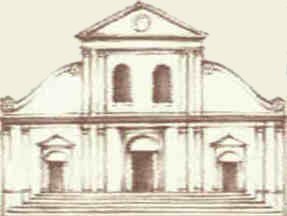
The Shroud of Turin was owned for centuries by the House of Savoy, and is still technically under its control. The whereabouts of the cloth has been accounted for since 1357. It was bought by the House of Savoy and taken to Turin in 1578. The Shroud is in St. John's Church in Turin, Italy (Scavone 17).
| Title Page | Page 1 | Page 3 | Works Cited |