(Skip the
lengthy introduction to the part actually about the Beach Boys)
There's no reason why there should be any "right" and "wrong" in rock
music. Rock fans know what they like and basically it could stop at that.
Critics, the professionals and amateurs alike, fall over themselves extrapolating
theories to justify their tastes. To try to confer on their opinions, on
their personal musical favourites, the value of truth. And that's fine
too. I mean, just cos' your dealing with something that's ultimately indefinable,
doesn't mean you shouldn't have a shot at it with any aesthetic theory
of your choosing. It's part of the fan thing, disserting about popular
culture, and rock and roll in particular. Constantly switching from the
spontaneous, heartfelt, first hand experience that rock provides to aesthetic,
sociological, artistic theories and considerations, all this is great fun.
Of course, this is only one side of the story. The other side is the
consensus of criticism around certain artists and their work. A consensus
that quantifies artistic merit. They're the people who've got more records
than you who've traced the music in question back to its obscure origins,
who make you think they've thought about it a lot more than you have.
Since rock has this ultimately indefinable quality about it critics
are torn between the elated fan's pleasure of avidly describing what they
feel and keeping an eye on that body of criticism that has been growing
from year to year and mysteriously always seems to make sense.
Nowadays, it seems an acceptable thing to ramble on at your heart's
content. It's a done thing to say "Fuck criticism, Fuck the rock theory
intelligentsia, Fuck that conservative, academic body of losers who don't
know anything about anything anyway". But you can't escape it (at least
I can't). Lurking in the back of my mind is always the lingering fear that
I'VE GOT IT WRONG.
All this is mixed with vague ideology about the "avant-garde" and "conservatism",
about "art" and "marketing a product". You say to yourself that true rock
has to have a rebelliousness about it, either in its social and personal
statement or in its novel musical format that either negates what has gone
before or puts across a whole different state of mind.
Dangerous stuff, cos' if you "get it wrong" you may be plugging something
that is ultimately conservative and unoriginal condemning rock'n'roll to
a market instead of an art of expression. You wouldn't want to do that
now, would you?
Ok, I'll admit it, these concerns are basically a bit silly, and, as
I have said before, if you can "get off to it", what more do you want?
Still, there's the lingering feeling that you've "got it wrong", and
the embarrassment when you actually realise you've got it wrong.
This happened to me with the Leeds band called "The Wedding Present".
I'd never actually listened to the band until I saw them live in 1992 or
1993. Actually I'd come into contact with the band before while I was working
as a French language assistant in a school near Leeds. A kid was listening
to a tape on his walkman. I asked him what it was, he answered "The Wedding
Present" and he let me listen for about ten seconds. He must have been
about fifteen or sixteen, I was twenty-one. This was in 1987 or 1988. So
this kid had latched on to a good band, he could relate to the grungy,
rebelliousness of it, the urgency of it, whereas it had passed me by. That's
the kind of thing you tend to think when you recall episodes like that.
That the kid was more spontaneous and could grasp it, whereas I had already
constructed a rock'n'roll aesthetic and it didn't fit in. Basically, I'm
not too worried at this point cos' after all, I didn't really get a proper
listen, so how could I have had an opinion one way or the other? I'm just
preparing the ground for the next part of the story. This was in 1992 or
1993 when I saw the band in concert and wrote a negative review in a student
newspaper about it. I was employed in this newspaper, and I was in charge
of the cultural pages. The newspaper was a strange business venture. It
was given out freely and relied on subsidies and advertising money to pay
its staff and its costs. Eventually, it capsized, but I had left at least
a year before that. I'd learned what I had to learn, and besides, the finances
had all but run dry.
All this to say that there was absolutely no budget for buying records
or anything, so when I went to the concert, I hadn't been able to hear
the band before (cos' I was too skint to buy the records myself, barely
having enough to live on).
That's my excuse. I went to the concert and the noise level just pissed
me off. Now I know Motörhead have that saying "If it's too loud, then
it's that you're too old!". Maybe they're right. Then again, I don't fancy
much becoming deaf. At this point in my life, I was getting in free to
loads of concerts all over the town, several a week sometimes, and the
noise level was beginning to take its toll. Temporary loss of hearing was
a regular occurrence in those days for me. Coming home from a concert and
then not being able to hear yourself piss properly. This was a normal thing,
the next day or so, everything would be back to normal. A little while
later, a concert would leave me worried. I had left the newspaper and was
now living in the town of Nancy. The concert was The Buzzcocks and it left
me with a hiss in the ears that lasted months. When everything was quiet,
I'd hear this whooshing in my head. I went to see a doctor, hypochondriac
that I am, and he explained to me all about the inner ear and cells being
bumped off by loud noise and then either repairing themselves or not. It
was a bit of a warning, "cool it with the concerts". That concentration
of concerts during my student newspaper days had weakened my defences.
When I talked about this with other people, loads of them, often amateur
rock musicians, admitted to having the same auditory problems.
All this to say that when I wrote this negative review of "The Wedding
Present" concert, that I had left before the end, I was suffering from
ear stress, or whatever. I'm always a little embarrassed when I think about
it. I thought of "repairing" the mistake by writing a review in a friends'
fanzine called "OHM", but I never got round to it.
 I was younger
then, and didn't think twice about doing that sort of thing. I mean, negative
reviews are one thing, but to write something without any evidence… I was
more cocky in those days, ready to force forward my "opinions" shamelessly.
Another class of the population tend to force forward their ideas shamelessly
too, I'm talking about people in the teaching profession.
I was younger
then, and didn't think twice about doing that sort of thing. I mean, negative
reviews are one thing, but to write something without any evidence… I was
more cocky in those days, ready to force forward my "opinions" shamelessly.
Another class of the population tend to force forward their ideas shamelessly
too, I'm talking about people in the teaching profession.
(The Wedding Present pictured
left.
Would they ever live down
Simon's scathing review?)
And that brings us to the point this ramble is supposed to be about.
The teachers who survive in the french "éducation
nationale" are the ones who are ready to push their "opinions" and conception
of culture down students' throats. Things have to stay simple and directive.
In my (short-lived) career as a teacher of English in France I came across
quite a few of these characters. The actors in today's story are a Beach
Boys song (Be True to your school) a Pink Floyd
song (another Brick in the Wall, part II, sorry
about that), myself and an inspector, let's call him "Mr.Jones", shall
we?
Ok, I'll admit it, I basically want to bitch, but the issues at stake
are nonetheless conceptions of culture and art. I'll even admit that the
lesson I prepared was crap and ill-designed for the class I was dealing
with. Whether it was or it wasn't. I'd prepared a "pedagogical project"
(as they are called) around several songs that dealt with the subject of
school. I've mentioned the first two, the third was a song by Madness,
called "Baggy Trousers".
I'm not gonna talk about the teaching methods here, just about the
song choice, and the issue of cultural assumptions.
To summarize the issue, Mr.Jones assumed, on the strength of the lyrics
(click
here for the lyrics), that the Beach Boys number was of poor quality,
empty and artificial, whereas he judged the
Pink
Floyd number as having obvious merit. I remember him talking about
it. He mentioned Parker's film, "The Wall".
He was obviously moved by it, you could feel the emotion in his voice.
All very understandable, the guy was approximately the same age as me and
"The
Wall" could well have been one of his favourites during adolescence
which may tend to confer upon it artistic qualities it doesn't actually
possess.
I'm sure most people who are Beach boys fans have had to face disbelief
from their friends. "What? The Beach Boys? You mean you actually like them?".
Again this is a problem of preconceptions, the importance of rock'n'roll
clichés. The enduring image of the overdriven guitar associated
with the "rebelliousness" that's considered to be "true rock'n'roll". "No
mean guitar, no rock'n'roll", loads of folks still stop at that one, totally
oblivious of any talent more harmonious pieces of work might possess. Do
they realise these strict criteria contribute to a force that contains
rock'n'roll in a dead format? Probably not. Then of course, there's the
striped shirt phenomenon. The Beach boys will probably never shake off
that preppy image, it caused them grief in the late sixties and it's continuing
to cause them grief even today. Again, those worn-out rock clichés
of rebelliousness associated with attitude and clothes sense. Ask people
to conjure up an image of the Beach Boys and it'll be that: preppy kids
in striped shirts. It won't be Brian Wilson directing the Pet Sounds sessions
or working on Smile, no it'll be the striped shirts every time.
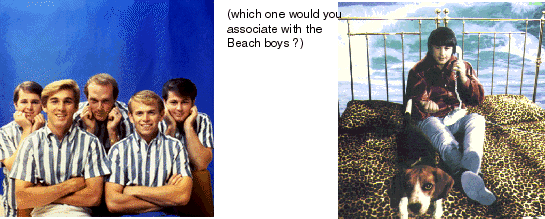
I don't quite recall how I tried to justify my choice to Mr Jones.
I just remember not having convinced him. Then again, in those days I wanted
to convince people. This went for the Beach Boys too. I'd only really started
to listen to them two or three years previously and I was under that thing
people who become big Beach Boys fans are under. The realisation that under
an unsuspecting exterior, Brian Wilson made possibly the most beautiful
pop music of the century and the need to tell everyone about it so they
can appreciate it too. I've calmed down, now. I don't try and make people
listen to music they don't want to listen to anymore, even if it is The
Beach Boys. Even opportunities I'd have jumped at a few years ago. Lots
of people know I'm a Beach Boys fan and it's a fact they don't understand.
I've tried to explain in the past, but they've remained unconvinced. A
few months back, a friend asked me to make her a compilation tape. Some
time back, I would have done this gladly. Now I just went "Oh, yeah. Right"
with the secret intention never to make such a tape. She asked for the
tape as if she were doing me a big favour or something. But its no deal,
if she wants Beach Boys albums she can go to the shops and buy them (which
she never will, of course, but then that's her loss).
Back to Mr Jones, and a situation I'd have gladly tried to right if
only I knew how. I met him several times after this inspection but was
never capable of attempting to explain why I thought he was wrong about
"Be True to Your School".
As you may know, Brian Wilson was really beginning to come into his
own by the time of the "Little
Deuce Coupe" album, and this track is the best example of this. It
wouldn't be long now before, exhausted by the combined strain of endless
touring and an increased emphasis on studio work, Brian would collapse
nervously and retire from touring to be able to concentrate on composition.
It's possible to argue the case of the lyrics saying one thing and
the music another. On the one hand, the frat-boy, conventional lyrics,
on the other the complexity of the musical arrangements and their almost
symphonic quality. The rising quality of the song is remarkable. A voice,
some simple horns, a discreet drum roll then a vocal crescendo that rises
and rises and rises.
The lyrics may be something of a fifties vignette but this doesn't
sound like a "jock" singing. The voice is fragile, almost unsure or insecure.
Although the song soars upward elatedly there are minor constructions in
there, there is uncertainty, possible melancholy. This can't be brushed
off as a triumphant sports song, a brash hymn to victory. No way. If the
fragile voice pretends a set of clichés are its identity, it may
be that this voice, and the music that surrounds it, reflects that adolescent
age where identity is shaky and still has to be found.
This is a great Beach Boys theme, a great Brian Wilson theme: the fragility
of passing from childhood to adolescence or from adolescence to young adulthood.
Something of this is present here, as well as some of that fabulous,
uplifting energy present in so many early Beach Boys hits (Fun, Fun, Fun,
I get Around…) and that symbolises the liberation of adolescence blooming.
Back to my lesson plan, I'd claim that kids, and these ones were about
fifteen, could relate to this music. And they did. They actually asked
to hear The Beach Boys again.
As for Mr Jones, well, this was probably the first, and only, time
that he'd heard "Be True to Your School". Nonetheless, he felt empowered
to comment unfavourably on its musical value showing, for one, the serious
limitations of his appreciation of art but also that he considered that
his title conferred upon him both the ability and the right to discern
the artistic merits of popular culture.
This man was no big shot in the educational hierarchy of the region
in which I taught. He has since displeased those "above" him in the educational
authorities and is no longer able to insult trainee teachers with his cultural
prejudice, he probably just insults his pupils with it instead.
Be that as it is, I will quote Bob Dylan's "Ballad of a Thin man" to
air my sentiments on this particular inspector's vision of music:
"something is happenin', but you don't know what it is, do you, Mr
Jones?"
If you're amused by that, one day I'll tell you the tale of another
inspection, my famous "Punk Project" which
featured the Sex Pistols' "God Save The Queen" and an extract from John
Lydon's (Pistols' lead singer) autobiography. But
that's another story.
In for a penny, in for a pound, as the saying
goes. If you've got this far, why not read another gripping tale from my
teaching days : The story of the dreaded "Punk Project".
Take me back to the Klick'O'Rama Beach Boys
Page
Take me back to the Klick'O'Rama main page