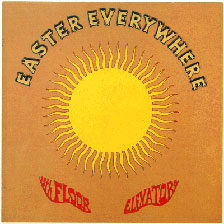
 Easter
Everywhere (1967):
Easter
Everywhere (1967):
Amplified jug with everything
!
What is the amplified jug, you may well ask ? Well, one of the Elevators
was Tommy Hall. Tommy Hall bought two things to the band. As a kind of
"spiritual inspiration" he was a great influence on the spaciness of the
lyrics. But he had to play an instrument too. And that instrument was…..the
amplified jug. So, apparently he blew into this jug, and there was a microphone
taped to it and it made this ascending and descending popping sound that
can be heard on most of the elevators' tracks. How could he manage to play
this thing? Beats me. I've read that it was Tommy's voice, as much as the
resonance of the jug, that created the sound. I've also heard that the
jug was supposedly where Tommy's drugs were stashed (he was main drug man).
However this might be pure myth. After all, there wouldn't be much of a
resonance if the jug was filled with drugs, now would there ? I've also
read that Tommy was inspired by John Coltrane when he played his jug. Hmmmm.
That seems to be pushing it a bit far to me.
So, the 'vators were the only band to use this novelty. And boy, did
they use it… They used it where it was appropriate (like in "You're gonna
Miss me" where its manicness complements the song well) but also where
it could only be perceived as a pain in the ass (what's that annoying popping
sound? Oh yeah, Tommy hall and his amplified jug).
I mean, let's face it, Tommy may have been influenced by John Coltrane,
but there wasn't exactly that much variety to his jug playing.
OK, so I may be an "unbeliever", maybe you think I didn't get "what
they were trying to do".
So I'll cool it and try and close the debate on the "amplified jug"
by some consensual comment so as not to annoy any die-hard fans who just
might chance upon my web-page.
Ok, so sometimes the jug really complements the music. It's an added
extra that gives a little more spice and mystery. At other times, on many
of the songs on Easter Everywhere, it contributes to the building of a
kind of sonic ambience, a whirling, thick sonic entity with which Roky
can perform. At other times…well, it's a bit of a pain.
But, jug aside, what can be said about "Easter Everywhere"?
It's a lot mellower than "The Psychedelic Sounds of…", that's for sure.
This would tend to indicate that it was very much in the budding "hippie"
scene of the time. And in a way, it is. There is a mellow, laid-back aspect
contributed by that specific, thick, distorted, wild guitar sound. That
mellow, "acid" guitar. Something happy, but also something deep and at
times deranged, something that would later become the trademark of a whole
batch of Californian rock. But at the same time, there are no guitar "histrionics"
here. No great Jorma Kaukonen riffs or solos. The acid guitar is used almost
sparingly. A few touches of colour, here and there, to complete the picture,
to paint a mood. Nothing excessive. No virtuoso displays. So, although
the album is a psychedelic pioneer, it can't be confined to the "psychedelic
genre". There's a wealth of musical tradition in there and Roky demonstrates
a variety of vocal styles.
One thing Roky does well are basic rockers. The primary force of rock'n'roll
channelled into Elevators style. "Levitation" is a good one. A raunchy
rocker, clanging guitar and screamed and soulful delivery by Roky. But
for one thing, the subject matter is a far cry from original rock'n'roll
as is the sonic treatment of the song, for that matter. The way the band
make it into something spaced out, the echo on it, the sound-layering giving
that overall wild effect.
The band do this many a time, on "Easter". They take a basic, rock'n'roll
starting block and move from there into a totally psychedelic experience.
"Pictures (leave your body behind)" has a simple, basic rock line, moving
back and forth in bluesy manner. The band take this and build their own
sonic environment around it.
Similarly "slide machine" has a kind of lazy, bluesy side to it. The
band maintain that bluesy feel while adding psychedelia: bursts of flamboyant
guitar, echo, amplified jug…
"She lives (in a time of her own)" contains some basic rock'n'roll
riffs. The 'vators manage to preserve this rockiness while moving the song
into a mellow, spaced-out and ethereal territory.
It's interesting to see what the band does to Dylan's "Baby Blue".
It's a laid-back, lazy version of the song. When I say "lazy", I don't
mean it in a negative sense, rather in a "wow, cool" spaced-out sense.
The guitar creates an atmosphere on this one. Guitar parts echoing into
one another. Long, sustained notes. Voluntarily messy and a tad disharmonic
at times. The painting of a mood, a sonic environment.
One of the songs is a bit different. They lay off all the layering,
echo and so forth and do a bit of a "straight" number. A folk number, with
mouth organ and female backing vocals: "I had to tell you". On this number
Roky's voice is sweet and gentle, sincere and heartfelt. At the same time
the song doesn't possess the sonic complexity that characterises the rest
of the album.
Often, Roky's voice is the most impressive part of the album. It often
carries the melody and carries the song through. Roky's voice gives coherence
to the opening epic poem "slip inside this house". Sometimes it is plaintive
and nasal, at other times expresses need, desire and desperation as in
the repeated chorus of "slide machine": "trying to, trying to, trying to
get back to you…"
"Earthquake" moves in unexpected directions. The song is a bizarre
sonic tableau and Roky's voice takes on new challenges. Amongst the echo,
the reverb and the cascading tones, Roky screams with desire. You can see
where Robert plant got his inspiration.
"Dust" is a beautiful song carried along by the vocal, although slightly
marred by "the jug". The voice moves from sincere, open desolation to the
expression of a soulful need, a desire. Roky lays on the words "As I love
you" like a kind of mantra. Like a charm, like an incantation.
"Pictures (leave your body behind)" is articulated like a long jam
during which to express oneself. Roky complies and is often seen to push
his voice to it's soulful limits. Again he shines through as the genuine
article, the guy Robert plant ripped off.