| John Muir: Pioneer of Conservation |
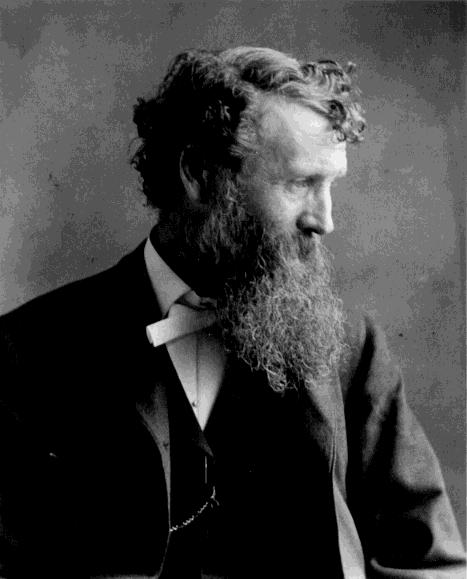 |
| John Muir was one of America's pioneers of conservation and Climbing To find out more check out the John Muir Exhibit which includes full text books and a lot of information on Muir. If you go to the John Muir Memorial Park in Marquette County, Wisconsin you will find a granite marker with these words inscribed on it: JOHN MUIR, Foster son of Wisconsin born in Scotland April 21, 1838. He came to America as a lad of eleven, spent his 'teen years in hard work clearing the farm across this lake, carving out a home in the wilderness. In the "sunny woods, overlooking a flowery glacial meadow and a lake rimmed with water lilies," he found an environment that fanned the fire of his zeal and love for all nature, which, as a man, drove him to study, afoot, alone and unafraid, the forests, mountains and glaciers of the west to become the most rugged, fervent naturalist America has produced, and the Father of the National Parks of our country. This short paragraph helps describe John Muir but can do little justice for a man of such wanderlust and depth. John Muir is known above all as a pioneer naturalist and founder of the Sierra Club but in addition was a climber, explorer, geologist, scientist, glaciologist, inventor, traveler, and writer. He can be credited with being the major driving force behind creating Yosemite, Mount Rainier, and the Grand Canyon as national parks. However, despite his many accomplishments, John Muir is often overlooked and unknown to the general public. John Muir was born April 21, 1838 in Dunbar, Scotland. At the tender age of three years old John went to the Dunbar Grammar School where he studied numerous subjects. In 1849 Daniel Muir, John's father, decided to immigrate to America seeking religious freedom, cheap land, and a prospect of a new life. The voyage required John and his family to spend six weeks on a small ship braving the cold waters of the North Atlantic. Once in America, the Muir family made their way to Wisconsin by way of boat, train, and wagon. In Wisconsin, Daniel Muir bought a tract of land and went about creating a farm out of the fresh tract of land. As a consequence, John was forced to work very hard under his father's command, plowing fields, digging wells, chopping wood, and doing other farm jobs. When John could escape the hardships of the farm, he would absorb himself in books and create machines. These machines, crafted out of wood and scrap metal included clocks, barometers, thermometers, and an "early rising machine" that would wake him up in the morning. At the age of 22 John left home to exhibit his machines at the State Agriculture Fair in Madison. This experience led John to briefly attend the University of Wisconsin for 2 1/2 semesters. After leaving the university John avoided being drafted to fight in the Civil War by working in a Canadian woodwork factory. By 1866, John was working in a carriage factory in Indianapolis, Indiana where he had a life-altering accident. While working in the factory, John had the misfortune of piercing his right eye with a metal spike. As a result, he lost eyesight in that eye and hours later lost his sight in his left eye. After weeks lying in a darkened room with bandages on his eyes John miraculously regained his eyesight. This experience inspired John, 28 at the time, to change his way of life. He would never return to industrial work and left on a journey that would deposit him to where he would spend the rest of his life. John set off from Indianapolis and walked to Florida, where he eventually went to Cuba. From Cuba he made his way to San Francisco via the Panama Canal, landing in March 1868. It was here in California that John found his true home, living there until his death. John Muir instantly fell in love with California and the Sierra Nevada mountain range. By 1869 Muir had taken up residence in Yosemite Valley, in the heart of the Sierra Nevada mountain range. Perhaps Muir's words can best describe his first impressions of the Sierra Nevada range, his future home: "One shining morning, at the head of the Pacheco Pass, a landscape was displayed that after all my wanderings still appears as the most divinely beautiful and sublime I have ever beheld. There at my feet lay the great central plain of California, level as a lake thirty or forty miles wide, four hundred long, one rich furred bed of golden Compositae. And along the eastern shore of this lake of gold rose the mighty Sierra, miles in height, in massive, tranquil grandeur, so gloriously colored and so radiant that it seemed not clothed with light, but wholly composed of it, like the wall of some celestial city. Along the top, and extending a good way down, was a rich pearl-gray belt of snow; then a belt of blue and dark purple, marking the extension of the forests; and stretching along the base of the range a broad belt of rose-purple, where lay the miners' gold and the open foothill gardens--all the colors smoothly blending, making a wall of light clear as crystal and ineffably fine, yet firm as adamant. Then it seemed to me the Sierra should be called, not the Nevada or Snowy Range, but the Range of Light." (Muir, The Treasures of Yosmite 1) The Range of Light, Looking at Yosemite Valley from the Merced River This writing shows Muir's splendor of the Sierra and his skill as a passionate writer. The range of light is still used to describe the Sierra Nevada today and seems to be a fitting name. For the next seven years Muir lived in a small cabin in Yosemite valley, observing the wonders around him. During this time John worked on his climbing, geology, and botany skills. By 1871 John had found living glaciers in the Sierra Nevada and proposed that Yosemite Valley was carved out by ancient glaciers. Muir soon became known throughout the country and distinguished individuals soon came to him including Ralph Waldo Emerson, Asa Gray, and Joseph LeConte. It was also during this time Muir became a published writer, beginning with articles in magazines titled "Studies in the Sierra." Muir moved from Yosemite to the Bay Area of California in 1875 where he continued penning magazine articles. Muir took his first trip to Alaska in 1879 and discovered Glacier Bay, a striking bay with the massive Muir glacier pouring into it. The next year Muir took a new pace of life marrying Louie Wanda Strentzel and working on a ranch with his father-in-law. Although it was a busy year, Muir still made a second trip to Alaska as well as a third trip the next year. While living in the San Francisco Bay area John Muir made some of his most notable accomplishments that we now remember him by. These accomplishments include Yosemite National Park being created in 1890 due to the efforts of Muir and his articles. Muir ended his ranching career in 1892 when he founded the Sierra Club to protect Yosemite National Park. He would serve as the president until his death in 1914. Muir said he created the Sierra Club to, do something for wildness and make the mountains glad. Muir and Theodore Roosevelt on Glacier Point, Yosemite Muir penned Our National Parks in 1901, which brought Muir to the attention of President Theodore Roosevelt. In 1903 President Roosevelt traveled to Yosemite and met with Muir. One of Muir's last acts of conservation was an unsuccessful bid to prevent the damming of the Hetch Hetchy Valley in Yosemite National Park. John Muir contracted pneumonia in 1914 and soon died in a Los Angeles Hospital December 24, 1914. John Muir died as a person that December day in 1914 but will never die in the hearts of those inspired by him. He is rightfully called the "Father of Our National Park System" for his efforts in creating Sequoia, Mount Rainier, Petrified Forest, Yosemite, and Grand Canyon national parks. He made first ascents of Mt. Ritter, the east side of Mt. Whitney, Cathedral Peak in Yosemite and early ascents of Mt. Rainier and Mt. Shasta. As a writer John Muir wrote hundreds of essays and many books including: Mountains of California, Stickeen, My First Summer in the Sierra, The Yosemite and The Story of My Boyhood and Youth. John Muir's legacy and spirit lives on in the many different places and venues that bear his name. These include but are not limited to: The Muir Woods National Monument, The John Muir Trail, The John Muir School, Muir Glacier, The John Muir Association, The John Muir Memorial Association, John Muir Memorial Park, The John Muir Award, The John Muir Trust, and lastly John Muir Day, a celebration of Muir's birthday, April 21 1838. It is through these places and venues that John Muir is remembered and honored. Works Cited Muir, John. "The Treasures of the Yosemite." The Century Magazine, Vol. XL. August, 1890. No. 4 Bibliography Muir, John. "Stickeen: An Adventure with a Dog and a Glacier." John Muir's Travels in Alaska. Boston: Houghton Mifflin, 1915 Muir, John. The Mountains of California. New York: The Century Co. 1894 John Muir Exhibit. "The Writings of John Muir." Online. Available http://www.sierraclub.org/john_muir_exhibit/, 18 December 2000 Back to Dan's Basecamp |