(Abridged
Version)
Prologue
JUNE
30, 1908 - 6:30 AM
 At sunrise on June 30, 1908, the area near
the Tunguska River in Siberia was the site of a
tremendous explosion that had the force of a modern
hydrogen bomb and took place at an altitude of several
kilometers. Although the explosion flattened trees for
kilometers in all directions, no creater was formed, and
aside from some microscopic nodules extracted from the
soil, no recognizable fragments of an extraterrestrial
object remain. Space scientists with Skyguard, the U.S.
government agency responsible for cataloging and tracking
asteroids, comets, and other near-earth objects,
generally agree that the explosion was caused by a small
comet that disintegrated in midair. Various UFO
enthusiasts in Russia and elsewhere, however, have
suggested that the blast was atomic and was created
artificially... At sunrise on June 30, 1908, the area near
the Tunguska River in Siberia was the site of a
tremendous explosion that had the force of a modern
hydrogen bomb and took place at an altitude of several
kilometers. Although the explosion flattened trees for
kilometers in all directions, no creater was formed, and
aside from some microscopic nodules extracted from the
soil, no recognizable fragments of an extraterrestrial
object remain. Space scientists with Skyguard, the U.S.
government agency responsible for cataloging and tracking
asteroids, comets, and other near-earth objects,
generally agree that the explosion was caused by a small
comet that disintegrated in midair. Various UFO
enthusiasts in Russia and elsewhere, however, have
suggested that the blast was atomic and was created
artificially...
Chapter One
MONDAY,
JUNE 14, THIS YEAR - 4:52 PM
Diane
Colston had promised she would be at her granddaughter
Jennifer's soccer game without fail. She had every
intention of being there, but she had badly
underestimated the time it would take her to deliver Mrs.
Kane's wedding cake. The mother of any debutante living
in Bartlesville, Oklahoma knew that having a wedding that
wasn't catered by Diane Colston would be a serious faux
pau. Diane's wedding cakes, as well as her other
pastries and confections, were the heart of her catering
business, and her services were so sought after that the
lead time on a "Reception by Diane" was six
months. It seemed to most clients that six months should
be more than enough time to plan and deliver food for a
wedding reception, so they were hard put to understand
why she was always running behind. All agreed, however,
that Diane's services were worth waiting for, even if it
meant slipping the nervous bride-to-be another
tranquilizer or two.
In fact,
Diane Colston was late for everything, which prompted the
old joke about being late to her own funeral. Because of
her attempts to be reasonably on time to various events,
she was also known as a lead-footed bitch when she got
behind the wheel of her Suburban Utility Vehicle.
Jennifer's
soccer game had already started by the time Diane left
the Kane estate on the east side of Bartlesville and
headed for the sports complex, which was located on the
southwest edge of town. As she raced south on Price Road,
she ran through a mental list of the various routes she
could take to cut down her drive time. She had done this
so often that her selection was based mainly on which
streets she could grossly exceed the speed limit without
being spotted by patrolling police cars.
The sports
complex was accessible by two major roads. Diane knew
that these roads would be clogged with soccer traffic,
but she remembered a route which might allow her to avoid
the traffic. It wasn't a paved street, but rather an
asphalt and gravel road which wound through what
Bartlesville residents presumptuously called "Circle
Mountain," which was a range of large hills
encircling the town--hence the name--and ended up just
south of the sports complex. This road had been
particularly popular in Diane's youth because of its many
twists and turns, its isolation, its suitability for car
racing, and especially for a legend associated with the
road. The legend concerned a slave who had escaped during
the Civil War and had hidden--and been brutally
murdered--on that road. It was said that a lantern
carried by his ghost could be seen bobbing up and down
along the road at certain times if the moon was just
right. (A variation of the legend had it that this slave
had lost one of his hands which had been replaced by a
hook, which device had ended up stuck in the door handle
of a car, etc. etc.) The Underground Railroad, which was
a foot trail running from Texas to Kansas used by runaway
slaves, did indeed pass directly through this area, so
the legend had some basis in fact.
One of the
more popular pastimes in Bartlesville during the
'60s--besides parking along the road and watching for the
bobbing light, among other in-car activities--was to
"Shoot the Gap" from one end to the other,
driving as fast as possible, and then boasting about it
at school the next day.
All these
memories ran through Diane's mind as she turned at the
eastern entrance to the Gap. It was in much worse shape
than she remembered; years of non-use and neglect had
reduced it to not much more than a rutted dirt road. She
wondered if anybody still shot the Gap and who the
current record-holder was. From the looks of it, nobody
ever drove down there any more.
She recalled
the Gap as being about ten miles long, with several sharp
right-angle turns, several railroad crossings, and a
one-lane timber-decked bridge across Sand Creek. This is
not the way it used to be, she thought sadly as she sped
down the road. Behind her SUV, clouds of dust swirled in
horizontal tornadoes. Trees on either side of the Gap
formed an opaque green canopy, creating a tunnel and
blocking the view around corners. There was no traffic to
be seen. She glanced at the LCD clock on the dashboard
and noted that she was twenty-two minutes late to the
soccer game. She accelerated.
As she flew
over one of the railroad crossings, she noticed the
dusty, X-shaped "Railroad Crossing Look Out For the
Cars" sign and smiled at the old spelling joke. She
saw that the tracks were brown with rust--even the train
had abandoned the Gap.
In the same
general vicinity as the Gap was another road which
meandered through the woods, marked by white crosses
painted on telephone poles along the way. On this road
was another part of Diane's youth: Gravity Hill. Gravity
Hill was really spooky because you could park your car at
the bottom of this hill--a slight incline, really--turn
off the engine, put it in neutral, and your car would
slowly creep up the hill. Supposedly, one of Mr. Scott's
high school physics classes had investigated this
phenomenon as a class project and the results had been
confiscated by the U.S. Air Force, who promptly
classified them as Top Secret. Diane was now twenty-nine
minutes late to Jennifer's soccer game. She had no idea
how long such a game was supposed to last but she knew
that if she missed one more of them she would never be
forgiven. There was no traffic anywhere in sight. She
accelerated.
The road made
a 45-degree turn towards Sand Creek and the one-lane
bridge. After the bridge it was a four-mile straight shot
to the end of the Gap at Highway 123. Diane remembered
that you had to line yourself up exactly with the center
of this bridge because spanning its length were two
narrow sets of wooden planks which were just wide enough
to accept your tires. Of course, there was an actual
bridge floor under the planks, but this was made of small
boards running crosswise and everybody knew that if your
wheels ran off the planks and onto the boards, your car
would break through the floor and the bridge would likely
collapse. She laughed to herself as she recalled how
young girls, including herself, lifted both feet off the
floor as they crossed the bridge to avoid becoming
pregnant (not by the bridge, of course.) Thirty-three
minutes late.
Slowing
slightly, she lined up the SUV with the bridge and prayed
that no one was doing the same thing on the other side.
She panicked momentarily as she wondered if the SUV's
wheels were too wide for the planks, but by the time she
had completed the thought she was safely across the
bridge. Damn, she thought. I forgot to lift my feet.
On the far
side of the bridge, the road was extremely bad: the creek
had been out of its banks on numerous occasions and had
deposited several inches of silt across the roadbed;
subsequent rains had eroded the silt and dug deep
channels. Overhead tree limbs drooped and slapped the
SUV's windshield; roadside foliage grabbed at its
bumpers. Diane knew she should slow down but she
couldn't--she had promised. Abruptly the woods
ended as the road passed a meadow. Sensing that she was
nearing the end of the Gap, Diane floored the
accelerator. She was now traveling at seventy-two miles
per hour.
MONDAY, JUNE 14
- 5:23 PM
Charlie
Redwing had been up since dawn with a sick dog. Spending
long hours with sick animals was nothing new for Charlie;
over the years he had nursed dogs, cats, cows, sheep,
pigs, chickens and goats through all sorts of ailments.
Zeke, the dog in question, was Betty Conkel's, and he had
driven over from Pawhuska to "doctor" the mutt.
Charlie was not a licensed veterinarian, but he had a way
with animals and was well-known around Oklahoma's Osage
County. He would not have bothered with Zeke except that
Betty's long-dead husband Fred had been Charlie's friend
and he knew the dog personally. The dog appeared to be
unable to move its hind legs; its breathing was raspy and
labored, and its nose was warm and dry. All it could do
was lie on its cushion, pant, and roll its big brown eyes
at Charlie. Zeke was at least fourteen or fifteen years
old and Charlie knew that there was nothing he could do,
so he had spent the entire day making the old hound as
comfortable as possible and waiting for the end.
Betty had
driven over to the grocery, leaving Charlie and Zeke
alone in Betty's ramshackle house along the Gap. Charlie
lifted Zeke and carried him out to the front porch so he
could at least see the outdoors he had so loved to roam
in his younger years. Charlie sat on the front porch
steps and stuffed his pipe with tobacco, trying to figure
out the best way to tell Betty, but he reckoned that she
probably already knew that Zeke would be joining Fred
soon, leaving Betty with no one but her cat. Charlie lit
his pipe and ruminated about Fred and all the other
friends he had lost in recent years. Hell in a hand
basket, he thought. He rapped the pipe against the stairs
a couple of times to knock out the dottle and was just
about to re-stuff it when he heard the explosion.
"Wonder
what the hell that was," he said to Zeke. Zeke
didn't answer--he was snoring softly. Charlie stood up
but could see nothing through the trees. He looked
through the screen door and saw that Betty's ceiling fan
was still whirling around so he ruled out a power
transformer explosion. Charlie stepped off the porch and
walked down the driveway to the road. To his right, about
a quarter mile down the road toward the meadow, a column
of greasy black smoke was beginning to rise. His first
thought was that something had happened to Betty's pickup
and he began running toward the smoke. As he got closer
he noticed that it was not coming from the road but out
in the meadow about twenty yards or so.
Charlie was
not used to running--particularly a quarter mile--and by
the time he got closer the smoke had increased its
intensity. He could see that it was coming from some sort
of vehicle which had left the road, because a portion of
the barbed-wire fence was gone and he could see deep ruts
in the meadow running from the road to the wreck. He
started to cross the drainage ditch but the heat was
intense, and now a slowly-widening circle of grass around
the wreck was burning. Seeing that there was nothing he
could do, he walked back to the house and dialed 9-1-1.
MONDAY, JUNE 14
- 5:46 PM
Deputy
Sheriff Ed Bagley received the radio call from the
dispatcher as he was dozing in his cruiser behind a
billboard on Highway 123. As he looked to the southeast
he saw the plume of black smoke over the treeline. He
pulled out onto the highway, hit his lights and siren,
and headed for the smoke. He swung left off of Highway
123 and into the Gap. As he pulled up abreast of the
wreck, he saw Charlie and Betty standing on the roadside.
He stepped out of his Crown Victoria, checking his
reflection in the rear view mirror to make sure his
ten-gallon Stetson and his sunglasses were adjusted just
right. "Alright, people, what've we got here?"
he said in his most authoritative voice.
"Not
sure," said Charlie. "Didn't actually see it. I
was sitting on the porch--Betty wasn't here--and I heard
this explosion. Walked down the road and saw that thing
burning in the field. Fire was too hot to get real close,
so I came back and called you guys."
"Well,"
said Bagley, straightening his tie and loosening his gun
in its holster a little, "I'm going to go have a
look. You stay right here--this is official police
business and I don't need no civilians messing up the
crime scene."
"Whatever,"
mumbled Charlie. Bagley got a Polaroid camera out of his
trunk, crossed the drainage ditch and walked along the
ruts toward the wreck. The fire had burned out, but wisps
of smoke were still emanating from the charred grass
around the twisted mass of metal. If this is a car, he
thought, it's the shortest car I've ever seen--whole
thing can't be more than five or six feet long. He saw no
reason to radio for paramedics or an ambulance; if there
was a body in the car it couldn't have survived the
crash.
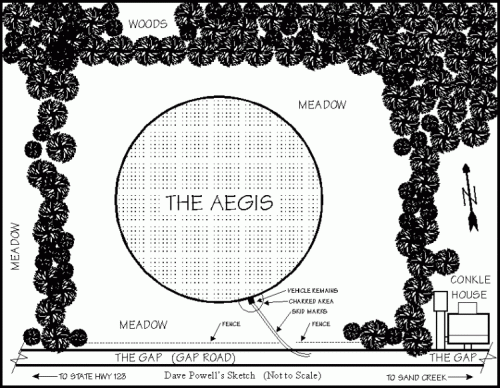
Something
else about the crash site was even more strange: the
charring did not form a circle around the vehicle but
rather a perfect semicircle about 30 feet in
diameter. Grass on the forward side of the vehicle--what
would have been the other half of the circle--had not
been touched.
Bagley walked
slowly up to the fringe of the charred grass and stared
at the scene. He did not want to step in the black ash
because it was still smoldering and he knew it would mess
up his carefully polished boots. He turned to his right
and began walking around the border of the ash, snapping
pictures of the vehicle as he went. He looked back over
his shoulder and saw that Charlie and Betty were still
standing on the road. A few more steps and Bagley would
be able to see the front of the vehicle. He turned toward
the wreck and began sidestepping to the right, camera
raised to his eye. On his third step the right side of
his boot struck something hard, followed by his leg and
arm. He lost his balance and fell backwards, dropping his
camera and his hat in the process. More surprised than
injured, Bagley stood up and looked around to see who he
had run into, but the spectators were still up on the
road. Must have stumbled over a rock, he thought. He
picked up his hat and his camera and began retracing his
steps around the fringe of the ash. This time he was
watching the ground when his head struck the obstacle.
"What
the hell's he doing out there?" Charlie asked, and
began walking toward Bagley, who was rubbing his
forehead. "Hey, are you all right?" Charlie
called out.
"Stop!"
shouted Bagley. "No, wait! Come here--but walk slow
and don't step in the black area."
Charlie
stumbled to a halt, then began walking slowly toward
Bagley, who was now moving in slow motion with arms
outstretched, like someone in a dark room feeling for a
light switch.
Suddenly
Bagley froze. "Charlie," he said over his
shoulder, "come up behind me and stick your arm out
next to mine real slow. Tell me if you feel
anything."
"Uh,
feel anything like what?" Charlie asked.
"Just do
it!" barked Bagley, still motionless.
What an jerk,
thought Charlie, but he did as he was told. As his
outstretched hand came even with Bagley's, his fingertips
contacted something. He placed his palm flat against the
"something." Whatever it was felt cool and
smooth.
"What do
you feel?" whispered Bagley.
"It's
like a piece of slick glass," replied Charlie.
"What're you whispering for?"
"Keep
your voice down, I don't want her over
here," Bagley hissed. He pulled his hand back and
rapped the "something" lightly with his
knuckles. It sounded and felt as if he were knocking on a
concrete wall. "Okay, Charlie, we both felt it so
I'm not crazy. There's some kind of invisible wall here,
and I think the car smashed into it. Here's what we're
going to do: we're going to walk back to the road, just
like nothing's wrong. I'll be damned if I'm going to
write up a report that says a car crashed into an
invisible wall in the middle of a field, so I'm going to
call the sheriff, and while I'm doing that you're going
to take the old lady back to the house. Make up any
excuse you like--unexploded gasoline, maybe. I don't know
what the hell's going on here, but this ain't no ordinary
car wreck. And Charlie, don't you dare tell anyone about
this--I'm deputizing you right now and swearing you to
secrecy."
MONDAY, JUNE 14
- 6:54 PM
After
calling in on his radio, Deputy Bagley returned to the
crash site and checked to see if the invisible wall was
still there. It was. He thought about feeling around to
see if there was an edge to the wall, but the weirdness
of the situation got to him, so he returned to his
cruiser and rolled a joint while he waited for backup.
It took an
hour for John Greyhorse, Sheriff of Osage County, to
arrive at the crash site. Greyhorse was a rotund,
cigar-chomping sheriff, but despite this stereotypical
"Buford T. Justice" image, he was an honest and
thoughtful officer. Although the Osage County Sheriff was
an elected office, John did not play politics, relying on
his excellent service record for continued reelection.
"Okay,
Ed, this better be good--I was clear over in Nelagone on
account of that fight at the snooker parlor last night.
What's so damned secret you couldn't tell me over the
radio? This isn't Homeland Security, you know."
"Yeah,
well, if it ain't now, it probably will be."
"What
the hell's that supposed to mean?"
"It'll
work better if I show you."
Bagley showed
him the wreck and had him feel the invisible wall. John
lit a cigar and blew smoke at the wall.
"Look at
that!" he cried. "The smoke bounces right
off!"
"Well,
whoopty doo. So what is it?" asked Bagley.
"I don't
know, but we better get these people out of here,
barricade the road, and call somebody who knows what this
thing is. Who else knows about this?"
"The old
lady knows about the wreck, and Charlie knows about the
wall, but I deputized him."
"Good
thinking. Well, I'd like to keep this in our
jurisdiction, but I think we're out of our league
here."
"Yeah,
but looky here: what if we call somebody in and that wall
vanishes or something before they get here?
We're going to look really stupid."
"We'll
have to call somebody; some kind of
professional, somebody discreet, that can verify
this wall without blabbing it all over the place. Then,
if it's still there, we can decide what to do."
"Do you
have somebody in mind?"
"Yeah, I
do. Fox Mulder, X-Files."
"Who?"
"Oh,
never mind. Go check on Charlie and Betty. And Ed...if
you breathe a word of this to anyone, I'll add your scalp
to my collection."
John
Greyhorse knew that if there really were an
"X-file" department at the FBI he wouldn't find
its phone number in the blue pages of the phone
directory, but he did know someone who might be almost as
good. He also knew he had to do something quickly;
whoever was still in that vehicle would be missed. If
there were any remains, the chances of obtaining forensic
evidence would quickly deteriorate.
He found some
metal stakes in his trunk and wrapped crime scene tape
around the crash site, then he walked up to the house.
Charlie and Betty were sitting on the porch and Bagley
was towering over them with his hand resting on his gun.
"Good gawd, Ed," he said, "Charlie and
Betty aren't vicious criminals; back off. Sorry, folks.
Here's what we got down there: somebody came tearing
along the road, lost control and ended up in the field.
Standard crash and burn, not the first time it's
happened. Used to have all sorts of kids racing through
here. Problem is, there's a natural gas pipeline out
there in the field and all sorts of spilled gasoline
laying around. Could blow up any minute and start the
whole place on fire. Hell of an explosion. So what we're
going to do is, we're going to barricade the road about a
mile either side of the field."
"John
Greyhorse, we both know there ain't no natural gas pipes
anywhere around here," said Betty. "We all got
propane--what in the hell are you talking about?"
"That's
just what I want you to tell anybody should they
ask," replied John. "Now Betty, this is
official sheriff business. Can you do that for me?"
"Well
you're the Sheriff, so I guess you know what you're
doing."
"Thanks,
Betty--I appreciate it." He instructed Bagley to
block off the road at the Highway 123 end with his police
cruiser. After Bagley left, he showed Charlie how to work
the remaining cruiser's flashers and the radio.
"Turn
the flashers on as soon as you block the road, then take
the shotgun and stand outside the car so you can see
oncoming traffic. If anyone gives you any trouble, shoot
them in the foot. Remember, now: big natural gas leak,
gonna blow up the whole area any minute now. Don't let
anyone headed this direction through except for a guy
named Dave Powell--let him through when he shows up.
Drives a black jeep-looking thing called a Hummer. Oh,
and leave me the keys to your pickup."
As soon as
Charlie was out of sight, John called his dispatcher on
his portable radio to say that he and Bagley would be
10-10 at the scene of an accident until further notice.
Then he went into Betty's house and made a phone call.
Dave's Sketch of the Aegis
Click to Enlarge
|
Aegis Locator Map
Click to Enlarge
|
END OF CHAPTER ONE
|