Whole Numbers
Define whole numbers

Place value through billions

Read and write whole numbers
Expanded notation
Scientific notation
Standard form
Roman Numbers

Number line
Absolute value of integers
Compare and order integers
Round whole numbers

Basic operations
Add (find sum)
Commutative,associative, zero
Check answer (sum)
Estimate sum

Subtract (find difference)
Estimate difference
Check answer (difference)

Multiply (find product)
Commutative, associative, distributive,  zero properties of multiplication
Estimate product
Multiply by powers of 10
Check answer (product)

Divide (find quotient)
Divisibility rules
Remainder
Estimate quotient
Check answer (quotient)

Arithmetic expression

Problem solving (word problems)

Define whole numbers

Digit - Any of the symbols used to write numerals. In the base ten system, the digits are 0,1,2,3,4,5,6,7,8, and 9.

Even Number - A whole number that is divisible by 2.
Odd Number - A whole number not divisible by 2.

Negative Number - A number less than 0.
Positive Number - A number greater than zero.

Real numbers are all of the rational and all of the irrational  numbers put together.  All of the numbers you normally deal with  are real numbers. Every real number is one of three types: 0, positive, or negative. The sign of a negative number is -. The sign of a positive number is +. In order to write positive numbers consistently with negative numbers, we often put the sign of a positive number before the number. So, for example, we often write: +3 instead of 3. The number 0 has no sign.

The absolute value of a real number is that number without a sign. Absolute values are always positive.
|0| = 0 the absolute value of 0 is 0
|5| = 5  the absolute value of 5 is 5
|-5|  = 5  the absolute value of -5 is 5
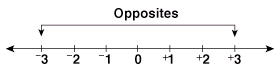
Opposite Numbers - Two numbers that have the same absolute value but have opposite signs.
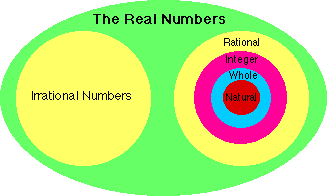
Irrational numbers are numbers which you can  write as decimals but not as fractions.  ?(pi) and the square root of  2 are irrational numbers.

Rational numbers are all the  different kinds of fractions.  1/2, 3/4, -2/3, and 5 are all  rational numbers. 

Integers are all of the whole numbers and their negatives. They are  ...-3,-2,-1,0,1,2,3,...  (The three dots means you keep going  in both directions.).  The integer zero is neither negative or postive.   Positive integers can be written with a + sign or without a + sign.  +3, and 3  are both read positive three.  Negative integers are written with a - sign.  -3 is  read negative three.  You can also use a number line to compare integers.  On  a number line, the integer to the right is always greater than the integer to the  left.  To order integers from least to greatest, order them as they would appear  on the number line. 

Whole numbers are the numbers you use when you count:: 0, 1, 2, 3, 4, 5, 6, 7, 8, 9, 10, 11,12, .....  The set is infinite.
The smallest whole number is 0. This set differs from the natural numbers by including 0. 

Natural Numbers - The set of numbers 1, 2, 3, 4,.... This set differs from the whole numbers by excluding 0.
 

Place value through billions
In order to represent numbers greater than 9, numbers are assigned place values beginning with the right-most position. The digits of a whole number are grouped in threes, called periods, which are separated by commas. Each period  contains three columns (ones, tens, hundreds).  
 hundred billions ten billions billions , hundred millions ten millions millions
,
hundred
thousands
ten
thousands
thousands
,
hundreds
tens
ones
8 3 4 , 2 0 7 , 3 5 2 , 5 0 4

A comma is placed at every three digits (counting from the left) to make reading large number easier.

A digit at a certain place-value is equal to 10 times of the digit to its right. For example:
  1 millions  = 10 hundred thousands
  1 hundred thousands  = 10 ten thousands
  1 ten thousands  = 10 thousands
  1 thousands  = 10 hundreds
  1 hundreds  = 10 tens
  1 tens  = 10 ones

Read and write whole numbers
Whole numbers are read or written in terms of the periods into which they are divided. 
  • In reading or writing whole numbers:
  • The word 'and' is never used.
  • If the name of the digit in the tens place (other than zero) ends in 'ty' it is followed by a hyphen.
  • The name of any digit (other than zero) in the hundreds column is followed by the word 'hundred'.
  • The name of any column containing a 0 is omitted.
  • The zero is never written in words.
  • The name of the ones period or column is never mentioned.

  •  


    The names of the periods, starting from the first three numbers on the right are ones, thousands, millions, billions and trillions.

    Written in digits Written in words
    7 seven
    45 forty-five
    375 three hundred seventy-five 
    985,564 nine hundred eighty-five thousand, five hundred sixty-four 
    652,804,364 six hundred fifty-two million, eight hundred four thousand, three hundred sixty-four


    Expanded notation
    Rewrite whole numbers in expanded notation using zeros for  placeholders. 
    The expanded form of a number is the sum of its place values.  
    9836 =   =9000  + 800 + 30 + 6
    9000
     800
        30
       6
    9836
    Scientific notation
  • Scientific Notation is a way of writing very large numbers.  
  • To write a  number in scientific notation, move the decimal point to the left to make a number that is between 1 and 10.  
  • Write that number times 10. 
  • Now  count the number of places the decimal point was moved to determine the exponent of 10. 
  • For the number 5,370 move the decimal point to the  left so the first number is between 1 and 10.  
    5.37 (the number 5 is between 1 and 10)
    Now count the number of places you moved the decimal place and use this number as the exponent for 10.  
    The decimal was moved three places so write the number in scientific notation as:  
    5.37 * 10^3
    Standard form
    When a number is written in scientific notation and needs to be written in
     standard form, move the decimal point to the right the number of places
     indicated by the exponent.
    5.37 * 10^3
    Move the decimal to the right 3 places  because 3 is the exponent of 10.  
    Write 5,370.  
    Notice that a zero was added at the end in order to move the decimal 3 places to the right.
    Roman Numbers
    Roman Number to Standard Number Conversion


    Roman number
    Standard number 
    I
    1
    V
    5
    X
    10
    L
    50
    C
    100

    Roman to Standard number conversion

      I     =   1 
      II    =   2 
      III   =   3 
      IV    =   4 
      V     =   5 
      VI    =   6 
      VII   =   7 
      VIII  =   8 
      IX    =   9 
      X     =  10 
      XI    =  11 
      XII   =  12 
      XIII  =  13 
      XIV   =  14 
      XV    =  15 
      XVI   =  16 
      XVII  =  17 
      XVIII =  18 
      XIX   =  19 
      XX    =  20 
      XXIV    =  24 
      XXXII   =  32 
      XL      =  40 
      XLVII   =  47 
      LIV     =  54 
      LX      =  60 
      XC      =  90 
      CXCII   =  192 
      CCLI    =  251 
      CCCXCIX =  399 
    Number line
    Absolute value of integers
    Absolute value measures the distance a number is from zero. The absolute value symbol is two vertical lines | 8|.

    The absolute value of +3 is |3|
    The absolute value of -3 is |3|
    Compare and order integers
    Integers are the set of positive and negative whole numbers. 
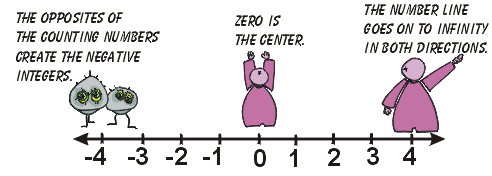
  • The number line goes on forever in both directions. 
  • Whole numbers greater than zero are called positive integers. These numbers are to the right of zero on the number line.
  • Whole numbers less than zero are called negative integers. These numbers are to the left of zero on the number line.
  • The integer zero is neutral. It is neither positive nor negative. 
  • The sign of an integer is either positive (+) or negative (-), except zero, which has no sign.
  • Two integers are opposites if they are each the same distance away from zero, but on opposite sides of the number line. One will have a positive sign, the other a negative sign.
  • As you move to the right on the number line, integers get larger in value. 
  • As you move to the left on the number line, integers get smaller in value.

  • +3 is greater than 0
    -3 is greater than -1
    4 < 7
    > -5
    Comparing Numbers 
    The equal sign =
    The less than sign <
    The less than or equal sign ?
    The greater than sign >
    The greater than or equal sign *
    Rounding
    Look at the number to the right of the place to be rounded. If the number is 5 or greater, add one to the column to the left. If the number is less than 5, the column to the left remains the same. Then change all the digits to the right of the place to be rounded to zeros.

    Basic operations
    Add (find sum)
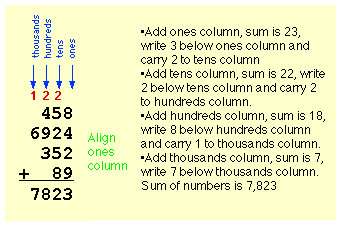
  • Numbers being added are addends.
  • The answer to an addition problem is the sum.
  • Align the numbers to be added with the ones' unit of each number in the far right column. 
  • Add the numbers in the ones' column. 
  • If the sum of the column is greater than 9, write the ones' digit under the column and carry any other digits one position to the left and write it above that column.
  • Add the numbers in the tens column, include any number carried to that column in the sum of that column.
  • If the sum of the column is greater than 9, write the ones' digit under the column and carry any other digits one position to the left and write it above that column.
  • Continue these steps with each column of numbers until all columns have been added.
  • Addition - identity, commutative,associative properties

    Identity:  The sum of zero and a number is the original number.

    Commutative Property: The order of the addends does not change the sum.

    Associative Property: The grouping of the addends does not change the sum.
     

    Identity:  
    14 + 0 = 14
    -12 + 0 = -12

    Commutative Property: 
    -8 + 10 = 10 + (-8)

    Associative Property: 
    -5 + 7) + 6 = -5 + (7 + 6)

    Check answer
    Inverse Operations - addition and subtraction are inverse operations, they undo each other.
    Check addition of two addends.
    Subtract one addend from the sum. Answer will be other addend.
    7 + 4 = 11
    11- 7 = 4
    or
    11 - 4 = 7
    Estimate sum
    To estimate a sum, first round each number to the same place. 
    Then add the rounded numbers. 
       87 round to  90
     +33 round to  30
     Estimation is 120
    Subtract (find difference)
  • The number being subtracted from is the minuend.
  • The number being subtracted is the subtrahend.
  • The answer to a subtraction problem is the difference.

  • 12 - 8 = 4 
    12 is minuend 
    8 is subtrahend  
    4 is difference 
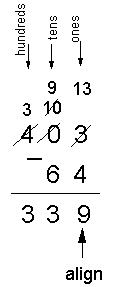
  • Align the numbers to be subtracted, placing the smallest number on the bottom. 
  • Begin at the ones position then move to the left. 
  • Subtract the bottom number from the top. If needed, a ten may be borrowed from the column to the left, decreasing it by one.

  •  
    Estimate difference
    First round each number to the same place. Then subtract the rounded numbers. 
    37 - 24
    37 rounded to 40
    24 rounded to 20
    Estimate is 60 
    Check answer (difference) Check subtraction. Add the subtrahend to the difference. Answer will be minuend.
    Multiply (find product)

    Multiplication is like a short way to do addition. 4 x 5 means 4 times 5 or 5 + 5 + 5 + 5 = 20. 5 x 4 means 5 times 4 or 4 + 4 + 4 + 4 + 4 = 20. 

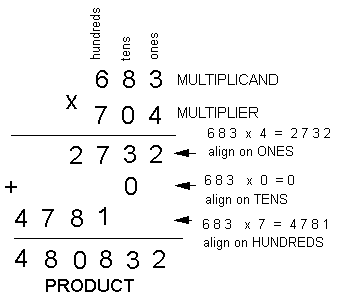
  • To multiply large numbers, start at the bottom right-most digit in the bottom term and multiply it times each digit in the top term recording your answer directly below. 
  • Place a 0 placeholder in the tens place of the line below your answer, then go to the next digit to the left on the bottom term and multiply it time each digit in the top term. 
  • When you have multiplied all the digits on the bottom term with a 0 placeholder in the tens place for each answer, add the results you recorded to find the answer.

  • The sign for multiplication on the computer is *. 
    Commutative, associative, distributive, zero properties of multiplication
     
  • Commutative Property:  The order of the factors does not change the product. 
  • Associative Property:  The grouping of the factors does not change the product. 
  • Distributive Property:  The multiply a sum by and integer, you can multiply each addend by the integer and then add the product. 
  • Property of Zero:  The product of an integer and zero is zero. 
  • Identity Property:  The product of one and and integer is the original integer. 
  • Commutative, associative, distributive, zero properties of multiplication

    Commutative Property:  
    -10 x 2 = 2 x -10
    Associative Property:  
    -9 x (5  x  -2) = (-9 x 5 ) x -2
    Distributive Property:  
    14(-7 + 11) = (14 x -7 ) + (14 x 11)
    Property of Zero:  
    7 x 0 = 0     -3 x 0 = 0
    Identity Property:  
    12 x 1 = 12    -9 x 1 = -9

    Estimate product
    To estimate products, use rounded numbers.
    33 x 28 
    30 x 30 = 900 
    Multiply by powers of 10
    To multiply by ten, just add a zero  at the end of a number.
    To multiply by one hundred, add two  zeros at the end of a number.
    To multiply by one thousand, add three zeros at the end of a number.
    Check answer (product)
    Check multiplication by division.
    Divide the product by one factor and the answer will be the other factor.
    Problem 
    12 x 3 = 36

    Check     
    36 ÷ 3 = 12  or   36 ÷ 12 = 3

    Divide (find quotient)
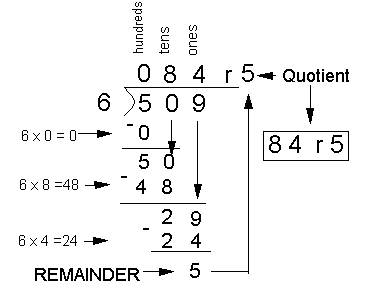
     Basic Division go here and watch a division problem being done.
  • Write the dividend (number being divided) inside the division symbol and the divisor (number divided by) outside the symbol.
  • Ask yourself if the first number of the dividend can be divided by the divisor. If so, put the answer above the first number in the dividend, if not place a 0 there.
  • If you used a 0, ask if the first two numbers of the dividend can be divided by the divisor. If so place the answer above the second number, if not not place a 0 there.When you place a number in the answer above the divison symbol, multiply that number by the divisor and write your answer below the numbers being used in the dividend. Subtract those numbers and bring down the next number in the dividend to get the next number to be used as a dividend.
  •  Place a number or 0 in the quotient and continue the process until all numbers are used.
  • If, when all numbers in the dividend have been used, you are left with a number smaller than the divisor, that number is your remainder.
  • Divisibility rules
    A number is divisible by the given integer if the condition is met.
    2-If the last digit is a 0, 2, 4, 6, or 8
    3-If the sum of the digits is divisible by 3
    4-If the last two digits are divisible by 4
    5-If the last digit is a 0 or 5
    6-If the number is divisible by both 2 and 3.
    7-Check it on the calculator as there isn't an easy test for 7
    8-If the last three digits are divisible by 8
    9-If the sum of the digits is divisible by 9
    10-I f the last digit is a 0
    11-Subtract the sum of the digits in the even positions (2nd digit, 4th digit, etc) from the sum of the digits in the odd positions (1st digit, 3rd digit, etc). If this difference is divisible by 11, then the number is divisible by 11.
    Remainder
    Estimate quotient
    To estimate quotients, use rounded numbers.  
    Look for numbers that divide with a remainder of zero.
    42÷18 
    40 ÷ 20 =2
    Check answer (quotient)
    Check division by multiplication and addition.
    Multiply the quotient by the divisor and add the remainder. 
    Answer will equal  dividend.
    Arithmetic expression
    An arithmetic expression is a list of real numbers separated by operation symbols. 

    5 + 7 
    4 - 7 + 3
    12 + 11 + 9 - 2
    2 * 3 - 4
    3 * 4 + 5 * 7
    6/2 + 1

    An arithmetic expression has a value which is determined by performing the calculations indicated.

    The value of the arithmetic expression 5 + 7 is 12.
    5 + 7 = 12
    Problem solving (word problems)
    Look for words that imply :
  • addition (total, sum, add, in all, altogether, combined, more than) 
  • subtraction (less than, difference, take away) 
  • multiplication 
  • division

  •  

    Hosted by www.Geocities.ws

    1