A fraction is a number used to name a part of a group or a whole.
The number below the bar is the denominator.
The number above the bar is the numerator.
The bar stands for division.
Fractions - Definitions - First Glance
In Depth
Examples
Workout

| Factoring
Factors are either composite numbers or prime numbers (except that 0 and 1 are neither prime nor composite). Factoring a number means taking the number apart to find its factors--it's like multiplying in reverse. To factor a number, divide the number continuously by the smallest possible divisor. Factors and multiples - First Glance Examples Workout Print this page for factoring help |
16/2=8/2=4/2=2 Factors of 16 are 2*2*2*2 or 2^4 If you multiply the factors of 16 together, the product will be 16. 2*2*2*2= 16 |
| Composite
Number
A composite number is any number that has more than two factors. |
COMPOSITE
NUMBERS up to 20
4,6,8,9,10,12,14,15,16,18,20 |
| Greatest
Common Factor (GCF)
The greatest common factor, or GCF, is the largest number that divides evenly into two numbers. To find the GCF of 16 and 84: Find the prime factors of each number by factoring them. Identify those prime factors that both numbers have in common and multiply them. Greatest Common Factor (GCF) - First Glance In Depth Examples Workout |
16/2=8/2=4/2=2 84/2=42/2=21/3=7 2*2=4 4 is the GCF of 16 and 84. It is the largest number that 16 and 84 can be evenly divided by. |
| Least
Common Multiple (LCM)
The least common multiple (LCM) of two numbers is the smallest number (not zero) that can be evenly divided by both numbers. To find the least common multiple of two numbers: List the prime factors of each number. Multiply each factor the greatest number of times it occurs in either number. Least Common Multiple (LCM) - First Glance In Depth Examples Workout |
30
= 2 *
3 * 5
45 = 3 * 3 * 5 2 and 5 each occur once in each number, 3 occurs twice in one number so multiply: 2 * 5 * 3 * 3 = 90 So 90 is the LCM of 30 and 45. It is the least number that both 30 and 45 will divide into evenly. |
| Parts
of a fraction
A fraction is a number used to name a part of a group or a whole. The number below the bar is the denominator. The number above the bar is the numerator. The bar stands for division. Fractions - Definitions - First Glance In Depth Examples Workout |
|
| Similar
and dissimilar fractions
If denominators are the same, fractions are similar. If denominators are different, fractions are dissimilar.
|
5/8 and 3/8 are similar fractions. 3/5and 2/3 are dissimilar fractions. |
| Proper
fraction
Numerator is less than denominator. Fractions - Definitions - First Glance In Depth Examples Workout |
Less than one whole (3/5). |
| Improper
fraction
Numerator is greater than or equal to denominator. Fractions - Definitions - First Glance In Depth Examples Workout |
Equal
to one whole (5/5)
Greater than one whole (7/5). |
| Mixed
number
Numbers with a whole number and a fraction. Fractions - Definitions - First Glance In Depth Examples Workout |
More
than one whole.
1 2/5 |
| Mixed
number to improper fraction
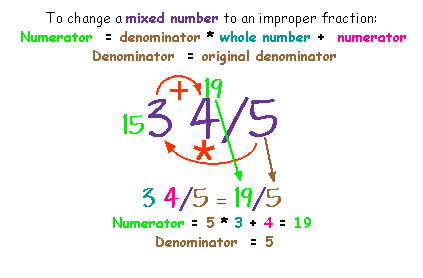
To change a mixed number to an improper fraction: Numerator = denominator * whole number + numerator Denominator = original denominator |
 |
| Improper
fraction to mixed number
To change an improper fraction to a mixed number: Numerator / denominator Whole number = whole number Numerator = remainder Denominator = original denominator |
 |
| Basic operations with fractions |
| Add and subtract fractions | Fractions - Adding and Subtracting fractions - First Glance In Depth ExamplesWorkout |
| Mixed
numbers
Add or subtract fractions with fractions and whole numbers with whole numbers. If result is an improper fraction, change it to a mixed number, add resulting whole number to the existing whole number and keep the fraction. Adding and subtracting mixed numbers In Depth Examples Workout |
7 2/3 fractions
added below
+ 3 3/4 10 17/12 = 10+1 5/12 = 11 5/12 2/3+3/4=2*4+3*3=8+9=17=
1 5/12
|
| Whole
numbers from mixed numbers
Subtract whole numbers. Carry down fraction. |
7
2/5
-4 3 2/5 |
| Fractions from mixed numbers | Add or subtract fractions.
Keep whole number
6
7/8
7/8-2/3=7*3-8*2=21-16=
5
|
| Multiply and Divide Fractions |
| Multiply
fractions
Change mixed numbers to improper fractions. Multiply numerators. Multiply denominators. Reduce and/or change to a mixed numeral. When fractions are multiplied, product will be greater than either fraction. Multiplying fractions - First Glance In Depth Examples Workout |
2/5
* 5/8 = 10/40 = 1/4
1 2/3
* 3 5/8 =
|
| Divide
fractions
Change mixed numbers to improper fractions. Change division sign to multiplication sign. Flip second fraction. Multiply numerators. Multiply denominators. When fractions are divided, product will be smaller than either fraction. Dividing fractions - First Glance In Depth Examples Workout |
2
2/5 / 1 2/3 = 12/5 / 5/3 =
12/5 * 3/5 = 36/25 = 1 11/25 |
| Solve word problems with fractions |