Decimal Numbers
 
Place value through thousandths

Read and write decimal numbers
Expanded form
Decimal notation

Compare and order decimals

Estimate and Round decimals


Basic operations with decimals

Add decimals

Subtract decimals

Multiply decimals
By zero
By powers of ten

Divide decimals
Whole number by decimal
Decimal by decimal
Repeating decimals

Exponents
Squares and square roots
Solve word problems with decimals

Decimal place value through ten thousandths
Place values of decimal numbers are determined by their position relative to the decimal point. The first number to the right of the decimal is the tenths' position, the second is the hundredths' position, the third is the thousandths', and the fourth is the ten-thousandths', and so on. Zeros to the right of the right-most digit of value are generally not expressed.
                            Whole Number                                                                                                  Decimal Number
hundreds tens ones decimal tenths hundredths thousandths ten
thousandths
3 5 9 . 8 2 7 4
*100 *10 *1 *1/10 *1/100 *1/1000 1*10000
Place value
Read and write decimal numbers Numbers - Decimal Numbers - In Depth
Numbers - Decimal Numbers - Examples
Decimals and Integers - Decimal Numbers - Workout
Expanded form
Decimal notation
Compare and order decimals To compare decimal numbers line up the decimal points and annex any zeros to the back (far right) so that all numbers have the same number of digits. Then
disregard the decimal points and compare the numbers as if they were whole numbers.
Estimate and Round decimals
Decimal numbers are rounded in the same manner as whole numbers except that zeros are not needed to fill in the rounded positions. Look at the number to
the right of the place to be rounded. If the number is 5 or greater, add one to the column to the left. If the number is less than 5, the column to the left remains
the same. Then remove all the digits to the right of the place to be rounded.
Estimating and rounding decimals
Estimating and rounding decimals - In Depth 
Estimating and rounding decimals - Examples 
Estimating and rounding decimals - Workout 


 Basic operations with decimals
Add decimals
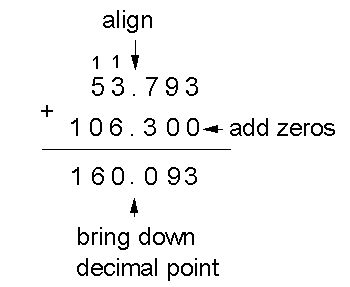
Line up the decimal points and add as if the numbers were whole numbers. If a number doesn't have a decimal point, the decimal point is understood to be at
the ar right of the number.
Adding/subtracting decimals 
Adding/subtracting decimals - In Depth  
Adding/subtracting decimals - Examples  
Adding/subtracting decimals - Workout 
Subtract decimals
Line up decimal points and subtract as if whole numbers. The top number MUST have the same number of decimal places as the bottom, so zeros may
need to be annexed to the end (far right). If a number doesn't have a decimal point, the decimal point is understood to be at the far right of the number.
 
Multiply decimals
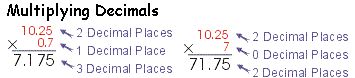
Multiply decimal numbers as if they were whole numbers. To find the the correct place to put the decimal point in the answer, count the total number of digits
to the right of each decimal point and count off that many places in the answer. Begin counting from the right, moving to the left.

Multiplying decimals 
Multiplying Decimals - In Depth 
Multiplying Decimals -Examples
Multiplying Decimals-Workout
By zero
By powers of ten
   
Divide whole number into decimal
To divide a decimal by a whole number, divide then put the decimal in the quotient directly above the decimal point in the dividend.
 
Divide whole number by decimal
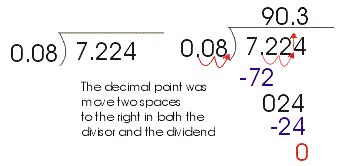
Move the decimal point in the divisor all the way to the right to make a whole number.Add a zero to the right of the whole number for each place the decimal point was moved in the divisor. Divide and put the decimal in the quotient directly above the decimal point in the dividend.
Divided decimal by decimal
To divide a decimal by a decimal, move the decimal point in the divisor all the way to the right to make a whole number. Then move the decimal point in the
dividend the same number of places to the right. Divide and put the decimal in the quotient directly above the decimal point in the dividend.
Dividing Decimals
Dividing Decimals - In Depth
Dividing Decimals - Examples 
Dividing Decimals - Workout
Repeating decimals
Exponents
An exponent is a number that tells how many times the base is used as a factor. In 3^2, 3 is the base and 2 is the exponent. When writing numbers the
exponent is written to the right and above a number. On the computer the sign for an exponent is ^.
Exponents
Exponents - In Depth  
Exponents - Examples  
Exponents - Workout  
Exponential Calculator 
Squares and square roots 
The square of a number is that number times itself. 
Finding the square root of a number is the inverse operation of squaring that number. 
Perfect squares are:
1, 4, 9, 16, 25, 36, 49, 64, 81, 100, 121, 144
Square roots
Square roots - In Depth  
Square roots - Examples  
Square roots - Workout 
Square Root Calculator
Print this page for help 
 I
Solve word problems with decimals
Hosted by www.Geocities.ws

1