Protective Equipment
| Many
accidents happen because people don't use protective clothes and
equipment. Read about why different kinds of equipment are
necessary.
|
|
|
|
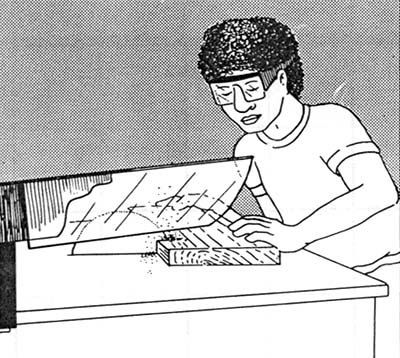
| 1. Machine operators need goggles, safety glasses, or face masks to keep flying particles and dust out of their eyes. Chemical workers need masks to protect their eyes from splashes. | 2.
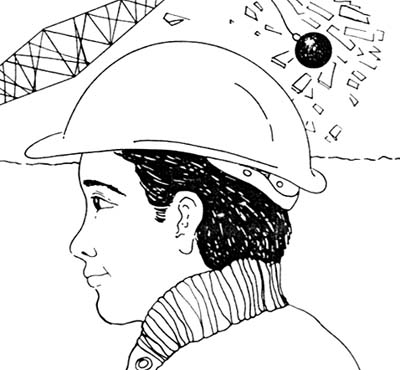
Hard hats are used when there is danger from falling or flying objects.
|
|
|
|
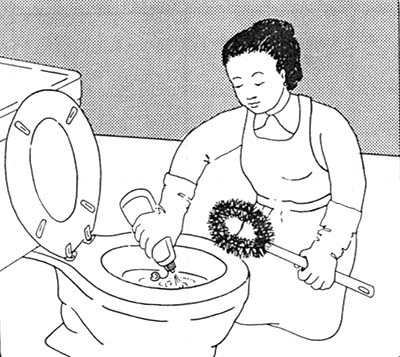
| 3. Gloves and aprons protect workers when they use dangerous chemicals. Workers can get skin rashes if their skin is not protected. | 4.
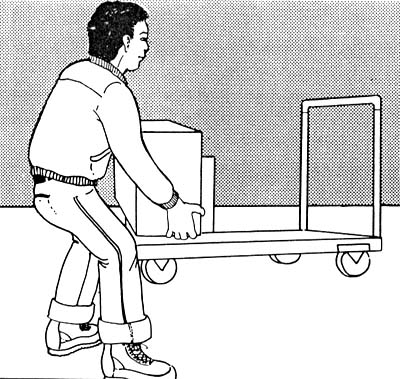
Sturdy workshoes protect people's feet from falling
objects.
|
|
|
|
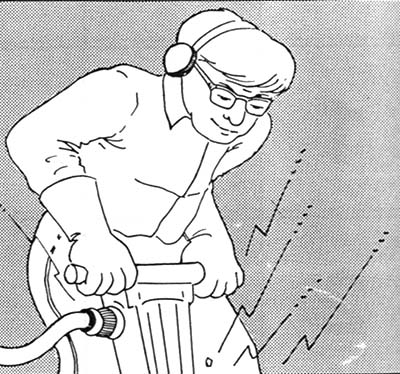
| 5.
Ear plugs or ear muffs protect the hearing of machine operators and other
workers in noisy factories. People can become deaf if their ears are
not protected.
|
6.
Respiratory equipment is used when there are harmful dusts, fumes, or
gases in the air. For example, coal miners wear respiratory
equipment because there is so much dust in the mines.
|
| Source : Speaking up at Work. New York: Oxford University Press, 1985. | |

Hand Tool Rules
|
Source: http://www.aomc.org/HOD2/general/Accinjpr-BASIC.html
|
|
- Do not continue to work if your safety glasses become fogged; stop work and clean the glasses until the lenses are clear and defogged.
- Use tied off containers to keep tools from falling off of scaffolds and other elevated work platforms.
- Carry all sharp tools in a sheath or holster.
- Tag worn, damaged or defective tools "Out of Service" and do not use them.
- Do not use a tool if its handle has splinters, burrs, cracks, splits or if the head of the tool is loose.
- Do not use impact tools such as hammers, chisels, punches or steel stakes that have mushroomed heads.
- When handing a tool to another person, direct sharp points and cutting edges away from yourself and the other person.
- When using knives, shears or other cutting tools, cut in a direction away from your body.
- Do not chop at heights above your head when you are working with a hand axe.
- Do not carry sharp or pointed hand tools such as screwdrivers, scribes, aviation snips, scrapers, chisels or files in your pocket unless the tool or your pocket is sheathed.
- Do not perform "make-shift" repairs to tools
- Do not use "cheaters" on load binders or "boomers".
- Do not carry tools in your hand when you are climbing; carry tools in tool belts or hoist the tools to the work area using a hand line.
- Do not throw tools from one location to another, from one employee to another, from scaffolds or other elevated platforms.
- Transport hand tools only in tool boxes or tool belts; do not carry tools in your clothing.
- Always match the size and type of screwdriver blade to fit the head of the screw.
- Do not hold the workpiece against your body while using a screwdriver.
- Do not put your fingers near the blade of the screwdriver when tightening a screw.
- Use a drill, nail, or an awl to make a starting hole for screws.
- Do not force a screwdriver by using a hammer or pliers on it.
- Do not use a screwdriver as a punch, chisel, pry bar or nail puller.
- When you are performing electrical work, use the screwdriver that has the blue handle; this screwdriver is insulated.
- Do not carry a screwdriver in your pocket.
- Do not use a screwdriver if your hands are wet, oily or greasy.
- Do not use a screwdriver to test the charge of a battery.
- When using the spiral ratchet screwdriver, push down firmly and slowly.
- Do not use pliers as a wrench or a hammer.
- Do not attempt to force pliers by using a hammer on them.
- Do not slip a pipe over the handles of pliers to increase leverage.
- When you are performing electrical work, use the pliers that have the blue rubber sleeves covering the handle; these pliers are insulated.
- Do not use pliers that are cracked, broken or sprung.
- When using the diagonal cutting pliers, shield the loose pieces of cut material from flying into the air by using a cloth or your gloved hand.
- Use a claw hammer for pulling nails.
- Do not strike nails or other objects with the "cheek" of the hammer.
- Do not strike a hardened steel surface, such as a cold chisel, with a claw hammer.
- Do not strike one hammer against another hammer.
- Do not use a hammer if your hands are oily, greasy or wet.
- Do not use a hammer as a wedge or a pry bar, or for pulling large spikes.
- Use only the sledge type hammer on a striking face wrench.
- Do not use wrenches that are bent, cracked or badly chipped or that have loose or broken handles.
- Do not slip a pipe over a single head wrench handle for increased leverage.
- Do not use a shim to make a wrench fit.
- Use a split box wrench on flare nuts.
- Do not use a wrench that has broken or battered points.
- Use a hammer on striking face wrenches.
- Discard any wrench that has spread, nicked or battered jaws or if the handle is bent.
- Use box or socket wrenches on hexagon nuts and bolts as a first choice, and open end wrenches as a second choice.
- Do not use power equipment or tools on which you have not been trained.
- Keep power cords away from the path of drills, saws, vacuum cleaners, floor polishers, mowers, slicers, knives, grinders, irons and presses.
- Do not use cords that have splices, exposed wires, or cracked or frayed ends.
- Do not carry plugged in equipment or tools with your finger on the switch.
- Do not carry equipment or tools by the cord.
- Disconnect the tool from the outlet by pulling on the plug, not the cord.
- Turn the tool off before plugging or unplugging it.
- Do not leave tools that are "On" unattended.
- Do not handle or operate electrical tools when your hands are wet or when you are standing on wet floors.
- Do not operate spark inducing tools such as grinders, drills or saws near containers labeled "Flammable" or in an explosive atmosphere such as a paint spraybooth.
- Turn off the electrical tool and unplug it from the outlet before attempting repairs or service work.
- Tag the tool "Out of Service".
- Do not use extension cords or other three pronged power cords that have a missing prong
- Do not remove the ground prong from electrical cords.
- Do not use an adapter such as a cheater plug that eliminates the ground.
- Do not plug multiple electrical cords into a single outlet.
- Do not run extension cords through doorways, through holes in ceilings, walls or floors.
- Do not drive over, drag, step on or place objects on a cord.
- Do not use portable power tools unless they have color-coded green bands taped to the handles.
- These green labeled tools have ground Fault Circuit Interrupters incorporated into the plug end of the power cord. The use of these power tools is required when working in older buildings or temporary work locations where the work environment is often damp, and the available electrical outlets may not meet our wiring standards.
- Do not stand in water or on wet surfaces when operating power hand tools or portable electrical appliances.
- Do not use a power hand tool to cut wet or water soaked building materials or to repair pipe leaks.
- Do not use a power hand tool while wearing wet cotton gloves or wet leather gloves.
- Never operate electrical equipment barefooted; wear rubber-soled or insulated work boots.
- Do not operate a power hand tool or portable appliance that has a frayed, worn, cut, improperly spliced or damaged power cord.
- Do not operate a power hand tool or portable appliance if a prong from the three-pronged power plug is missing or has been removed.
- Do not operate a power hand tool or portable appliance that has a two-pronged adapter or a two conductor extension cord.
- Do not operate a power hand tool or portable appliance while holding a part of the metal casing or while holding the extension cord in your hand.
- Hold all portable power tools by the plastic hand grips or other nonconductive areas designed for gripping purposes.
Source: http://web.uvic.ca/ohs/handtool.html