Biography
by Dave Smith
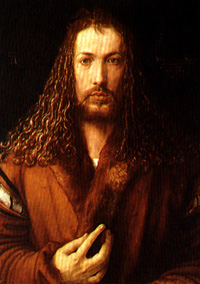
Albrecht Dürer is known as the �prince of German artists.� Dürer is most
well-known for his prints which include woodcuts, etchings, and engraving. Some people
say Dürer is one of the best print makers, but he also worked with the painting. Since the
paintings were expensive to purchase, he worked with engravings because they were less
expensive and could be mass produced. Dürer strove to combine art of north and south
Europe. He was one of the first artists from northern Europe to use a modern style in his
artwork. The quality found in the Italian Renaissance influenced his drawing, painting,
and engraving. Dürer realized that he would have an impact on future artists through his
work. Because of this, he signed his works with an �AD� and also dated them.
Albrecht Dürer was born in Nuremberg, Germany, on May 21, 1471. Dürer came
from a family of eighteen children. He was an apprentice to his father who was a
goldsmith. Dürer attended school at St. Lorenz and took classes in reading, writing,
arithmetic, and Latin. His father noticed Dürer�s talent in drawing. When Dürer was
fifteen years old, he started his apprenticeship with Michael Wolgemut on November 30,
1486. Michael Wolgemut was a local artist in Nuremberg. Dürer was apprenticed to
Wolgemut for three years. He ended his apprenticeship in 1490 when he was nineteen
years old. At this time, Dürer did paintings of his father and mother.
In April of 1490, Dürer began his �wandering years.� He did so by leaving
Nuremberg for Holland. It was typical for artists �wander� after their apprenticeship.
During his time away, Dürer�s marriage had been arranged for the spring of 1494. It was
arranged for Dürer to be married to Agnes Frey. The wedding took place on July 7, 1494.
The relationship between Dürer and Agnes was somewhat rough, and it would turn out
that no children would come from this marriage. Dürer had become well-known in the
intellectual part of the community in Nuremberg, but he neglected his wife in doing so.
Durer studied prints of the Italian artists Mantegna and Pollaiuolo that he had been
exposed to at Wolgemut�s studio. A plague hit Nuremberg in the summer of 1494.
Because of the plague, Dürer left for Italy, by himself, just two months after his marriage.
During his stay in Italy, Dürer did many works on commission. He was
commissioned by Friedrich the Wise Duke of Sacony. With this commission in 1496,
Dürer did the etching entitled �Four naked women.� His focus on proportions is
noticeable in the engraving entitled �Adam and Eve� which was done in 1504. During his
visit, he focused more on engraving than painting. Dürer returned to Nuremberg in
February of 1507.
Dürer focused on painting from 1507 to 1512. Dürer worked on commissions for
Emperor Maximilian I from 1510 to 1519. He went to Switzerland in 1519 and then to
the Netherlands in 1520. Dürer did the painting, �Four Apostles,� in 1526. Toward the
end of Dürer�s life, he worked on books which sought to show the scientific aspects of
painting and drawing. The books also showed proportions and perspectives from a
mathematical viewpoint. Dürer was enthralled by beauty and perfection. He died on April
6, 1528, in his birthplace of Nuremberg.
