 |
|
 |
 |
 |
 |
 |
 |
 |
 |
 |
 |
 |
 |
 |
|
 |
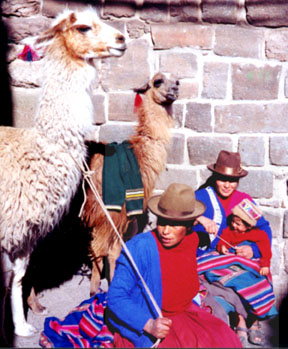
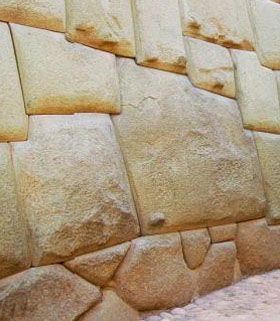
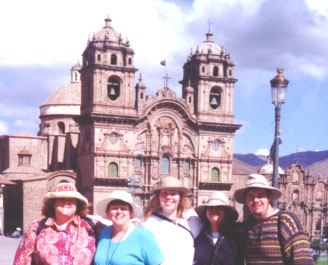
| The flight from Lima to Cusco had us soaring over the brown, snow-capped Andes. In under an hour, we had touched down in Cusco - ready to begin our adventure. In the luggage pickup section, there was a group of Incan musicians, smiling and in costume. THAT was when we really felt like we were in Peru. At the airport we met Victor, our guide for the next week. He had our driver take us to El Balcon, just a few blocks away from the Plaza in Cusco. This was to be our favorite hotel. It had a lovely open courtyard with a garden, a friendly cat named Carlotta, and rooms carved into the mountain behind it. We dumped our bags off and went to sit for a bit outside the cantina, sipping on coca tea in the chilly morning air. After a nap and quick meal of chicken soup, we walked out onto the cobblestone streets and headed towards the Plaza. Victor had trouble keeping us all together, as we were busy taking pictures, stopping in front of stores, and talking to kids. Finally we reached the Plaza. The cathedral wasn�t open yet, so we made our first Peruvian purchases from a local Incan woman. We were quickly surrounded by other sidewalk merchants and kids, who pressed us to buy their wares. Luckily, the cathedral opened at this time and we went in to take a look. The cathedral had been damaged by local quakes, so was in the process of being restored. One of the more fascinating things included a huge silver dais, which they used to walk through town on holy days - but because it�s so heavy, was transformed into a float and placed on top of a car! Another interesting factoid: local Incans painted almost all of the huge paintings that hang in the church. These artists did not leave their name, but put a little �local flavor� into what they painted. Like the Last Supper, in which Jesus and the Disciples are sitting down to a meal of cuy, or guinea pig (a traditional Cusco dish). In addition, the statues of Jesus were also carved by Incan artists and definitely had a more womanly appearance (part of the Incan belief in Pachamama � Mother Earth). After the Cathedral, we then walked up a very steep street to see the chapel of San Blas. We made frequent stops - not only to catch our breath, but to do a little shopping, take pictures of the llamas (and get charged for it!), and check out the Incan masonry. The interlocking stones have survived hundreds of years and many earthquakes because of the superb Incan craftmanship. We then took a taxi over to the Temple of the Sun. Before the Spainards, its walls had been covered in gold plating, silver (for the Temple of the Moon), precious stones and crystals (for the Temple of the Stars). I only wish I could�ve seen it back then! |
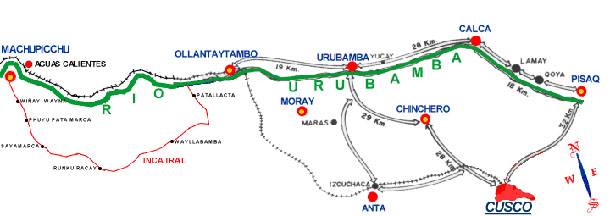
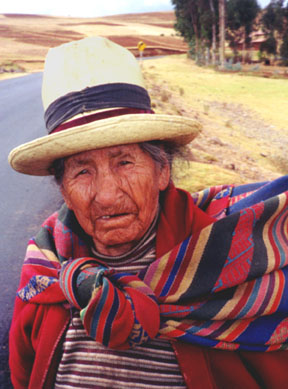
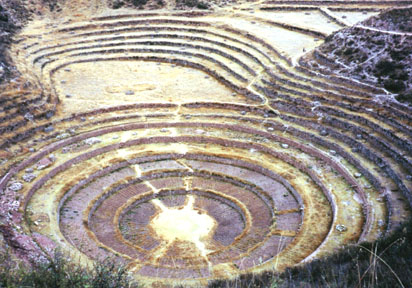
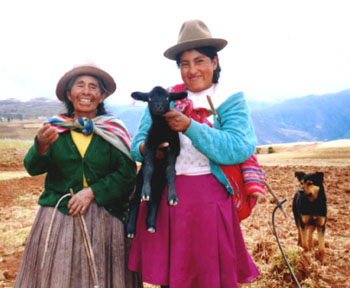
| The next day involved traveling through the Sacred Valley. First to Moray, then down to Urumbamba for lunch, then over to the Pisac ruins, and back to Ollantaytambo. On the way to Moray, we had the driver pull over so we could take a picture of the valley. But the best picture was one my mom snapped of this little old lady who looked simply ancient. She was so sweet and just so happy when my mom gave her a �propina� (tip). It�s one of the best pictures of the entire trip! In Moray, we saw the original crop circle. The Incans had taken fruits and vegetables from the Amazon basin and, being so ingenious, figured out a way to experiment with growing them in different temperatures and elevations. They built this huge circle with terraced levels to do this. It even has drainage canals. They were even able to make the fruits & veggies grow larger! |
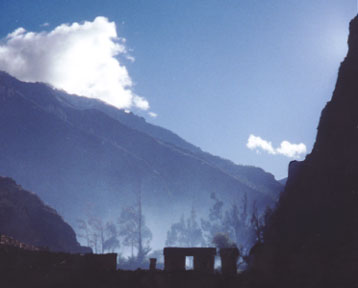
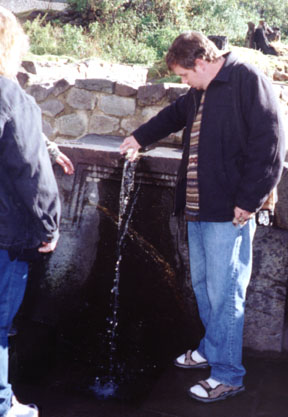
| While at Moray, Victor pointed out the tiny seashells that were scattered everywhere. Can you believe that, at one time, the land we stood at (which is around 10,000 feet above sea level) was once at the bottom of the ocean? Talk about a land that�s always moving! The little seashells were actually hundreds of thousands of years old. Victor also had us taste the berries used to create indigo & purple dyes - giving us purple tongues as a result! Outside of Moray we stopped across the valley from Salineras, the ancient Incan-built salt mines that are still in operation. Salt water from the springs is diverted into flat beds so the water evaporates and leaves behind the salt. Those Incans� they could do anything! In Urumbamba, we stopped to eat at a tourista buffet place. The food was just �asi asi� (so-so), but the stop gave a chance to relax and chat. We then drove to Pisac along the Urumbamba River. The river... the mountains that shot straight up from the valley... local people in native dress... it was just beautiful. In Pisac, we briefly went through the market and then drove up to the ruins located above the town. However, since the walking path was so damn steep, I decided to stay behind and just enjoyed myself looking out at the amazing vistas and breathing it all in. At the end of the day, we drove back the way we came and went on to Ollantaytambo. We sang a few songs in the van to make the drive go a bit quicker. I think Victor and our driver enjoyed our energy. Ollantaytambo was just awesome. Incan aqueducts still run through town and you can see the ruins on the hills above. There was also a bright moon out, which made the place seem even more mystical. In the morning, we toured the Temple of the Sun ruins. Simply magical! The early morning sun was just rising through the valley, casting a wonderful amber glow over everything. The mists were rising and it truly felt timeless. This was one of my favorite moments of the entire trip. Along our walk, Victor pointed out a �magical� Incan fountain - in which you could change the flow of the water by simply moving your finger against the edge. Move it this way to get a constant stream, move it that way and you get a dribble. Very cool. Next stop... Machu Picchu! |