basic synthesisers are.....basic, with the skills of
a three year old you can stick one together, of course you have to find
plans for each of the circuit components. i will not provide extensive
circuitry designs. of course you can find many parts that will fill
the bill. most of this page will be filled with pictures, that is
the most effective medium for this type of thing.
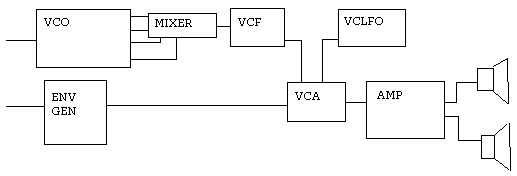
flow of sound, the basic components.
what do they do? simple, the vco is a generator of basic waveforms,
a range of frequencies are sounds. 20hz is as low as most people
can hear, those are not considered, above 30000hz sounds go so high that
only weird people and dogs hear it. the ease of use of the vco is
dependent on your choice of type, linear is the easiest to use simply because
it is easiest to interface with a keyboard.
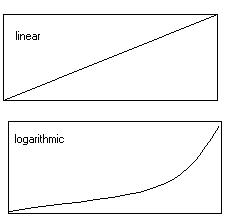
what does it linear mean? basically it is the range of voltage
and frequency change. there are logarythmic and linear, log. means that the voltage from the keyboard is a direct relation to the frequency output, linear is the voltage disociated from the frequency.
for example, with linear 1volt=1octave, meaning middle c is 1volt different
from the next highest and lowest c. with logarithmic, 1volt=almost
an octave, meaning from c to the next it would be 1volt, but to the next
it would be 1.3volts, to the next, 1.88volts. with a keyboard configured
for linear, you feed it 10volts you can stuff 10 octaves in it. with
a logarithmic keyboard you feed it 24 to get the same thing. why
is linear preferred? with it you can use the same resistor value
for each key, and the difference between each key voltage is 1/12volt.
with logarithmic you have to have a different voltage for each key, which
i assure you is a big deal.
a vco puts out several different wave forms, each basic wave makes a
different basic sound, by adding the waves together and changing each one
differently you can get very new and wild sounds, also you can replicate
real sounds with your own preffered accuracy.

unfortunately the design that i will yak about first will be monophonic,
meaning one sound at a time. i will give basic designs for polyphonic,
meaning many sounds at a time, possibly with enough cash all keys at a
time could be used simultaneously, each possibly with a different sound.
you could have several vco's, each making a different wave type, this
is the way that sounds are made in older soundblaster compatible cards.
each note was made of several sine waves mixed together, this can work
for you but is not as fun. a nice little explanation.
the envelope generator is a piece of circuitry that is very nescessary,
the waves come out of the vco at full volume all the time, this is not
desirable. but cutting the waves out entirely is not desirable either,
so the envelope generator is used to lower the volume of the wave to nothing
while allowing it to remain at full strength and stability. it is
set so that when it recieves a voltage it triggers the generator.
if you examine a waveform you will see some characteristics that point
out the basic means of sound generation.
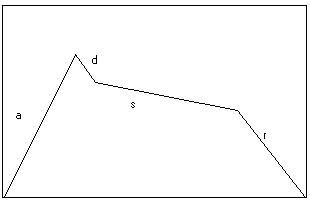
when a wave becomes a sound it first rises to a peak, this is called
the attack. the volume drops suddenly, this is called the decay.
then the wave slowly drops, this is called the sustain. then when
the sound ends, it quickly drops to nothing, this is called release.
if you whistle you can hear it, at the start you force the air out of your
lips, it rises to a piercing level, then it drops to a comfortable level
that you can maintain for a while, then you stop, the sound fading quickly
but noticable. the attack and release are generally very short, the
decay is much shorter, the sustain is longer, generally longer than all
the others put together.
the next basic component is the vca mixer circuit, the envelope generator
needs to have a method of controlling the volume. the vca and mixer
are part of the generator, vca means voltage controlled amplifier.
if you had to control the envelope with a knob you could, but you would
get carpal tunnel syndrome from the amount of activity needed to play one
song, and instead of three minutes it would take three years. there
is a sister circuit called an envelope follower, you use another instrument
to trigger the envelope generator, and the envelope collapses when the
other instrument stops. the envelope generator recieves the signal
from the keyboard and starts the envelope, the voltage from it controls
the vca. the problem is that you would have a hard time controlling
the generator with the variable voltage from the keyboard, the solution,
use a different type of switch in the keyboard. the type of switch
required is a dpst, that is hard to find, use dpdt. one side of the
switch sends the voltage to the vco, one side sends to the envelope generator,
the first image shows this in greater detail.
now for example circuits.
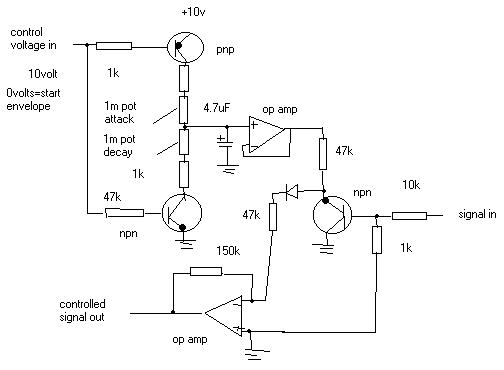
envelope generator+vca, it's rather bad but it works.