 |
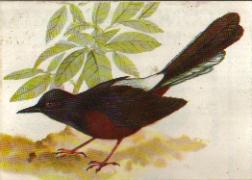
13. Common Shama A shy bird which avoids open places, but is familiar in lowland forests. Possibly the most melodious singer in the country. When singing, it holds up its wings and tail rather stiffly. As it hops about, it twitches and fans its tail. |
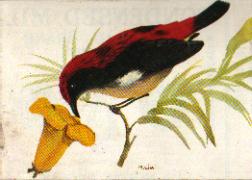 |
14. Scarlet-backed Flowerpecker A small bug pugnacious bird which feeds mainly on mistletoe and insects. It is not welcome in orchards as it is known to transfer seeds of parasites to fruit trees. Commonly seen in flocks of five or six in open country and coastal areas. |
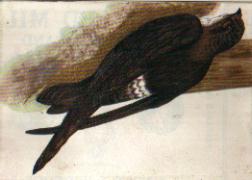 |
15. House Swift Commonly found in towns, even in the busiest streets, where its nests in colonies under the eaves of houses. The nests are usually clustered untidily together. If undisturbed, the birds nest in the same place for years. |
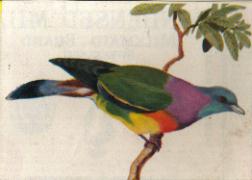 |
16. Pink-Necked Green Pigeon The commonest green pigeon in the country. In many places, they often fly in great numbers in the evening and are a favourite of sportsmen and hunters. The females have a distinctive call "Oh-tu-tu-tu". |
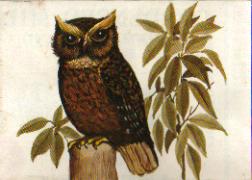 |
17. Collared Scops Owl Mostly found in the lowlands - in forest, suburban and town gardens. It has a soft, rather mournful hoot. The colour of the plumage varies from grey to brownish-red and the common name is derived from a pale collar behind the neck. |
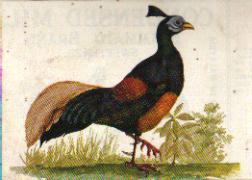 |
18. Crested Fireback Pheasant A ground bird and a very swift runner. Found mostly in forests, it goes about in parties of five or six, usually with only one male among them. When alarmed, it cries "chukun-chukun". The males often make a whirring sound with their wings. |
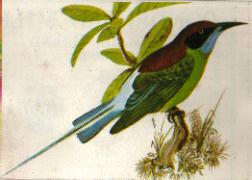 |
19. Blue-throated Bee-eater A sociable bird, it is almost always seen n flocks. It hovers over water for insects, especially after rain in the evening. When it swoops down to catch them, the loud snap of its bill can be heard. |
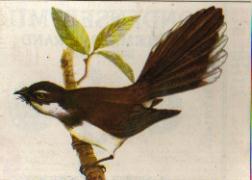 |
20. Pied Fantail Flycatcher An active and lively bird which hops and prances about all the time, flicking and fanning its tail. An aggressive bird when nesting. It is commonly found in low-lying open country, and sometimes in gardens. |
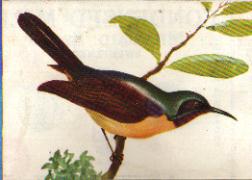 |
21. Brown-throated Sunbird Commonly seen in pairs in gardens and coconut plantations feeding on nectar and insects. The picture shows the male. The female is quite different, with dull green plumage. When quarreling, it chirps "chit-chit-chit". |
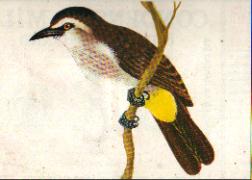 |
22. Yellow-vented Bulbul One of the commonest garden birds, often seen on the ground and in low bushes, in parties of six or more. They are recognized by their chuckling chatter. Their diet includes all kinds of berries, small fruit and insects. |
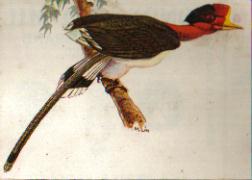 |
23. Helmeted Hornbill A large bird of the tall forest, measuring about 50 inches long including its elongated central tail feathers. It is unique call starts off with a series of mellow notes, "rising gradually in pitch and speed; followed by shrill chuckles; and ending with a mocking laugh". |
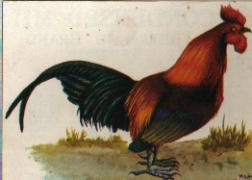 |
24. Red Jungle Fowl A beautiful bird in full plumage. It resembles the domestic bantam, except its crow has a thinner sound. One o the commonest game birds. It frequents jungles along rivers and the edge of cultivated areas from the lowlands to the central highlands. |
Hornbill