Latin or Foreign Legends on English coins
Welcome to Six Pence King
English Six Pence 1551-1970
Latin or Foreign Legends on English coins
Silver content of 20th Century British Coins
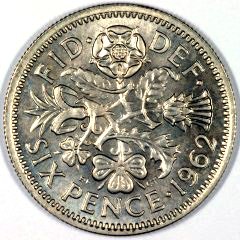
The first sixpence was produced in 1551. It was common for people to trim the coins because they were so soft due to a high silver content. However, the amount of silver was eventually changed to 92.50% (sterling) silver and since 1662 they have been milled. This resulted in them becoming harder to trim and they also did not wear out as fast. The milled edge is the outcome of being struck by a die rather than a mechanical coin press. It is interesting to note that during the American Revolution the Spanish Dollar (Piece of Eight) was worth about sixpence. A private in the British Army of this era was paid a subsistence of six pence per day. In 1920 the sixpence were debased to 50% fine silver. The sixpence actually was made in both alloys that year so there are two versions of the coin. In 1947 they were changed to copper nickel. Silver coins stopped being minted in the U.K. almost twenty years before the same transformation in the U.S.A. because the U.K. had to repay the bullion it borrowed from the United States during World War II. The 1952 George VI is the key date of the later sixpences because of its low mintage. It can be compared to the key date 1950-D U.S. Jefferson Nickel but the 1952 sixpence is actually twice as rare. In 1952, sixpence were only minted to be used in the West Indies because of a shortage of nickel during the Korean War. The last sixpences minted for circulation were in 1967. The reverse on the last design bears a floral motif which includes a rose, a thistle, a leek and a shamrock. These represent England, Scotland, Wales and Ireland respectfully. In 1970 the final sixpence was issued in a proof set. The slang term for a sixpence is a tanner. Sixpences were also used in other members of the Commonwealth such as Australia, Ireland, and New Zealand. English Sixpence Elizabeth II 1953-1970 R. Interlaced rose, thistle, shamrock and leek. Sixpence Anne I 1703-1711 Sixpence William III 1695-1701 Sixpence William & Mary 1693-1694 Sixpence James II 1686-1688 Sixpence Charles II 1674-1684 Sixpence Oliver Cromwell 1658 Sixpence Commonwealth 1649-1660 Sixpence Charles I 1625-1646 Sixpence James I 1603-1624 Sixpence Elizabeth I 1561-1602 United Kingdom Pre-Decimal Proof Sets Other Pre-Decimal English Coins Farthing Half Penny Penny Two Pence Three Pence Four Pence Half Crown Crown Last updated January 25, 2008 Please contact us to Send us an email message with one of the above topics in the subject line. � Sixpence King 2000-09
In the United Kingdom they used to have obscure coins known as farthing, sixpence, shilling, florin and crown but on Feb 15th 1971 the Coins of England were decimalized. Formerly, there were 12 pence to a shilling and 20 shillings to a pound so 240 pence (240d) would equal a pound (1 �). A pound was originally worth a pound of silver. Pennies used to have the symbol (d) which came from denarius a common small silver Roman coin. A sixpence would be 6d. After decimalization there were 100 pence (100p) to a pound. The previous money remained legal tender with the shilling valued at five pence and the sixpence valued at two and a half pence. The sixpence remained popular because it was useful in feeding parking meters. However, inflation caused the sixpence to be demonetized at the end of June 1980.
List of countries that have minted Sixpence
Year
Mintage
Monarch
Composition
Proof Available
Notes
1970
750,000
Elizabeth II
Cupro-Nickel
Proof Only-"Last Sterling Set"
Value of Proof 6d is 2 �
1967
240,788,000
Elizabeth II
Cupro-Nickel
NO
SPINK 4149
1966
171,636,000
Elizabeth II
Cupro-Nickel
NO
SPINK 4149
1965
127,872,000
Elizabeth II
Cupro-Nickel
NO
SPINK 4149
1964
152,236,000
Elizabeth II
Cupro-Nickel
NO
SPINK 4149
1963
112,359,637
Elizabeth II
Cupro-Nickel
NO
SPINK 4149
1962
178,359,637
Elizabeth II
Cupro-Nickel
NO
SPINK 4149
1961
115,052,017
Elizabeth II
Cupro-Nickel
NO
SPINK 4149
1960
103,288,346
Elizabeth II
Cupro-Nickel
NO
SPINK 4149
1959
93,084,441
Elizabeth II
Cupro-Nickel
NO
SPINK 4149
1958
123,518,527
Elizabeth II
Cupro-Nickel
NO
SPINK 4149
1957
105,654,290
Elizabeth II
Cupro-Nickel
NO
SPINK 4149
1956
109,841,555
Elizabeth II
Cupro-Nickel
NO
SPINK 4149
1955
109,929,554
Elizabeth II
Cupro-Nickel
NO
SPINK 4149
1954
105,241,150
Elizabeth II
Cupro-Nickel
NO
Type 2- SPINK 4149 BRITT:OMN dropped from the obverse
1953
70,323,876
Elizabeth II
Cupro-Nickel
YES-Coronation Set, Value of Proof 6d is 5 �
Type 1-SPINK 4141
Sixpence George VI 1937-1952
All rights reserved