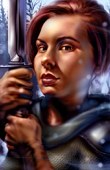
| Warriors: The Warriors are the bread and butter of a strong party: From the Tank who goes toe-to-toe with the strongest enemies, to the Archer who shoots the bad guys down before they can even get close, Warriors are what hold the party together. They have the best THAC0, the best HP, and the best Saving Throws. Most Warriors get up to 10 hp per level (plus or minus any modifiers for their Constitution). All Warriors start off with 4 proficiency stars at Level 1, and then earn 1 more at every 3rd level thereafter. |
Fighter: The Fighter is your basic Warrior in that he's specialized for physical combat: He can wear any type of armor (well, except Mage Robes, but what would a Fighter want with those) or shields, use any type of weapon, and put up to 5 proficiency stars into any weapon. Only a pure (or Dual-classed) Fighter can put 5 stars into a weapon; all the other Warrior-types (including Multiclassed Fighters) are limited to 2 stars.
The Fighter kits are the Berserker, Kensai, and Wizard Slayer. Read more about Fighters here.
Paladin: The Paladin is a forthright champion of honesty and decency, a holy warrior dedicated to scouring the Realms of all that is Evil. All Paladins must be of Lawful Good alignment. Like the Fighter, they can use any type of weapon or armor. Advantages over the Fighter: +2 bonuses to all Saving Throws, as compared to a Human Fighter of the same level. Paladins can Turn Undead (at a slightly lower level than the Cleric). Paladins can cast Detect Evil and Protection from Evil, once per day per level. At Level 9, Paladins learn Cleric spells, although they are limited to the first 4 levels of spells. Disadvantages: Gains levels more slowly than a Fighter, can only put 2 stars into a weapon. If the party's Reputation falls below 6, character becomes a Fallen Paladin, and loses all benefits while retaining all disadvantages. This condition is permanent.
The Paladin kits are the Cavalier, Inquisitor, and Undead Hunter. Read more about Paladins here.
Ranger: Rangers are caretakers of the boundary between Man and Nature, helping the two to live together and understand each other. They must be of Good alignment, and tend to have a natural affinity for animals. Again, they can use any type of weapon or armor. Advantages over the Fighter: Rangers can Stealth like a Thief, although they cannot Backstab. Rangers can cast Charm Animal once per day for every 2 levels. At Level 8, Rangers learn Druid spells, although they are limited to the first 3 levels of spells. (Even though Rangers can reach Level 8 with ToSC, their spells are not implemented until BG2.) Rangers get to choose a Racial Enemy, the type of creature that the Ranger best knows how to fight. When in combat against this type of creature, the Ranger gets a +4 bonus to his attack roll (although in any non-combat situation, such as dialogue, with this type of creature, the Ranger takes a -4 penalty to his Reaction score). Rangers get 2 free points in Dual-Wielding. Disadvantages: Gains levels more slowly than a Fighter, can only put 2 stars into a weapon. If the party's Reputation falls below 4, character becomes a Fallen Ranger, and loses all benefits while retaining all disadvantages. This condition is permanent.
The Ranger kits are the Archer, Beast Master, and Stalker. Read more about Rangers here.
Barbarian: The Barbarian seems to rely on his own brute strength and natural toughness to win the day, rather than learning the finer points of wearing armor or gaining finesse with a weapon. Advantages over the Fighter: Rolls a D12 for hitpoints each level, instead of a Fighter's D10. Once a day per 4 levels can invoke their Barbarian Rage, which makes them immune to several types of spells. Barbarians are immune to Backstab, and gain resistances to physical damage. Disadvantages: Can only put 2 stars into a weapon, cannot wear Plate or Full Plate armor.
The Barbarian class has no kits. Read more about Barbarians here.
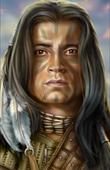 | Priests: Priests are valuable members of a strong party: Not only do their Healing spells (and other defensive spells) very frequently rescue a character from the brink of death, but they're quite handy on the offense as well�consider the Cleric spell Harm, which, when the spell connects (The user must first cast Harm, then make a successful melee hit on the first try), reduces the enemy to ONE hitpoint. Or the Druid spell Insect Plague, which summons stinging insects that attack up to 6 enemies of the caster�any enemy caught in the swarm takes continual damage and has a 100% chance of spellcasting failure. Priests gain spells in this manner: Each time they gain an experience level that allows them access to a new level of spells (usually the odd-numbered levels), all the spells in the new spell level automatically appear on the Priest's Scroll, ready to be memorized the next time the Priest sleeps, and cast the next day. Priests gain |
Cleric: Clerics are more commonly used than Druids, because they're more valuable on the front lines, once they've used up their spells. Clerics can wear any type of armor or shields, but they may NOT use any weapon that either cuts or stabs an enemy�these weapons have been expressly forbidden to them (for whatever reason) by their respective Gods, of which there are many in the BG pantheon. Clerics may only use the Mace, Club, Flail, Warhammer, Morning Star, and Quarterstaff for melee purposes, and their only ranged weapon is the Sling. Clerics learn all 7 levels of Priest spells, though they do not have access to every spell: Some spells are only open to Druids, some are open only to Clerics. About half of the spells can be used by both classes of Priest. There are also some Cleric spells based on alignment: Good Clerics do not learn Unholy Blight and Unholy Word, nor do Evil Clerics have access to Holy Smite and Holy Word, their counterparts. Neutral Clerics get all 4 of those spells. All Clerics can Turn Undead.
The Cleric kits are the Priest of Lathander (Good), Priest of Helm (Neutral), and Priest of Talos (Evil). You may not take a Cleric kit if its alignment does not match your character's. Read more about Clerics here.
Druid: Druids are guardians of Nature, though not in the same way that Rangers are: Those who disrespect and abuse nature must be punished, not merely corrected. A Ranger, upon seeing human travelers in a forest being attacked by Wolves, would usually try to drive the wolves off, killing them if they refused to leave, or seemed rabid. A Druid would simply look on it as Nature's Balance, and accept it (although if animals attacked areas already settled by Humans, a Druid would probably try to get the animals under control, and back where they belonged). Druids also learn all 7 levels of Priest spells, and they must all be of True Neutral alignment. Druids refuse to wear any armor that is not 'natural' in origin�in other words, anything made of metal is out. They also will not carry any shield larger than a Buckler, although they can wear helmets. (It's these armor restrictions that make Druids less popular than Clerics.) Fighter/Druids, on the other hand, are willing to overcome this mental block, and can wear any type of armor, although they will still only use Druid weapons; these are the Club, Staff, Spear, Sling, Dart, and for some reason, the Dagger and Scimitar as well. Druids gain levels very quickly in BG1/ToSC, then very slowly in BG2, then quickly again in ToB. Starting at Level 7, Druids gain the ability to Shapeshift into a Black Bear, Brown Bear, or Wolf (and back). Due to their link with Nature, high-level Druids are shielded from its dangers: At Level 15, they become immune to poison, and at Level 18, they gain 10% resistance to Fire, Cold, Acid and Electricity, with another 10% at Levels 21 and 24.
The Druid kits are the Avenger, Shapeshifter, and Totemic Druid. Read more about Druids here.
Monk: Q: When is a Priest not a Priest? A: When he can't cast spells, and earns his living by beating things to death. The Monk is some sort of funky combination of Fighter/Priest/Thief, and giving their whole description here would really clutter up this page, so I've given them their own page all to themselves, and hopefully they'll stay out of everyone else's way. Read about them here.
The Monk class has no kits.
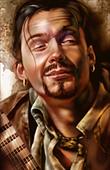 | Rogues: The Thief and Bard are so different that they almost don't even belong in the same superclass. Still, here they are. They do have some similarities, though; they both gain up to 6 hitpoints per level (plus or minus any modifiers for their Constitution), and they gain levels at the same rate�extremely fast. They both get 2 weapon points at level 1, gain another point for every 4 levels, and can put up to 1 point into any of their available weapons. |
Thief: Every strong party needs�note that I said needs�a good Thief. If there's a certain door you have to walk through, but you can't go near it because there's a Trap there that's going to Fireball you into oblivion, call your Thief. A lock that even your strongest Fighter can't force open? Call the Thief. An enemy who would be so much easier to kill if someone snuck up behind him and placed a dagger between his kidneys? Thief. In BG1, Thieves get 20 points each time they Level Up, which they may distribute in the following 4 categories: Find Traps, Pick Locks, Pick Pockets, and Stealth. In BG2, they earn 25 points per level, to be spread into 7 areas: Find Traps, Set Traps, Pick Locks, Pick Pockets, Detect Illusions, and also Stealth has been broken into Hide in Shadows and Move Silently. Also, in BG2, Thieves gain experience for the party each time they pick a lock or disarm a trap; and the higher the Thief's level, the more EXP everybody gets. Thieves can wear only Leather, Studded Leather, Hide Armor, or Elven Chain Mail (gotta stay nimble & flexible), and can use any of the lighter weapons: Staff, Club, Dagger, Short Sword, Long Sword, Ninja-to, Wakizashi, Katana, Short Bow, Light Crossbow, Sling, and Darts. Thieves cannot use Scimitars in ToSC, but they can in BG2. They may only use Bucklers for shields, and they cannot wear helmets. Thieves cannot be Lawful Good, and Multiclassed Thieves cannot take any Lawful alignment. (The fact that single-classed Thieves can be Lawful Neutral and Lawful Evil is probably a mistake.)
The Thief kits are the Assassin, Bounty Hunter, and Swashbuckler. Read more about Thieves here.
Bard: Bards are a combination of Fighter, Thief, and Mage. They can use any weapon except the Composite Long Bow, although they do not have a Warrior's THAC0 and cannot wear any armor heavier than Chain Mail. They can Pick Pockets, but have no other Thief skills. They can cast Wizard spells (and they learn spells in the same manner a Mage does, by copying Scrolls), though they do not gain spell slots as quickly as a Mage, and can only cast the first 6 levels of spells (compared to the 9 spell levels that true Wizards can use). Note that Wizard spells cannot be cast while wearing any armor other than Mage Robes (which Bards cannot wear at all) or Elven Chain Mail, so if your Bard in BG1 wants to cast spells in battle, he has to be buck naked to do so. The Bard's trademark is his Battlesong, which removes him from combat but enables his comrades to fight better. Another asset that Bards have is their extraordinarily high Lore, due to the amount of time they spend learning tales and ballads. Bards are limited to Bucklers in their choice of shields, and cannot wear helmets. Bards must have the word "Neutral" in their alignment.
The Bard kits are the Blade, Jester, and Skald. Read more about Bards here.
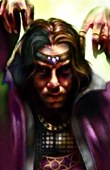 | Wizards: The Mage and Sorcerer are the stereotypical Old Bearded Guys in Robes that look feeble (all right, they ARE feeble) until they blow the opposition to Kingdom Come. They have the crappiest THAC0, the lowest hp (only a maximum of 4 hp per level, plus or minus any modifiers for their Constitution), and they can't wear any armor heavier than Mage Robes. Why not? Well, let's compare Priest spellcasting vs. Wizard spellcasting. All a Priest has to do is call upon the power of his/her Deity and say a simple prayer, and the God(dess) uses the Priest as a conduit for the spell's energies. A Wizard, on the other hand, has to recite complex incantations and perform arcane hand-gesture rituals, quickly combining spell components all the while. You can't do that wearing cumbersome armor, it's just too dang clunky and would cause the Wizard to drop something or otherwise fumble the spell. Helmets |
Mage: The Mage is your basic Wizard. He doesn't know what the hell to do in a fight, except throw rocks with his Sling and try not to get killed, but give him an opportunity to start chucking spells and he's your new best friend. Wizards gain spells in this manner: When they find a Spell Scroll that they don't already know, they can attempt to scribe the Scroll to their Mage Book. The odds of this succeeding are determined by the Mage's (or Bard's) Intelligence, and the relation of the highest level of spells the Mage can cast, as opposed to the level of the spell on the scroll. The Scroll itself is destroyed in this process, whether the transfer was completed correctly or not. If the attempt was successful, the spell is now in the Mage's spellbook permanently. (In BG2 with ToB installed, Mages can 'erase' spells from their book, if they have a limit to the number of spells of each level they can learn, and they wish to make room for a more useful spell. BG1 does not allow this. Also, in BG2, Mages and Bards earn experience for the party with each successful transcription.) Once the spell is safe in the spellbook, the Mage is free to memorize and cast it as many times as he has spell slots.
The Mage is the only Wizard available in BG1, but that's OK because he's the only class that has kits in BG1, the eight Specialist Mages: Abjurer, Conjurer, Diviner, Enchanter, Illusionist, Invoker, Necromancer, and Transmuter. If you're playing BG2 with ToB installed, you may also choose the Wild Mage kit. Read more about Mages here.
Sorcerer: The Sorcerer is very like the Mage in terms of skills, equipment, and spellcasting ability. The difference is that the Sorcerer can cast 1 more spell of each level than the Mage can, making him a powerhouse of spells. Also, the Sorceror does not have to choose his spells the night before: Whereas the Mage must decide how many times he wants to cast Identify the next day, and how many spell slots to use for Magic Missile, the Sorcerer simply knows he can cast 6 Level 1 spells. Whether they're all Identify or all Magic Missile, it doesn't matter�the Sorcerer chooses which spells to cast at the moment he casts them. The tradeoff is this: The Sorcerer can memorize more spells per day, but can know much, much fewer, so they're nowhere near as versatile. Of course, there are a great many Wizard spells that are almost completely useless (like Infravision), and that's what makes Sorcerers worthwhile. Sorcerers cannot scribe spells to their Book; Instead, when they gain a new experience level, they are allowed to choose 1 or 2 new spells they wish to put into their Book�they do not have to wait until they find a Scroll of the proper spell. The Tricky Bit: Sorcerers may have no more than five spells of each level in their Spellbook, and the choices they made when selecting new spells are irrevocable. Playing a Sorcerer is not reccommended for anyone who does not know the Mage backwards & forwards. Sorcerers can still use the other spells, though, but only by casting them directly from the scrolls (put the scrolls into your Quick Item slot), which Mages and Bards can do as well.
The Sorcerer class has no kits. Read more about Sorcerers here.