Chapter 1: The spirit of the Game


The game of Baldur's Gate is all about choices. You choose what kind of adventurer you want to have as your main character (This is a roleplaying game, and the main character is, essentially, you), you choose what skills & weapons he/she should use, you choose which people should accompany you on your journeys (one of the more difficult decisions, this), and you choose where you all go and what you all do. Note that you don't have to perform the typical, heroic do-gooder actions common to most sword & sorcery adventuring epics: Sure, you can go kill evil dragons and rescue princesses, but you can also create a main character who is Evil in alignment, and recruit other Evil people into your party, and ravage the countryside doing evil things. The game is very realistic�you can do just about anything you want: Shoplifting, burglary, setting booby-traps for your enemies to blunder into, spying, patronizing whorehouses, dabbling in the black market, owning your own house, getting
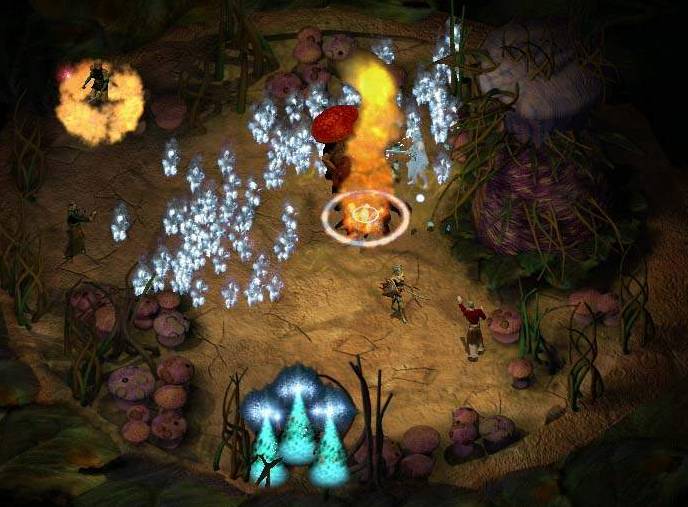
drunk, picking bar fights, everything. You can even go around town, killing every single person you see if you really want. But be warned: The game is realistic on that count as well. If you kill innocents, your Reputation quickly falls into the toilet and soldiers & bounty hunters will arrive to hunt you down. Still, if you're powerful enough, you can kill them too. There are really only 3 major things that you can't do in this game: Climb things (walls, cliffs, trees), set fire to things, and ride horses. For a good example of just how weird you can get, click the thumbnail.

The character you create is your Player Character, the PC. everyone else you meet is an NPC. The Realms are populated with a diverse array of people: Peasants, Noblemen, Flaming Fist Mercenaries, Beggars, Slaves, Courtesans, Merchants, Bartenders, Ruffians, Thieves, Amnish Bodyguards, Drunks, the works. Quite a lot of these people have names and personalities, and a tiny fraction of them will be willing to join your adventuring party. (I will refer to them as either 'party members' or 'recruitable NPCs,' depending on whether or not they're currently in your party.) These people are very important, because no one character, no matter how powerful, has all of the skills needed to do everything in the game. (It's true�some people do run Solo games, but they have to know the game inside & out if they hope to succeed.) Your party has
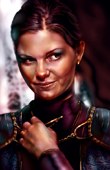
a maximum size of 6, meaning you can find up to 5 other people (such as the woman on the left) to join you on your crusade. A lot of the recruitable NPCs have their own agendas: If, when they join you, they tell you of some place they want to go, or something they want to do, you should probably do it fairly quickly, or the party members will get sick of you dragging your feet, and will leave your party, and you'll never see them�or the equipment you gave them�ever again. (Don't worry, you usually have a few days to accomplish the task, and the party member always reminds you that their task still needs doing�their way of saying, "Get a move on, stupid!") Party members will also desert you if the party's Reputation violently conflicts with their own personal Alignment: Good characters will not tolerate being Despised, and Evil characters seethe at working with someone Heroic. (Note: Your party members are
totally unaware of your alignment. Let's say you put together a party of 5 NPCs who are as close to Lawful Good as possible. It won't matter if you're playing a Lawful Good Paladin, a Neutral Evil Assassin, or a Chaotic Neutral Wild Mage�your party members will treat you exactly the same, reacting only to what you do or say, not what you think.) Also, certain party members harbor special grudges against other NPCs, and if you mix them in a party, fights are pretty much certain to break out. (This can usually be avoided by not having Good and Evil NPCs in the same party.) Reputation is also important when you kick a member out of the party: If they've been happy (or at least neutral) with the way you've been running the party, they'll stay right where you left them, waiting for you to come back so they can work with you again. If they've been complaining about your leadership decisions, chances are that as soon as you boot them, they'll wander off and vanish forever. There are also NPC "pairs," who don't want to be separated from each other: 2 early examples of these are Xzar & Montaron (partners in a super-secret organization), and Khalid & Jaheira (husband & wife). If you recruit or boot one, the other one follows.

As I said before, the PC represents you. If your other party members die in combat, you can usually take their equipment to the nearest Temple, where the priests will cast Raise Dead (for a suitable donation, of course) and restore your friend to life. When you die, however, you're just plain dead, and you must Reload from your last Save. (The PC's body cannot be brought back to life because there is no body: For some reason, your flesh dissolves into energy at the moment of death. This is a bizarre phenomenon, and you'll see it first-hand each time you die.) There are also certain spells that your party members can recover from, but the PC cannot. These are: Flesh to Stone (beware the Petrifying gaze of the Basilisk), Imprisonment, and, if you're playing Solo, Maze and I think one other spell, possibly Hold or Stun or Dire Charm.

The closest friend & ally you will have in this game is very close to you right now: The Space Bar. What does the Space Bar do? Pause and un-Pause. At ANY time, you can pause the game, issue separate instructions to each of your party members
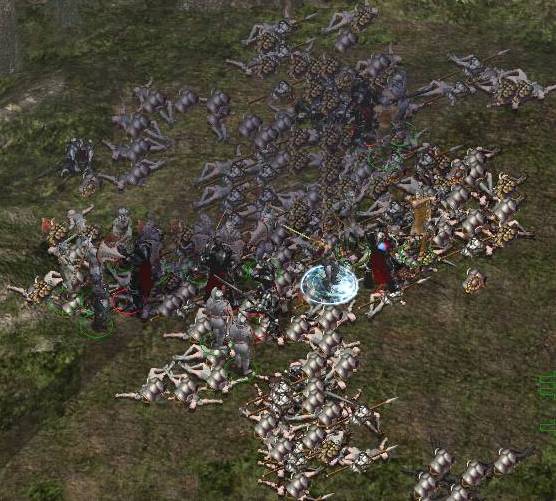
(and any Summoned/Charmed creatures), then resume the game and watch those instructions be carried out. This enables you to use all the tools at your disposal with surgical precision, even in the middle of a huge brawl (like the slaughter seen at right). This "instant-Pause" feature is so addictive that after a few hours of playing Baldur's Gate, you'll be fervently wishing you could do the same thing in all your other games. In BG1, the only thing you can't do while Paused is rummage through your Inventory screen, swapping out gear and passing out your stuff for other party members to carry. The designers Armor for Sale--Cheap. Slightly used. Various sizes and styles available.
made going to the Inventory screen automatically un-Pause the game, because it's not realistic to [Pause, take off your armor, put on a different set of armor, then swap out your Crossbow for a Sword & Shield and resume the game]�essentially going through a complete change of equipment in zero time, and in the middle of a fight. So the timer's always running in the Inventory screen, which is kind of disconcerting when you get up in the morning, start doing a complete reorganization of everybody's backpack, and by the time you're done, the sun is setting. In BG2, the game is still Paused in the Inventory screen, but you're not allowed to change your armor while you're within sight range of any enemy.

You're not going to beat the game with the first character you create, nor even with the tenth. You'll play for about 2 hours with your first character, then decide you really should have given him better stats. Your 2nd game will last for 6 hours, until you get sick of running around with only 3 Charisma. Your 3rd character will boldly go for 10 hours, at which point you find some really cool item or weapon that you wish you'd taken into account during Character Creation. Don't worry�the fact of
the matter is, every single one of those people you made is capable of beating the game; all you need is proper knowledge of strategies, equipment, and how to direct 6 people in battle.

You're also going to be Reloading a lot when you're just starting out, because your PC died or your party got its butt kicked in some battle and you want to try it again. This is because, when you're just starting out, all your party members are Level 1 or 2, meaning that none of you has any real
hitpoints. So, if anything happens, you die. To complicate matters, there's a hostile Mage very early in the game, and he's very difficult for a young party: He casts Mirror Image and Horror, and if he gets either of those spells off, he's almost guaranteed to stay alive long enough to kill at least one of your party members. Don't get discouraged when he kicks your sorry ass, just try something different. You may decide to go do something else, and come back later when you've gained a couple of levels.

Your journal is your friend: Important things that happen to you, such as starting or finishing a quest, or beginning a new chapter of the plot, will automatically be noted down in your Journal. This comes in very handy when you finally reach the city of Baldur's Gate itself, and you suddenly have subquests coming out of your ears. Go through your Journal and mentally check off the quests you've already completed�your sanity will thank you for it. In BG2, your Journal has separate sections for "Quests" and "Done Quests," to better help you keep track of what needs doing. You can also write notes to yourself in a third section, notes such as "Dumped a bunch of gear, including weapons, potions, ammo, and the Rynn Lanthorn in a bookcase in the back of the Copper Coronet." A note like that can rescue your whole game, because the Lanthorn is a plot-critical item: If you forget where you put it, you can't finish the game. You should also note down obstacles you are unable to overcome, such as a bad guy who's too tough to beat (maybe you can come back & hand him his ass later on) or a door that just will not open (maybe you'll find a key for it at some later stage in the game).

At the start of BG1, your map starts out almost completely blank. Your character knows the locations of the local cities & towns (these are marked in light brown), and the major roadways, but has never actually been there. To add new areas to your map, walk to the edge of the map you're on, and keep right on walkin'. Your cursor will change to a wagon wheel, which denotes Travel. Your character will walk off the edge of the map and peer off into the distance, resulting in a new visible area to explore. The game will automatically go to the Map screen, where the new area is marked in blue, meaning that you can go there, but you've never actually been there. Areas that you've already visited are marked in black. To travel from area to area, simply walk off the edge of the map, and then select your destination: Any map area marked in blue or black (it does not have to be adjacent to your current location).
The map of BG1 is keyed to the plot: Certain areas of the Sword Coast will not show up on your map (and you can't go anywhere unless it's on your map) until you have been to certain other areas, which will be inaccessible to you until you've completed this other task, etc, etc. This is to force you to follow the plot, which is actually pretty cool. This is not to say that the game locks you into a linear sequence of events: Anything but. Yes, the Main Plot is strictly linear, but the huge array of subquests (some of which are difficult to distinguish from the Main Plot) and various regions to explore are more than enough to get you really confused about which quests you still have to finish, and when, and to get you completely lost in the process.
ToSC is meant to be played concurrently with BG1: It's not part of the Main Plot, but instead adds new map areas that may be visited at any time during BG1. Tech Note: If you install ToSC in the middle of a game of BG1, the new ToSC areas cannot be placed on your map, until you run the program called MCONVERT in your Baldur's Gate directory. This updates the map for your current game, and for all future games.

The map for BG2 is even more open: You start the game underground, but almost as soon as you emerge into open air, you can go practically anywhere in the game. All you have to do is talk to people (Most of them will even come up & do the talking for you), and they will draw new areas to visit on your map. Only about 15% of the map (the map areas that are directly related to the Main Plot), is off limits to you near the start of the game. Be aware that the game adjusts itself to suit you: When entering a new area, the game looks at your PC's Experience Level (either that, or the average level of your party) and uses it to determine the difficulty of the monsters you'll be facing. An average player entering an area loaded with Undead may find himself facing Greater Mummies�while, if he had visited earlier, he'd be fighting Mummies or Skeleton Warriors, and if he'd saved that area until later, he might find Bone Golems or Liches.
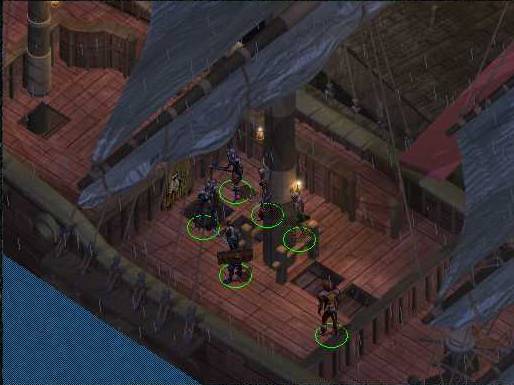
Just sit right back and and hear a tale, a tale of a fateful trip, that started in this tropic port, aboard this tiny ship... ToB is not meant to be played concurrently with BG2: It does not begin until you've beaten BG2:SoA. (SoA is the abbreviation for Shadows of Amn, which I will use to refer to BG2 itself, before/without ToB.) Once you start ToB, you will be unable to go back & visit the map areas from SoA, so be sure to wrap up any important unfinished quests (and collect any valuable goodies) before proceeding to the final showdown. Plot-wise, ToB is a disappointment: The map is almost directly linear, with only 2 choices for you to make: At one point, you'll get to decide which of 2 map
areas you wish to visit first, and the massive dungeon of Watcher's Keep can be accessed at almost any time (even during SoA, which is a nice twist).


There's only one thing I really don't like about the Baldur's Gate series....before I played BG, I played Diablo. What made Diablo so much fun after so many games is that each time you played, the dungeon was randomly generated, and you never knew what types of enemies you were going to be facing, what unique monsters you might run into, or what kinds of loot you might find. With Baldur's Gate, even though the game is almost constantly rolling dice, there is very little randomness (of the Diablo variety) at all. The maps are always exactly the same, with exactly the same people in them, who always have exactly the same stuff. True, the loot dropped by your run-of-the-mill monster is randomized, but only to some extent: A Hobgoblin will always drop a Helmet, Leather Armor, a Short Bow and the Arrows to go with it, a Bastard Sword, and one other random item, usually a low-level Gem or maybe even a spell scroll. That's about as random as it gets. Sorry, but there it is. It wouldn't have hurt BioWare to have taken a page or two from Blizzard's book, and thrown more randomness in there�they could have randomized the number of allies the bad guys have nearby, or the magical loot that they drop, or something�at least move the Traps around, for Pete's sake.
Hosted by www.Geocities.ws

1