There were only small aggravations on the rest of the trip (as opposed to the large aggravation of leaving the other suitcase). The pin in the nose wheel broke, as we were being pushed back from the gate at Heathrow, and we sat for an hour waiting for another one. In Nairobi, they told me I couldn't go through customs to switch my bag, that airline personnel would have to transfer it, so I pictured arriving at Dar-es-Salaam with no suitcases. I went back to the #@&% Airlines desk, where I was ignored for an hour. When everyone else, who was going to Addis Ababa or Entebbe before my plane left, had been served, I was told to go find the British Airways representative. Luckily, she happened to be standing at the other end of the counter, and was really nice. She gave me a pass to the First Class Lounge, where I just slept on a couch, and found my bag and carried it to the next plane. It was only an hour and a half late for departure, so Dr.G., who was to pick me up at Dar es Salaam, waited a long time.
I have three other roommates right now. We live in a big house, about eight miles from town. The roads are horrible, so it just seems like far. Big potholes. Some roads paved; some not. We have a 4-wheel drive, but the radiator is going out. It has already been welded four times, and they are trying to find a new one at a reasonable price.
What I have done so far includes: Afternoon Clinic-A man with HIV and huge swollen glands for 4 years. Dr.G. thinks he should get radiation, but suspects they must not not willing to do it, as no one has given it to him yet. He is trying to talk him into a biopsy, although probably no one here can do the desired tests on the tissue. There were two kids, 10 months and 5 years, with AIDS, with not much to be done for them. There is no pediatric infection clinic here, so they all come to the adult clinic. There were other people with tiredness and diarrhea from AIDS. The clinic was real interesting, but it seems like the people usually get fungus medicine, or stomach medicine, or maybe an antibiotic for whatever problem there is. Thursday-I went to the ward to see if any of the new patients from the day before could be included in the pneumonia study. There were five and the doctor in charge of the study was busy getting the papers filled out and examining them. Friday-We did three bronchoscopies on patients enrolled the week before. It will be good to know more Swahili. There are several nurses that help.
Mary and I ran on the beach Thursday and Friday morning. The tide is high right now, so the sand is either soft or covered in seaweed, but it is like soft pine needles, and not bad to run on. There are a lot of fishermen who camp on the beach. It was crowded Thursday, but Friday they were away.
Yesterday, we did some errands, and went to the post office for stamps and envelopes. 'Kwa Ndege' on front of the Air Mail envelope translates to 'By Bird' (or plane, but I like bird better). We also went to the market to get food for the next week. Our cook, Gordon, fixes supper for us during the week. On the weekend, it seems everyone just fixes peanut butter and jelly, so I hope he doesn't get sick. There are four other people who work at the house: a gardener, two night watchmen, and a housekeeper. We each pay $10/week for all these people to work here.
At the hospital, patients are all in one open ward (20-30 beds), with mats on the floor if all the beds are full. There are about 16 medical floors and about 8 surgical floors and separate TB, leprosy, and pediatrics buildings that I know of so far. Next week I will spend more time on the floor, so I will know more about what kind of patients there are.
There are a lot of things that remind me of Arabia. Water and sugar come from the Emirates. There are cattle, and goats, and chickens loose all over, but I haven't seen a camel yet. There is a monkey that sits in bushes across the street, though.
These are letters I sent my sister from Dar es Salaam, Tanzania, between January and June, 1992. (Email didn't exist.) These letters show how one reacts to seeing new things, and to doing without things often taken for granted. Sometimes, I used the letters to vent frustrations. Some episodes are probably less interesting. Small portions have been omitted, and some people's names have been changed. Explanatory comments that I have inserted are in this typeface. I was living in a house provided by the International Health Program of Duke University. Please email any questions or comments.
Tanzania is a republic on the East coast of Africa. The largest city is Dar-Es-Salaam, with over 2 million people. Kiwahili is the official language, but many people speak English, and there are many tribal languages. Most people live in the countryside. Agriculture, mining, and textiles are the most important industries. Per capita income is very low, but primary education is strongly supported, and literacy is 68%. Zanzibar Island, Mt. Kilimanjaro, Serengeti Game Park, and Ngorogoro Crater are some tourist destinations in Tanzania.
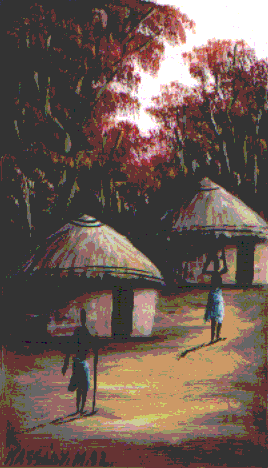
The artwork is by Tanzanian artists. Many of the graphics come from cards from Nyumba Ya Sanaa. The Tingatinga paintings are from Hadithi na visa kutoka Tanzania by Birthe and Jesper Kirknæes copyright 1988. The people of Tanzania accomplish miracles, with hard work and very few resources. I thank them for their hospitality.