தொல்காப்பியம் |
TolkappiyamFollowings are extracts and scanned pages given for reference purposes. |
| During discussions, debates and requests it is
often asked to provide evidence in the form of scanned images.
Especially Unicode consortium requires the scanned images to avoid controversies. Even though this practice will definitely shut the human development process, especially of Tamil with it's scientific based scalable writing system, I thought it is advisable to get along with this restrictive system rather than not getting anything done. So it follows
Scanned Pages with pointed explanations.
|
Elongating Vowels (Longer than Long vowels)
There are 30 Alphabet in Tamil
Aytham occuring at the end of a word
Also view functions and occurences of Aytham. eg1, eg2
Near voice-less I and Near voice-less I :
Short Vowels, Long Vowels, Elongating Vowel (longer than long vowel)
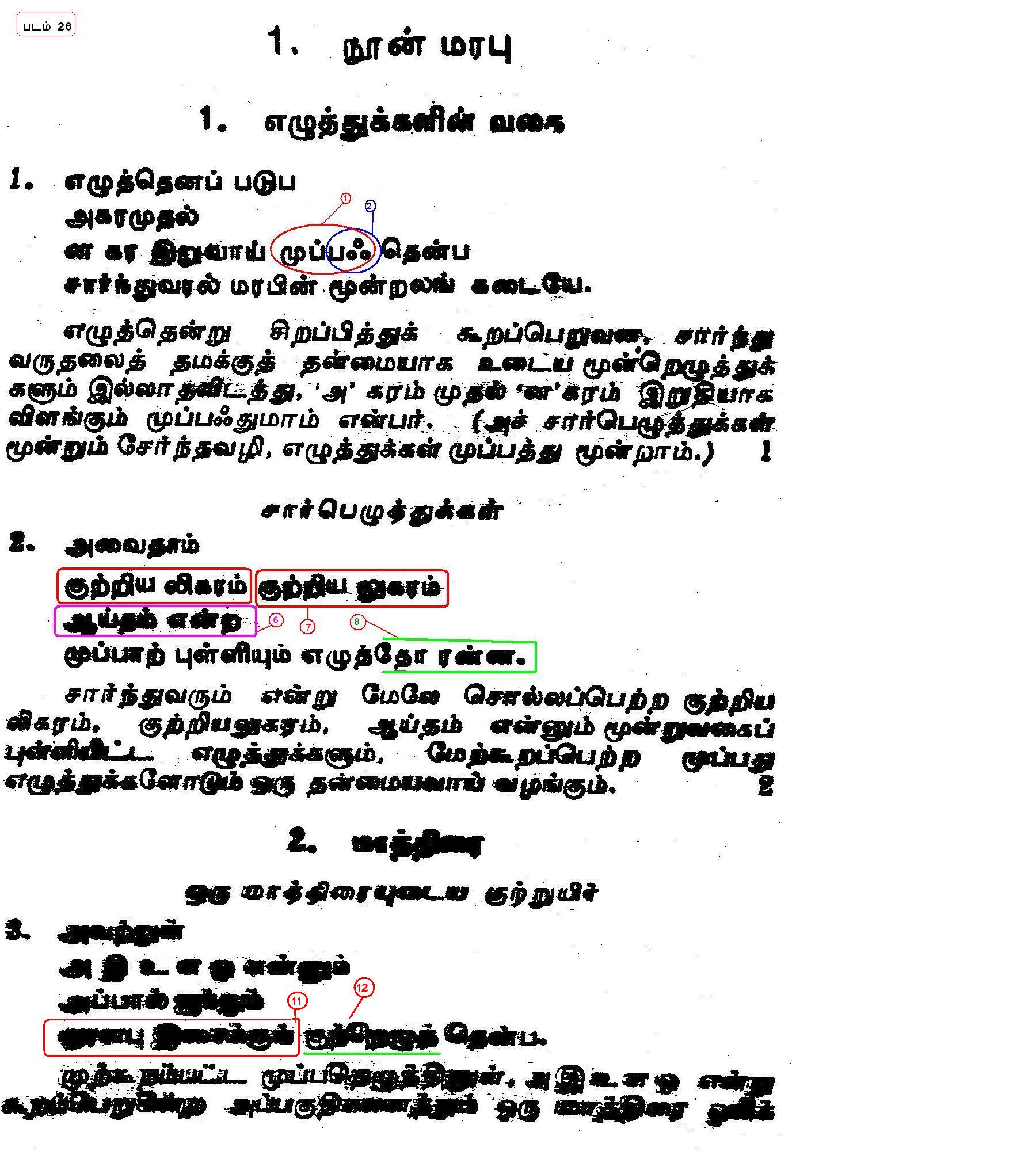
Item 1.1.1 below defines 30 alphabet, and 3 relational alphabet. In the 30 alphabet 12 are vowels (souls) and 18 are consonants (living-body).
The circled 1, proves a practice that Aytham can also take position at end of a word.
Near voice-less i, near voice-less U and Aytham/Glotaliser (aspirates, aH, kH, Ha, Hk, khhk, kQ, Qk, etc..). Near voice-less i and u is used to express true representation of consonant clusters. example, there is no such think as PR or BR cluster, but PiR as in PiRoud, and BuRook where traces of i and u are active. Item marked with circled 7 indicates the definition of near voice-less u.
==============================================================
Squared 4 below indicates the rule about long vowels
Squared 5 below indicates the rule that dis allows the creation of separate characters for longer than long (elongated) vowels
Squared 6 below indicates the rule that defines how to write elongated (longer than long) vowels. It states accumulate/add the approbriate vowels to elongate the timing/mathrai.
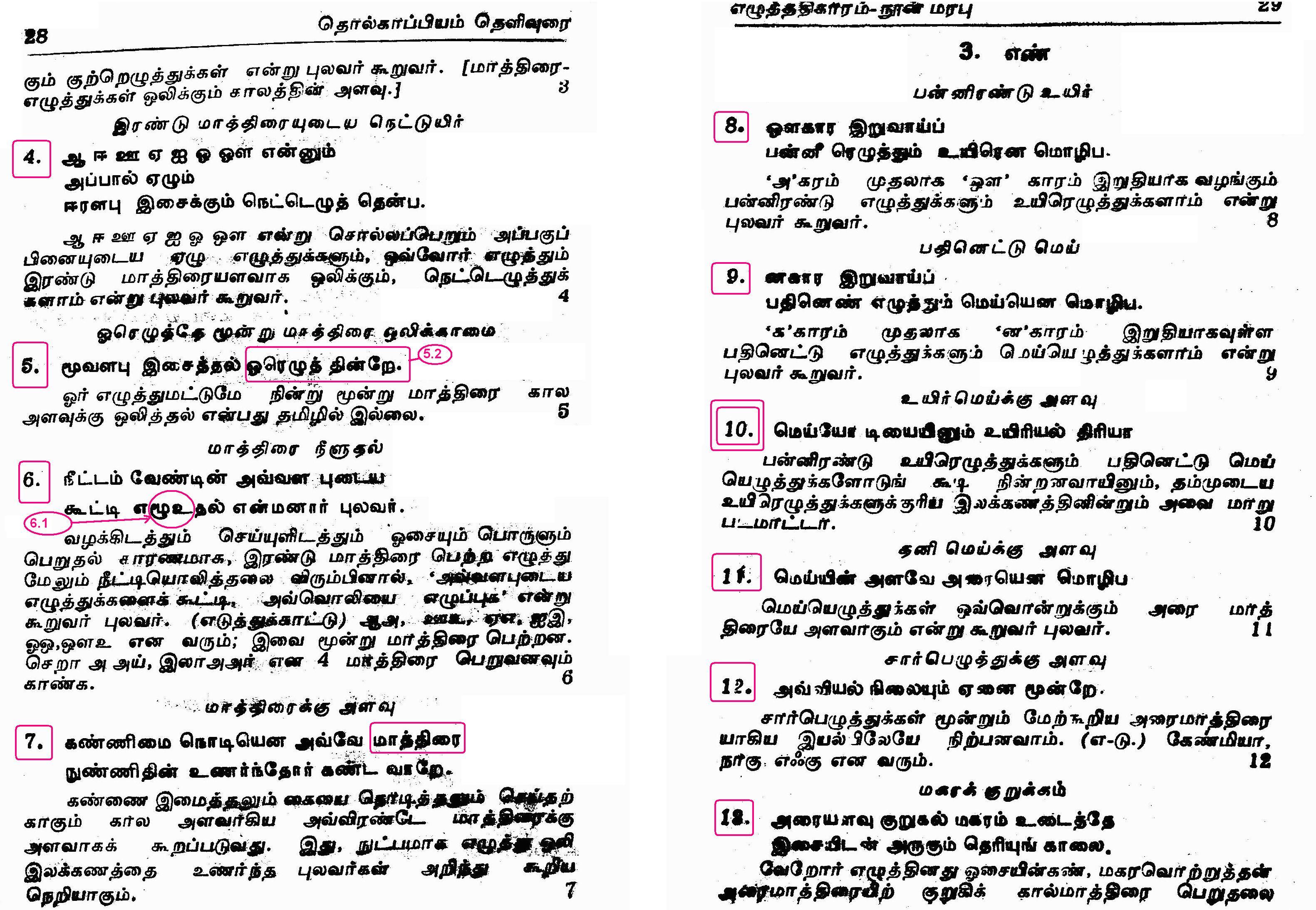
See 6.1 above for sample usage of longer than long (elongated) vowels.
It is also very important to note that necessary machinary, type faces and other supplies for printing facilities in India in those days were maintained by european businesses, those european businesses declined to cater for longer than long vowels of indipendent type, because it was unacceptable additional cost for them and also other Indic languages did not use it. Because of this a twisted (eg, வரூஉம் ) standard was set for Tamil to use the independent vowel characters instead of using dependent (eg, வரூும்)vowel characters during the early days of printing. This had eventualy became the temporary standard to the extent that even some of Tamils are unable to distinguish the combining nature (puNar) pronounciation and split form of pronounciation. (ie, வரூஉம் splitsup at third mathrai, while all three mathrais are combined and continuous in வரூும்). As Unicode is capable of providing this facility (by removing the ristrictions placed by dotted circle) we should be able to use the ancient , scientific and thoughtfull sytem and remove the use of independent vowels for longer than long vowel representation by letting it to wither. ie, Go back to basics.