Department
of Physics
Faculty of Mathematics
and Science
State University
of Jakarta
INDONESIA
Jalan
Pemuda No.10 Rawamangun Jakarta Timur Indonesia, Telp: +62 -21- 4894909
e-mail:
[email protected]

Research
Report
by
Siswoyo
[email protected]
Students'
Attitude and Conception about Science:
A Comparison
of Fukuoka University of Education (FUE) Japan
and State University
of Jakarta (UNJ) Indonesia
PART
I
INTRODUCTION
A.
Background
Much of the national attention
has focused on science, mathematics, and technology/vocational education.
(Dennis W. Cheek, 1992). Japan has generally taken a "catch-up" approach
to science and technology. According to the Fundamental Law of Education
of Japan 1947 (Law No. 25), education shall aim at the full development
of personality, striving for the rearing of people, sound in mind and body,
who shall love truth and justice, esteem individual value, respect labors,
have a deep sense of responsibility, and be imbued with an independent
spirit, as builders of the peaceful state and society. The aims of education
shall be realized on all occasions and in all places. In order to achieve
the aim, Japan shall endeavors to contribute to the creation and development
of culture by mutual esteem and co-operation, respecting academic freedom,
having a regard for actual life and cultivating a spontaneous spirit (Education
in Japan: A graphic Presentation 1994, Ministry of Education, Science,
Sport and Culture (Monbusho)
While, according to the Constitution
of Indonesia, the national education system has its roots in the Indonesian
culture. The system-based on Pancasila, the 1945 State Constitution, and
the Law No. 2/1989 about National Education System aims to generate abilities
and to increase the standard of living and dignity of the Indonesian people
in order to achieve the national development objectives. According to Law
No. 2/1989, the national education system is identified in terms of units,
paths, types, and levels of education.
Both Japan and Indonesia
established their national education curriculum in accordance with of the
spirit of their constitution. Japan and Indonesia have different policy
and reform in education system and science education reform. Japanese Government
Policies are priorities and prospects for a Lifelong Learning Society,
increasing diversification and, sophistication. In Indonesia general education
prioritizes expansion of general knowledge and improvement of skills for
the students. Vocational education prepares students in mastering a number
of specific vocational skills needed for employment.
Universities in Japan and
also in Indonesia mandated to apply the results in systematic education
to develop future generations of human resources. Through undergraduate
and other programs, universities produce people with general educational
attainments and specialized abilities that enable them to contribute to
society. In graduate schools, affiliated research institutes, and other
facilities, universities train young researchers to further the progress
of scientific research.
Universities are also urged
to expand cooperation with industry with respect to research and human
resource development. At the same time, universities must fulfill their
basic role in training and educating future generations. Scientific research
that refers to the creative intellectual activity in all fields of the
humanities and social and natural sciences are takes important place in
universities and their affiliated research institutes. Scientific research
is the advanced, intellectual pursuit of truth by researchers driven by
the desire to attain a systematic, comprehensive understanding of humanity,
society, and nature. Thus respect for researchers' autonomy and freedom
of thought is absolutely vital, so scientific research is conducted mainly
in universities, where this requirement can best be met.
Research in cooperation between
Fukuoka University of Education Japan with an institute of education in
Indonesia on science, mathematics, technology and vocational education
system were important to providing useful the understanding about educational
system both countries. For Fukuoka University of Education (FUE) Japan
and State University of Jakarta (UNJ) Indonesia it was a need to cooperate
in research program and to develop human resources both Universities. We
need to improve the students attitude and conception about science. Fraser
(1982) suggests to science educators who wish to improve their students
achievement to deal directly with the subject matter rather than putting
emphasis upon attitudes. We need more view that cognitive and affective
domain should be address for social attitudinal reason. Related with the
student’s achievement and students attitude toward science it is impotent
to conduct the researches about students conception and attitude toward
science.
B.
Statement of Problem
1. How do FUE students attitude
toward science?
2. How do FUE students conception
about science?
3. How do UNJ students attitude
toward science?
4. How do UNJ students conception
about science?
C.
Aims of Research:
1. Collect information about
FUE and UNJ students' attitude toward science
2. Collect information about
FUE and UNJ students' conception about science
3. Compare student’s attitude
toward science between FUE students and UNJ Students
4. Compare student’s conception
about science between FUE students and UNJ students.
D.
Purpose of Research
The purpose of Research
is to develop the cooperation between Fukuoka University of Education (FUE)
Japan and State University of Jakarta (UNJ) Indonesia in way to improve
the understanding about both Universities Curriculums. For both university
it is important to share both curriculum policies and develop cooperation
to make advance research to improve science processes teaching.
PART II
THEORYTICAL FRAMEWORK
A.
Attitude
Attitude is defined as an
affective reaction (e.g. like/dislike, enjoy/not enjoy) to an object or
stimuli, in case of this research is science. Attitude is also defined
as perceptual orientation and response readiness in relation to a particular
object or class of object (Eysenck and Arnold, 1972). Some qualification
must be added however: (a) Attitude must show reasonability enduring, thus
distinguishing them from sets and expectation, which normally refer to
more temporary states of readiness. (b) Attitude must show variation between
individuals and between cultures, i.e. they related to issue upon which
people which people disagree. (c) Possibly the most important distinguishing
feature of attitudes is that they are necessary evaluative or affective.
(d) The attitude concept in psychology has the scientific status of a hypothetical
construct.
1.
Attitude Components
Attitudes are complicated
mixtures of some basic psychological processes. Attitudes consist of three
components: cognitive component, affective component and motivational component
a) Cognitive Component
This component commonly
called beliefs or knowledge structure about object and events. Some beliefs
are based in fact about many beliefs are false: the belief that spaces
are unlimited is true, and belief that atom cannot separate into small
piece is false.
b) Affective Component
Although students obtained
a good grade in science class, we still need more information about students
affective component of their attitude toward science. Sometimes, in fact
the affective component is primary. This is especially clean in the case
of attitude formed early, such as student interest to science before they
know much about science in class.
c) Motivational Component
Attitude is also linked
to an object’s importance to us. If student know in the future most of
job will require knowledge of science, they motivated to be a science teacher
or to be scientists or researcher in science laboratory.
2.
Attitude Change
From a social-psychological
viewpoint, an attitude is a dependent variable of a process of social influence.
The independent variables conditioning it are elements of a communication
process: source variables, message variables, channel variable, received
variable and destination variables. The more adequately these variables,
and in particular their general mode of operation as well as their significance
for a specific situation, are known, the easier it is to predict the direction
and degree of a change of attitude.
Attitude change as
dependent quantity is regarded as a stochastic process in which the individual
(the recipient) has to pass in turn through the stages of attention, comprehension,
yielding, retention, and action if the communication process is to effect
a change in attitude.
B.
Some Science Concepts Related to the Topics
1.
Force and acceleration
Force and acceleration are
related. Acceleration also involves a direction because the definition
of acceleration involves velocity which has a direction associated with
it. Force has a direction, namely the direction in which it is applied.
The direction in which the force is applied is also the direction in which
the object accelerates.
The object should accelerate
in the direction in which the force is applied. Therefore, a force causes
an object to change its velocity. When the force is in the same direction
as the velocity, the object will speed up in the same direction as the
velocity. An object speeds up in the direction of its velocity when the
direction of its acceleration and its velocity are the same. Alternatively,
one could say that, when the direction of acceleration is the same as the
direction of an object's velocity, the object will "accelerate". This obviously
follows from the first conclusion because we know that the direction of
the force and acceleration are the same.
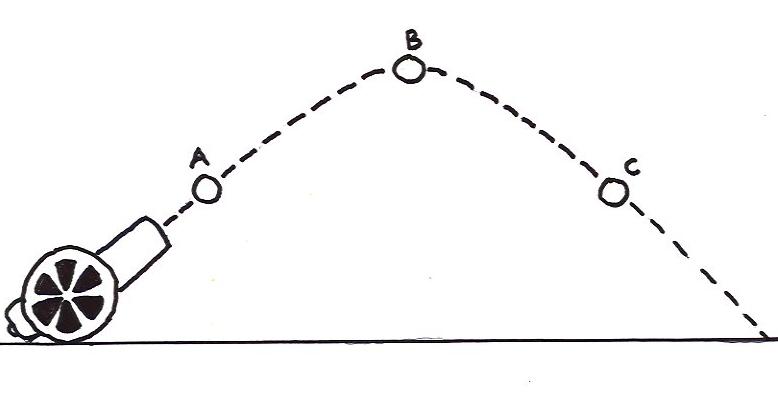 The ball thrown upward from
the cannon. The explanation the phenomena above are:
The ball thrown upward from
the cannon. The explanation the phenomena above are:
A. This is the initial position
of the ball at t = 0 seconds. After a second, the ball has slowed down
while moving up from its initial position. The ball is still moving upward
because its velocity is positive.
B. After b seconds, the
ball has slowed down to 0 m/sec. The ball is momentarily at rest only at
this exact time. This corresponds to the peak because it is the highest
point the ball reaches. After this point, the ball will begin to move downward
and speed up.
C. After c seconds, the
ball is moving downward while speeding up. It will continue to move downward
while speeding up. The ball is moving downward because the velocity is
negative. The ball is still above the origin (which we have chosen to be
its initial position in this case) because the position is still positive.
In the next, the ball has returned to its initial position. However, it
is now traveling downward instead of upward. Notice that the speed is the
same as when the ball was initially thrown upward. However, the velocity
is different because the ball is now traveling downward, while it was traveling
upward initially.
2.
Light
The sun, the stars, lamps
even lightning bugs give off light. They are called luminous bodies (from
the Latin word lumen meaning light). Other object such as stones, trees,
moon are non-luminous. They are visible only when they receive light from
some luminous source and reflect it to our eyes.
Careful observation shows
that the light from candle flames comes from many small, hot particle of
carbon heated by the burning gases from the candle wax. Thus the flame
is another incandescent source of light. Many of carbon particles are not
completely burned in an ordinary flame. They cool off as they carried above
the flame by the air, become non luminous, and make up the part of the
rising smoke.
Whether a body is luminous
or non-luminous depend as much its condition as on the material of which
it is made. Electric light bulbs give of light as long as electric current
passed through them.
Light is emitted from luminous-bodies
travel through space in straight line, carries energy, and is absorbed.
Any model of light must include something that has these properties. The
simplest thing that we can imagine having these properties is a particle.
We imagine that a luminous body gives off a stream of light particle called
photons.
When we illuminate
a piece of paper with a small bulb, the intensity off illumination will
increase as we bring the bulb closer to the paper. What does the particle
model of light predict for the qualitative relation between intensity of
illumination and distance from a small light source? To answer this question
we make two assumptions: (1) the intensity of illumination is directly
proportional to the number of light particles or photon hitting a unit
area per unit time; (2) no photons are lost as they travel.
The basic principle of the
received model for vision and imaging
1. The phenomena of sight
crucially upon the axiom that light travels in straight lines (in a homogeneous
medium), but that the speed of this propagation is so great to be imperceptible,
and is effectively instantaneous.
2. The geometry of light
is important, but the direction of motion is not: the path of a ray from
object to eye is identical with the line of sight from eye to object. The
latter may be more convenient for some purpose, for example. When considering
the angle subtended by an object, and the effect of this on perspective.
3. In optical diagram, straight
lines, with or without arrows show rays. These rays are not to be confused
with visible beams of light, as can be produced by the unfortunately named
ray box
4. Although light leaving
a source (or an illuminated object) can and does take an infinite number
of different directions, only a small numbers (usually one or two) of these
ray will be shown on a ray diagram.
4.
Pressure
Objects submerged at rest
in a fluid are subject to pressure forces from the fluid. The more deeply
submerged the object is, the greater the force. The net force, or buoyant
force, point in the upward/toward the surface direction and acts through
the center of gravity of the object, also known as the center of buoyancy.
Since the object is nonspecific, it is helpful to take an object of a given
size composed of the fluid material. Then, since the object is at rest,
the buoyant force must be equal in magnitude to the weight of the fluid
displace by the object. This is known as Archimedes Principles.
5.
Heat Engine and Combustion
Engines change heat energy
into mechanical energy to do work. Gasoline engines and diesel engines
are examples of engines that do work. Each engine uses the heat from a
burning fuel to?produce hot gases. Gasoline and diesel engines are called
internal combustion engines. Most gasoline engines burn gasoline vapor
in the presence of oxygen inside cylinders. Gasoline is vaporized and mixed
with air in the carburetor. From carburetor, the gasoline and air mixture
is sent to the cylinders. The mixture enters a cylinder through an intake
valve.
Each cylinder has a piston
that moves up the cylinder compressing the gasoline and air. When the piston
reaches the top of the cylinder, the spark plug produce air electric spark
that ignites the fuel producing air explosion of hot gases. The gases push
again the piston, forcing it to move down. As the piston moves the cylinder
again, it pushes the gases out through the exhaust valve. When the piston
moves down again, more gasoline and air enter the cylinder. In the compression
stroke, the air is compressed to a higher pressure than in a gasoline engine.
The pressure makes the air extremely hot. At the end of the compression
stroke, the fuel is injected into the compressed air. In stead the air
is hot enough for mixture to exposed and push the piston out. The cycle
is completed with the exhaust stroke.
The energy produced in the
engine is transferred to the wheels of the car through a series of shafts
and gears. Gasoline and diesel engines waste most of the energy that they
produce. Only about 12 % of the energy in the fuel burned by a gasoline
engine is used for power. Although a diesel engine is heavier than a gasoline
engine it can get about 25 % better gas mileage.
Much of the heat energy
of fuel is released through the exhaust pipes. Some of the exhaust is unburned
hydrocarbons. Other exhaust gases are CO2, CO, NO, and NO2. The wasted
from gasoline and diesel engines are sources of pollution.
C.
Students' understanding of scientific concepts
It is well know about student
understanding of number of concepts that are important in the teaching
of physics, such as force, mass, energy and light. These understanding
are resistant to change, have much in common in different part of the word
are often at odds with the views promoted in school physics.
They are known by a variety
of names, e.g. alternative conceptions, alternative frame works, students
science, and there are several book that present and interpret the research
finding in ways that teacher are likely to find accessible.?It is a common
place to assert that these understanding are constructed by the active
engagement of the mind of learner with natural phenomena within a range
of social contexts.
The task of the teacher is
seen as of eliciting students alternative conception and their providing
the range of experiment necessary to allow student to amend, refine or
abandon these conception in favor of a scientific understanding of natural
phenomena.
Driver et al (1985, 1994)
have sketched the understandings of concepts such as light, electricity,
head and temperature, gravity, the particulate nature of matter and the
gaseous state, which students bring to science lesson and indicated how
these change and develop.
It is possible to engage
the minds of learner by wide variety of teaching strategies, some of which
might be described as formal and didactic, rather than informal and exploratory.
Indeed, selecting a strategy that is more, rather than less, likely to
interest student and promote their learning is central to a teacher professional
competence.
Answering a question about
heat transfer in a physics examination may demand and understanding of
heat in terms of molecular motion.
D.
Research are related
Teachers with a positive
attitude toward science like to teach science and students taught by them
will have positive attitude toward science. Also, teacher with negative
or neutral attitude toward science may transmit that attitude to their
student (Shrigley 1974). To Nurture a positive attitude toward science
is important; however, the factor that effect a pre service teacher’s attitude
toward science still are not clearly known. Certain studies have state
that attitude toward science has nothing to do with the number of science
credits earned by respondent.
Gable (1981) mentioned that
more science course taken might have positive effects on students attitude
toward science. However studies have revealed a moderate correlation between
cognitive development and science achievement, no evidence can be shown
to support the cause and effect relationship between cognitive development
and science achievement.
Related with the science
concepts, research notes the confusion between vector and scalar or force
and velocity or force and pressure, the way in which the terms were applied
to speed, velocity and acceleration. According to the studies in Mechanics
Learning by Orton (1985), Newtons' Laws produce many misconceptions.
Many of which research found based on the conscious or unconscious rejection
of the precept of the First Law, that force cause change in motion, in
favor of the common senses notion that force is needed to cause motion.
Some ideas of students about
force and motion considered a force to be something that is in a body,
acting in the direction of motion. A physicist considers a force acts on
a body causing changes in motion; force can be acting in a direction opposite
to that of the motion. Many children associate friction only with motion
and do not consider frictional force exist if two surfaces are not moving
relative to each other. To a physicist frictional force can exist in these
stationary situations.
To many children, and to
scientists, light travels away from a source. However, to children, how
far it travels is considered to depend on how far from the source the visible
effect of the can be observed, e.g. does it appear to illuminate a wall?
Hence many children consider light from a candle travel only about a foot
in daylight but travel further in the dark. To a physicist the light continues
in a straight line until it is absorbed or reflected by some object.
PART
III
RESEARCH METHODOLOGY
A.
Description of Subject Research
1.
FUE Students
Students of Fukuoka University
of Education came from Fukuoka Prefecture and another prefecture around
Kyushu Island such as Nagasaki, Kumamoto, Miyazaki, Saga, Oita, and Honshu
Island such as Yamaguchi prefecture. Science students must studies various
courses are offered in areas such as physics, chemistry, biology, earth
science and astronomy, and science education, with the aim of training
students to be elementary school and junior and senior high school teachers.
All of respondents have completed the study the basic concept of physics,
chemistry, biology and mathematics.
2.
UNJ Students
Students of State University
of Jakarta or Universitas Negeri Jakarta came from Jakarta and another
city around Jakarta called Jabotabek (Jakarta, Bogor, Tangerang, Bekasi).
They also come from another province in Java such as West Java, Central
Java, East Java, and Sumatra Island. They graduated from Senior High School.
In the first year, the students of Faculty of Mathematics and Science should
be completed the study the basic concept of physics, chemistry, biology
and mathematics.
B.
Data Collection
Data were collected from
two faculties of science of two universities Fukuoka University of Education
(FUE) Japan and State University of Jakarta (UNJ) Indonesia. Numbers of
students was participating as samples 207 students of Fukuoka University
of Education and 257 students of State University of Jakarta. Data were
collected under authority of university teachers. Participant university
student in the two universities were comparable with grade level. Several
data source were used to answer the questions of interest. These source,
however, were limited to questionnaires and science that could be collected
and analyzed.
The questionnaires and attitudes
scales were asked to complete the information. Procedures of data collection
are:
First, questionnaires are
available in tree languages English, Japanese, and Bahasa Indonesia. Data
collection in Fukuoka University of Education Japan is use instrument in
Japanese language. Data collection in State University of Jakarta (Indonesia)
is use instrument in Bahasa Indonesia.
Second, most of data were
collected in science class. Students answer the questionnaire and attitude
scale under supervises by teacher. Sometime teacher supervises the students
to answer the questionnaire and attitudes scales in his room. Time consumes
to answer the questionnaire and attitude scales are about 20-30 minutes.
C.
Instrument of Research
1.
Attitudes Scales
Two instruments have been
developed in this research. First is Student Attitude toward Science Scale
(SASS). This instrument developed by modifying the original Menis Instrument.
Student Attitudes toward Science Scale (SASS) made into two languages are
Japanese Language and Indonesia Language. SASS consists of 23 items concerned
with the importance of science, science as a career and science as subject
in the school curriculum.
1. Science is
useful for solving the problem of everyday life
2. Science has
ruined the environment
3. Science is
very important for a country's development
4. The money
spent on science is useful.
5. Scientific
inventions and discovery improve our standard of living
6. Science will
help to make the world a better place in the future
7. Much of the
anxiety in modern society is due to science
8. Scientific
invention and discovery is bad more often than being good.
9. Science and
technology are the cause of many of the world problems
10. Scientific inventions
has increased tensions between people
11. Working in a science
Laboratory (for example, in such cases as
the electric power company and the medicine manufacture company)
would be an interesting way to earn a living
12. In the future most of
jobs will require knowledge of science.
13. The people who understand
science are better off in our society
14. In my future career,
I would like to use the science I learned in school
15. It is important to know
science in order to get a good job
16. I would like to become
a science teacher
17. Science is an enjoyable
school subject
18. The science taught in
school is interesting
19. Science is difficult
subject
20. Science is difficult
when it involves calculating
21. Science is difficult
when it involves handling apparatus
22. There are too many facts
to learn in science
23. Science is relevant
to everyday life
2.
Student Conception about Science
The Second instrument is
Student Conception about Science (SCS). This instrument developed by extracting
some ideas from authors teaching experience in school and university and
refers some idea about misconception in physics or science journal. SCS
are consist of some concept of physics and science such as gravitation
force, parabolic line, light, water pressure, combustion. This instrument
consists of 9 questions and each question required student to described
the reason they answer. There were 4 options available, and one option
was the right answer and the others were distracters. SCS is not only to
assess right or wrong answers but the most important thing is the student
reason about their answer.
D.
Data Analysis
The analysis of the questionnaire
included frequency distribution, means and standard deviation, t-test and
graph analysis. T-test was used to compare students attitude to toward
science between UNJ students and FUE students. Each respondent is asked
to rate each item on some response scale. For instance, they could rate
each item on a 1-to-5 response scale where: 1 = Strongly disagree; 2 =
Disagree; 3 = Undecided; 4 = Agree; 5 = Strongly agree.
All of these odd-numbered
scales have a middle value is often labeled Neutral or Undecided. It is
also possible to use a forced-choice response scale with an even number
of responses and no middle neutral or undecided choice. In this situation,
the respondent is forced to decide whether they tendencies more towards
agree or disagree end of the scale for each item.
The final score for the respondent
on the scale is the sum of their ratings for all of the items (this is
why this is sometimes called a "summated" scale). On some scales, several
items have reversed in meaning from the overall direction of the scale.
These are called reversal items. We need to reverse the response value
for each of these items before summing for the total.
The written responses to
the science question were analyzed and classified into categories that
described the students�Ereason to the question asked (total of science
questions are 9).
PART IV
RESEARCH RESULT
AND DISCUSSION
A.
Description of Data Analysis
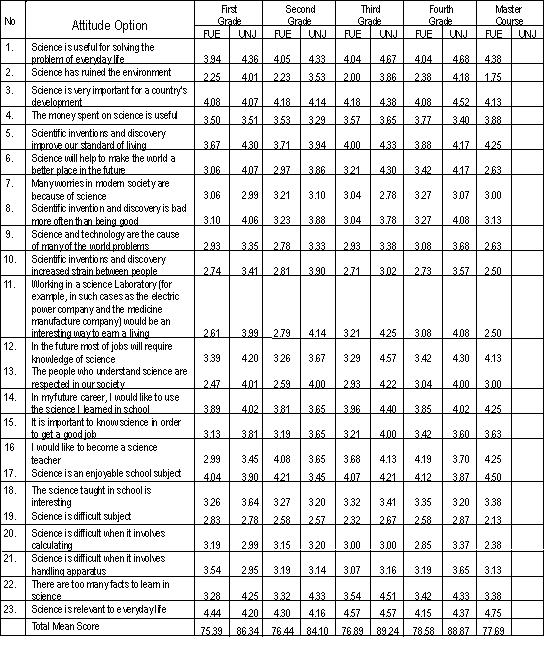
Data have been described
into two main sections i.e. the description of student' s attitude toward
science and students' responses to science questions.
1.
Description of students' attitudes toward science
Table 1: Mean score of students'
attitude toward science
2.
Description of students' response to the science questions
a)
Students' Correct Answer on Question No.1, 2, and 3.
Description of students'
responses to question 1,2,3 which asked the students to determine force
direction of the ball while moving as projectile motion (parabolic line).
The question is which direction of force of the ball at A, B, and C position?
The correct answers of question
1,2, and 3 are the same i.e. the direction of force of the ball is downward.
Number of students responded these question correctly (%) were various
and it out lined in figure 1:
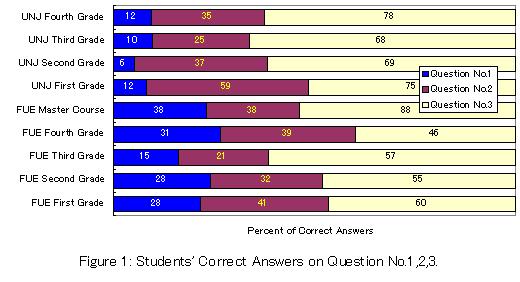
Students' responses both
FUE and UNJ Students to question 1,2 and 3 were various. They have taken
many mistakes to determine the correct answer to these questions. Answering
question number 1, UNJ students were bad more than FUE students.
Answering question number 2 and 3 both UNJ and FUE students' responses
were quit similar. Some students attributed this to a force from cannon
as follow.
-
Force is caused by push of cannon
throwing it upwards
-
Because the force is overcoming
the gravitational force
-
The direction in which the force
as applied is also the direction in which the object accelerates
-
There is a resultant force from
vertical and horizontal obtained from the angle made by the direction
b)
Students' Correct Answers on Question 4
Question number 4 asked
students to compare the speed of light came from different source A (5
watts bulb) and B (100 watts bulb). The question is what do you think about
speed of the light came from both sources? The option available were:
A. Speed of light came from
bulb A is more than bulb B
B. Speed of light came from
bulb A is less than bulb B
C. Speed of light came from
bulb A is same with bulb B (correct answer)
The correct answer of this
question is the speed of light came from both sources is the same (option
C). The students' correct answers outlined in figure 2.
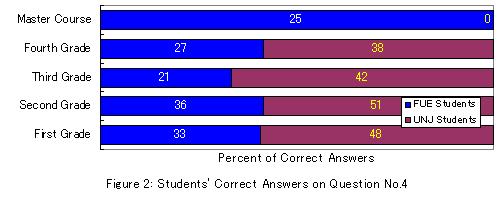
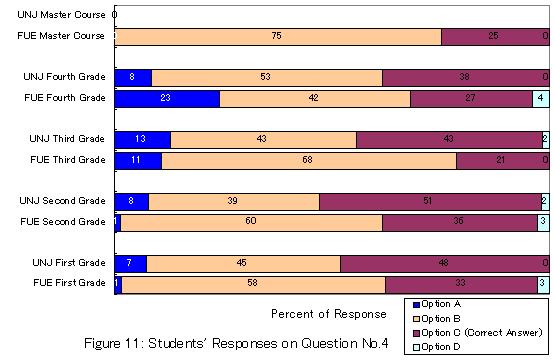
The most wrong answers between
FUE and UNJ students were B (speed of light came from bulb A less than
bulb B). FUE First, Second, Third, Fourth Grade, and Master Course students
attracted 58%, 60%, 68%, 42%, and 75% responded incorrectly, and the other
did not give their reason for answer. UNJ First, Second, Third, and Fourth
Grade students attracted 45%, 39%, 43%, 53% responded incorrectly, and
the other students did not give their reason for answer.
c)
Students' Correct Answers on Question 5,6, and 7
Result from question 5,6,
and 7, which asked the students to determine the direction of force of
the ball moving upward vertically and after reach the top it moved downward.
The question is which direction of force of the ball at A, B, and C position?
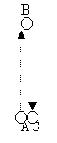
The correct answers of question
5,6, and 7 are the same i.e. the direction of force of the ball was downward.
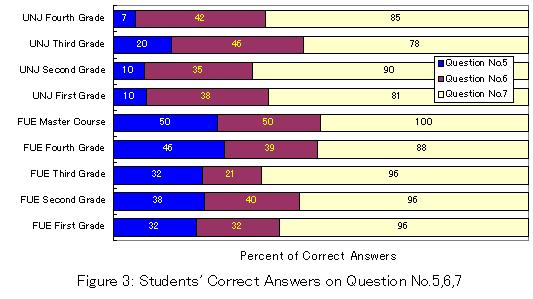
Number of students responded these questions correctly (%) were various
and out lined in figure 3. Generally they have mistake answering question
5 and 6 but answering 7 they answered correctly.
Students selected the option
A (the direction of force is upward) for question 5 and option B (the direction
of force is downward) for question 7, indicating that they preferred the
force to be parallel to the motion. Students selected option C (no direction)
for question 6, indicating that no force is acting at position B of the
particle.
d)
Students' Response on Question 8
Question number 8 asked
students to predict the water pressure acting at the diver when a boat
passes through above him. The option available are:
A. Water pressure acted
to the man was increased
B. Water pressure acted
to the man was decreased
C. Water pressure is constant
(correct answer)
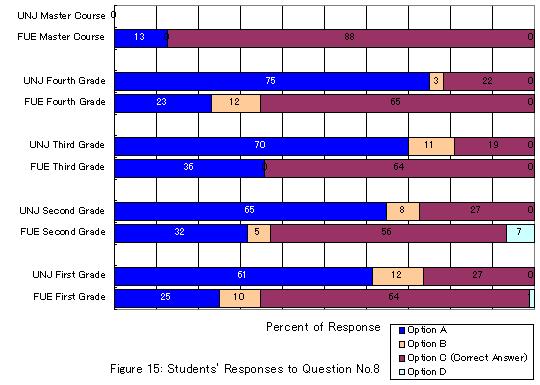
Number of students' responded
(%) these question correctly were various and out lined in figure 4:
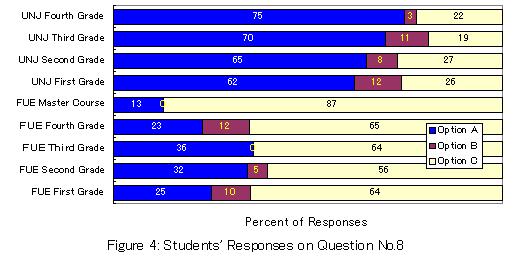
They’re many reasons of
students' responses to this question. Most of UNJ students thought that
pressure acted to human are increased. This is wrong answer. Most of FUE
students answer correctly to this question.
e)
Students Responses on Question 9
Question number 9 asked
students to determine how many gases are emitted through exhaust pipe of
engine. The options are available below:
A. Gases emitted are more
than 10 kg (correct answer)
B. Gases emitted are less
than 10 kg
C. Gases emitted are equivalent
with 10 kg
Number of students' corrected
responses (%) of these question were various and out lined in figure 5.
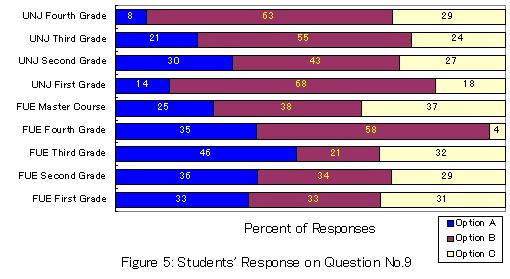
Students selected option
A (the emitted gases out through exhaust pipe are more than 10 kg) is the
correct answer. Answering this question, FUE students are answered better
than UNJ students. The reasons they gave are various evens they answered
correctly.
B.
Research Finding and Discussion
1.
FUE Students' Attitude toward Science
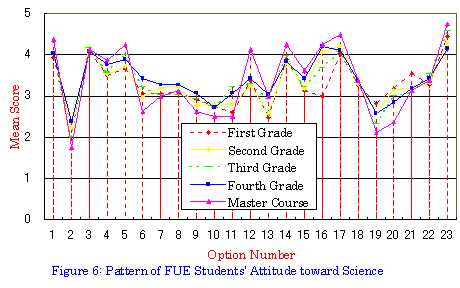
-
FUE student patterns of response
to Attitude Scale toward science are the same, although quantity is different.
-
Most of the students agree with
the statement, Science has ruined the environment. Students as higher level
(Master course Students) hold negative attitude toward this statement (mean
score = 1.75). Students' attitudes toward this statement become negative
as high as their grade level. The students believe that science has ruined
the environment although they believe that science is useful for solving
the problem of everyday life and important for country's development.
-
Most of the students do not
agree that science will help to make the world a better place in the future.
Their average score of this statement are less than 3.00 they worry that
science caused the anxiety in modern society and they think scientific
invention and discovery is bad more than good.
-
Most of the students believe
that in the future, most of job will require knowledge of science and they
would like to use the science they learned in school in their future career
but they do not believe that the people who understand science are respected
in their society.
-
Only first grade students hold
negative attitude to the statement “I would like to become a science
teacher. Most of the students of this university agree with this statement.
Their attitudes are increase as high as their grade level. First grade
students are the new students in university, they do not know much about
education. University needs to provide students to improve their knowledge
about education, teaching methodology and so on.
-
Most of the students agree that
science is difficult subject. Their attitudes are increase as high as their
grade level. Master course students have the lower score of this statement
and first grade students have the higher score. This fact is a little confusing,
because usually new students have many problems in way how to study in
new circumstance or new school. Perhaps this condition is caused of students
experience to science in class. Been studying science, students have faced
many difficulties of science, unexciting teacher methodology, difficult
test. So after they study they have perception about science that science
is difficult subject. Students at high level (master course and fourth
grade) agree that science is not difficult what it involving calculating
but all of students agree that science is difficult when it involving handling
apparatus.
2.
UNJ Students' Attitude toward Science
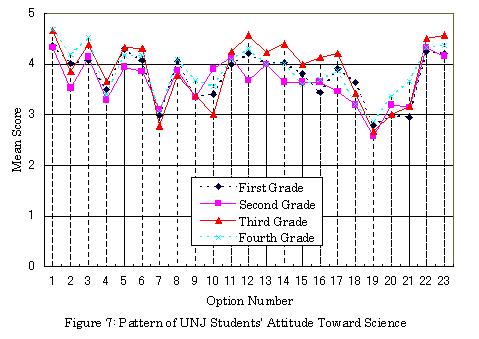
UNJ Students pattern of
response to the attitude scale shown in graph above generally were the
same.
-
UNJ students attitude towards
attitudes statement generally positive. Only statements as follow indicated
negative attitude e.g. many worries in modern society are because of science
(66%), science is difficult subject (76%) and science is difficult when
it involves calculating and handling apparatus.
-
Most of UNJ Students hold positive
attitude to the statement “I would like to become a science teacher. Their
attitudes are increase as high as their grade level. It mean students interest
and motivation are conducive to promote them selves as a science teacher
in the future.
3.
Comparison of FUE and UNJ Students' Conception about Science
a)
Students' Response on Question No.1
Question
No.1:
Consider throwing the ball
initially with parabolic line. After A second, the ball will be in A position.
After B second, the ball will be in B position and after C second the ball
will be in C position as following picture below. Which direction of force
at A position.
A. Upward (vertically) B.
Downward C. No direction D. Other direction, please draw!
(Give your reason) |
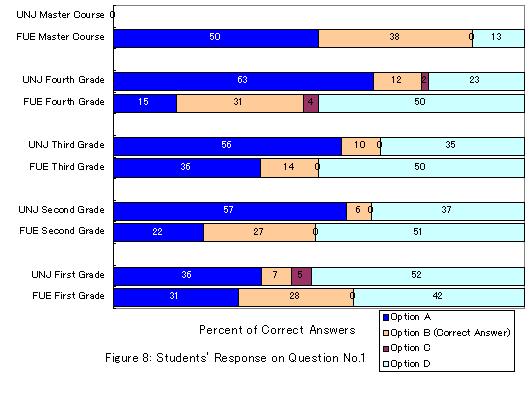
Students responses on these
questions are various. Most of UNJ students selected the option A and FUE
students selected the option D, both of the answers above are wrong. The
correct answer is option B (the direction of force acting at the ball is
downward). Students selected the option A indicating that they think the
force is caused by push of the cannon throwing it upward. Students selected
the option D indicating that they think the direction in which the force
is applied is also the direction in which the object accelerates. Four
percent of fourth grades of FUE student selected option C (no direction).
This option is not reasonable, because most possible thing is downward
or upward.
b)
Students' Response on Question Number 2
Question
No.2:
| Which the direction of force
acted at the ball in B position:A. Upward B. Downward
C. No direction D. Other direction (please draw) (Why? Give your reason) |
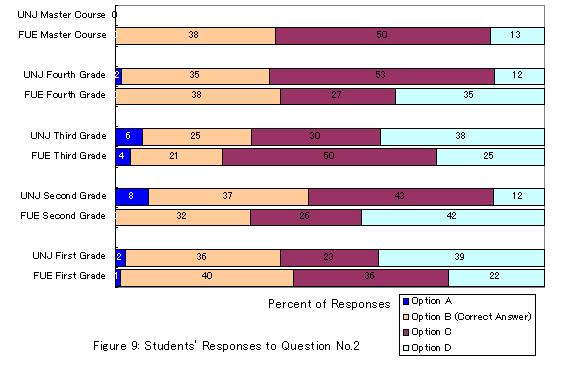
It is reasonable if most
students choose option C (no direction) because at B position there are
some perception about force worked at the ball. First perception, in B
position the ball change the direction move upward to reach the top for
a while and than move downward. Research found that many student chose
option C. First grade 36 percent, second grade 26 percent, third grade
50 percent, fourth grade 27 percent and master course students 50 percent.
Small numbers of student
chose option A (upward). It is reasonable because they imagined that the
ball stopped at B position. Many student chose option D (other direction).
Students think the ball moved to another direction, in this case the ball
move to horizontal direction.
c)
Students' Response on Question No.3
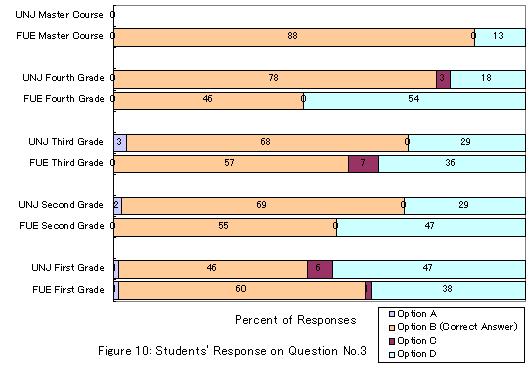
Question
No.3:
| Which the direction of forces
are worked at the ball in C position:A. Upward B. Downward C. No
direction D. Other direction (please draw)(Give your reason) |
Many students choose option
B: first grade students 60 percent, second grade students 55 percent, third
grade students 57 percent, fourth grade student 46 percent and master course
students 88 percent. Many students chose option D, first grade students
38 percent, second grade students 47 percent, third grade student 36 percent,
fourth 54 percent, and master course students only 13 percent.
Some student attributed the
force due to the ball moved in projectile motion i.e. force is due to the
push of the cannon throwing it upwards, and the force is overcoming the
gravitational force.
Other student simply stated
the case that there were horizontal and vertical force acting on the particle
and so the resultant was in the direction of motion. “There is a resultant
force from vertical and horizontal obtained from the angle made by the
direction and velocity. “It has an upward acceleration and also gravity
acted on it and resultant force is the direction shown.
d)
Students' Response on Question No.4
Question
No.4
The picture below shown
two light sources (Light A 5 watt and Light B 100 watt). How far the light
traveled from both light sources?
A. Light A travel > than
Light B B. Light A travel < than Light
B C. Light A travel = Light B
D. I don’t know |
This question asked the students
to compared the speed of light emitted two light sources presented 5 watts
bulb and 100 watt bulb. The most wrong answer of students both universities
was they chose the option B (speed of light came from bulb A (5 watts)
are less than bulb B (100 watts). This is indicating that students referred
the speed of light to be similar with the bright of light. The correct
answer is the speeds of light came from both light sources are the same.
e)
Students' Response on Question No.5
Question
No. 5:
Consider throwing the ball
upward with an initially velocity. After A second the ball has slowed down
while moving up from its initial position. After B second the ball has
slowed down to 0 m/s. The ball is momentarily at rest only at this exact
time (the ball reaches to the peak). After C second, the ball is moving
downward while speeding up. It will continue to move downward while speeding
up. Please follow the picture below:Which the direction of force worked
at the ball in A position
A. Upward
B. Downward
C. No direction
D. Other direction (please draw) Give your reason |
Most of students chose option
A; first grade students 64 percent, second grade 53 percent, third grade
64 percent, fourth grade student 58 percent, and master course 50 percent.
Many student chose option
B; first grade students 32 percent, second grade student 39 percent, third
grade student 32 percent, fourth grade student 46 percent, and master course
50 percent. Only view students chose options C and option D
f)
Students' Response on Question No.6
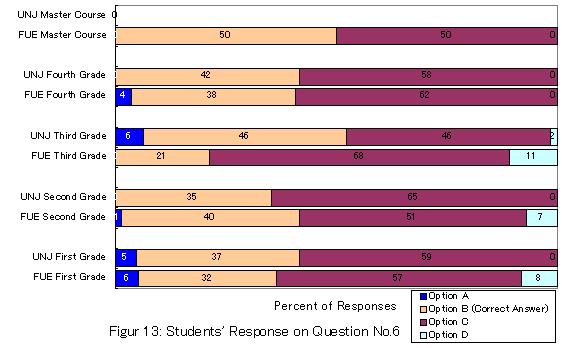
Question
No.6:
Which the direction of force
acted at the ball in B position
A. Move upward
B. Move downward
C. No direction D. Other
direction (please draw). Give your reason |
More than 50 percent of FUE
and UNJ students selected the wrong answer. They selected the option C
(there is no direction of force) indicating that students still hold misconception
about the direction of force. They think after the ball reach the top there
are no force acting at the ball.
g)
Students' Response on Question No.7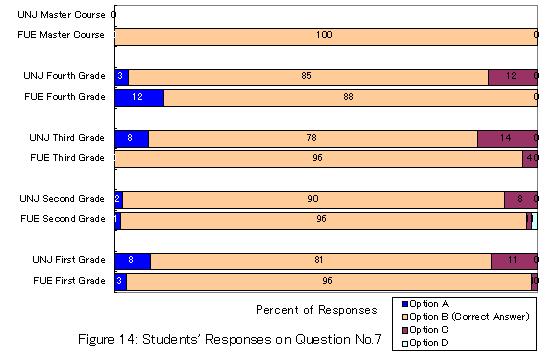
Question
7:
Which the direction of force
acted at the ball in C position
A. Move upward
B. Move downward
C. No direction
D. Other Direction. Give your reason |
Most of student selected
the correct answer (option B) on this question; first grade student 96
percent, second grade students 96 percent, third grade student 96 percent,
fourth grade student 89 percent, and master course student 100 percent.
There is no misconception about this question.
Let us consider the situation
in the question number 5,6,and 7. We are throwing the ball upward initially
with a constant downward acceleration. Therefore, the initial velocity
and the acceleration are in opposite directions. Since the ball is experiencing
an?acceleration, there must be an external net force which is responsible
for this. Because the net force causes the acceleration, the net force
and the acceleration are in the same direction. As a result, the net force
and the initial velocity of the ball are also in opposite directions.
We have already encountered
this situation before in which the net force and the initial velocity are
in opposite directions. We should already know qualitatively what happens
to the ball. The ball should slow down as it moves upward. It will eventually
slow down to 0 m/sec. After it reaches this point, the ball will then start
to speed up while?moving downward.
Students selected option
A for question 5 and option B for question 7, indicating that they preferred
the force to be parallel to the motion, and yet selected option C for question
6, indicating that no force is acting at position B of the particle. Similar
confusion arose between force parallel to motion for question 5 and 7 and
the strategy of gravity only for question 6 and 7.
g)
Students' Responses on Question No.8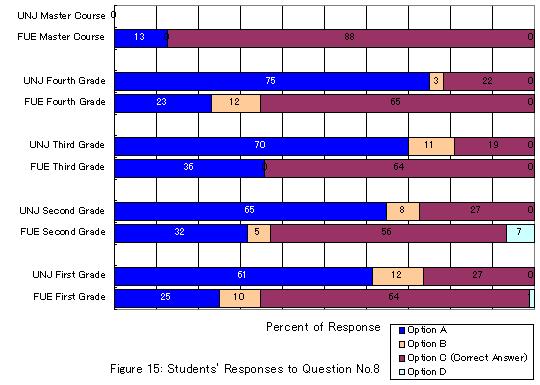
Question
No.8:
A man is diving in the sea.
While a boat pass on him. What do you think about the pressure on that
man?
A. Increase
B. Decrease
C. Constant
D. I don’t know |
UNJ Students reason to this
question is various. They chose option A (pressure are increased) by the
reason as follow: boat give off pressure to human; because of upward pressure
of water and boat pressure; because of the water pressure acted to all
direction; because the density of water are more than human density;
h)
Students' Response to Question No.9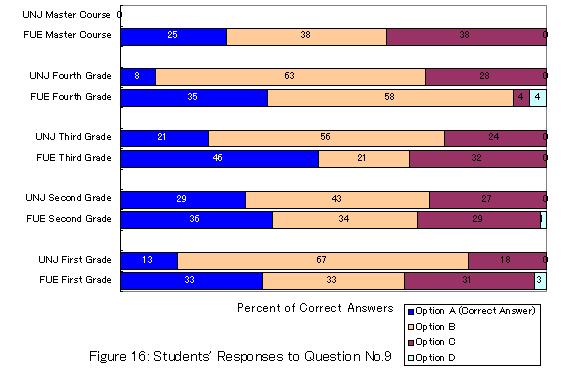
Question
No.9:
Gas container of the car
fulfills with 10-kg gasoline, and than we use the car until the gasoline
on container are empty. How many kg gases the car emits?
A. More than 10 kg
B. Less than 10 kg
C. Equivalent with 10 kg
D. I don’t know. (Give your reason) |
Students chose options B
(the emitted gases out through exhaust pipe are more than 10 kg) is the
correct answer. Answering this question, FUE students are answered better
than UNJ students. Although they answered correctly but the reasons they
gave are various. They selected the option by the reason as follow: fuel
and air mixed to combustion; fuel and oxygen are mixed in combustion; it
needs more energy power to burn 10 kg of fuel; energy is not used only
for exhaust and evaporation process.
Students selected the option
B (the emitted gases out through exhaust pipe are equivalent with 10 kg)
is incorrect answer, but more than fifty percent of student chose this
option. They reason for this question are: not all the materials emitted
are gases but energy too; fuel are expanded; density of gas is less than
fuel; efficiency of engine is not 100 percent; fuel are used to moved the
machine; the process of combustion are based on conservation of energy
principle; some energy are loss in combustion process; some of emitted
gases are unburned for saving; gases are evaporated before combustion process.
Option C (the emitted gases
out through exhaust pipe are less than 10 kg) is incorrect answer. Students
chose this option by the reason as follow: combustion process is based
on conservation of mass principle; based on conservation of energy principle;
based on Gay Lussac Law; based on Lavoiser Law; all of fuel are used for
combustion;
4.
Comparison of FUE Students and UNJ Students Attitude toward Science
a)
The Comparison of Group Levels
Table 2: t-test of First
Grade FUE and UNJ Students' Attitude toward Science
---------------------------------------------------------------------------------------------------------------------
Group
n Mean
SD t-statistic
t-value df
P<
---------------------------------------------------------------------------------------------------------------------
UNJ 1
83 86.337 13.316
6.349615 1.660
153 0.05
FUE 1
72 75.389
7.762
----------------------------------------------------------------------------------------------
Table 2 presents the mean
score and t statistic and t value. This table indicated t statistic > t
values its mean UNJ Students attitudes more positive than FUE students'
attitudes. Figure 3 exhibits the contrast between FUE and UNJ first grade
students' attitude toward science
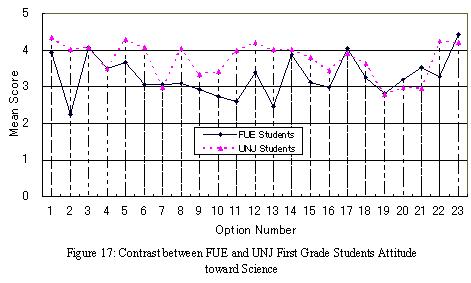
Table 3: t-test of Second
Grade FUE and UNJ Students' Attitude
----------------------------------------------------------------------------------------------------------------------
Group
n Mean
SD t-statistic
t-value df
P<
----------------------------------------------------------------------------------------------------------------------
UNJ 2
51 83.941
12.551 3.750846
1.660 122
0.05
FUE 2
73 76.452
8.095
----------------------------------------------------------------------------------------------------------------------
Table 3 presents the mean
score and t statistic and t value. This table indicated t statistic > t
values its mean UNJ Students attitudes more positive than FUE students'
attitudes. Figure 18 exhibits the contrast between FUE and UNJ second grade
students' attitude toward science
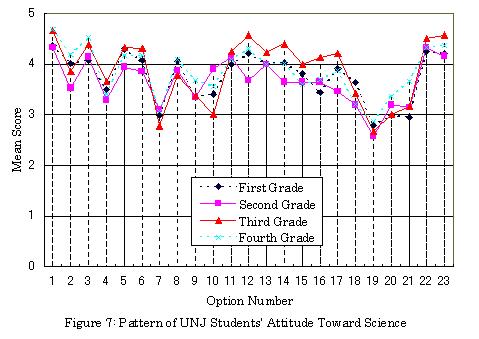
Table 4: t-test of Third
Grade FUE and UNJ Students' Attitude
-----------------------------------------------------------------------------------------------------------------------
Group
n Mean
SD t-statistic
t-value df
P<
-----------------------------------------------------------------------------------------------------------------------
UNJ 3
63 89.238
8.399 6.1817
1.660 89
0.05
FUE 3
28 76.893
8.962
-----------------------------------------------------------------------------------------------------------------------
Table 4 presents the mean
score and t statistic and t value. This table indicated t statistic > t
values its mean UNJ Students attitudes more positive than FUE students'
attitudes. Figure 19 exhibits the contrast between FUE and UNJ third grade
students attitude toward science
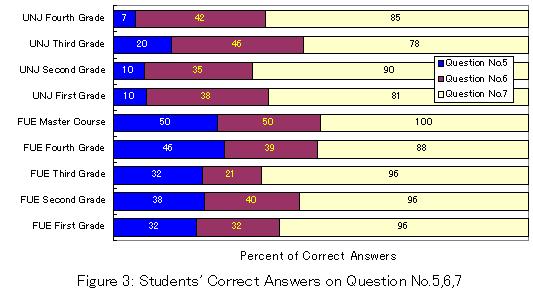
Table 5: t-test of Fourth
Grade FUE and UNJ Students' Attitude
-----------------------------------------------------------------------------------------------------------------------
Group
n Mean
SD t-statistic
t-value df
P<
-----------------------------------------------------------------------------------------------------------------------
UNJ 4
60 88.867
9.967 4.7797
1.660 84
0.05
FUE 4
26 78.577
8.801
-----------------------------------------------------------------------------------------------------------------------
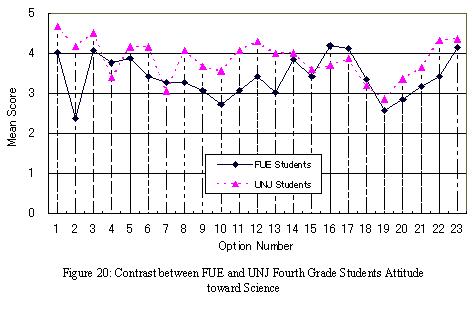
Table 5 presents the mean
score and t statistic and t value. This table indicated t statistic > t
values its mean UNJ Students attitudes more positive than FUE students�E
attitudes. Figure 20 exhibits the contrast between FUE and UNJ fourth grade
students' attitude toward science
Statistically the difference
between FUE students and UNJ students�Eattitude toward science determined
by t-test formula as followed below:
Table 6: t-test of FUE and
UNJ Students Attitude
-----------------------------------------------------------------------------------------------------------------------
Group
n Mean
SD
t-statistic t-value
P<
-----------------------------------------------------------------------------------------------------------------------
UNJ
257 87.163
11.4706 11.69571
1.646 0.05
FUE
207 76.454
8.220066
-----------------------------------------------------------------------------------------------------------------------
SD: Standard Deviation,

Degrees of freedom (df)
for the t test is df = (N1+N2)-2= (257+207) -2= 462
Using a probability table
for the t statistic (available in most statistics books), the researcher
determines that a value of t =1.646 is sufficient to demonstrate statistical
significance at the 0.05 level. Therefore, for this problem, t (462) =
11.6957, p < 0.05 is statistically significant. The researcher concludes
that student’s attitude between FUE students and UNJ students are difference
significantly.
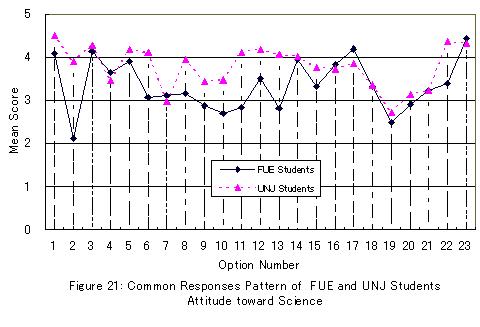
Figure 21 presents common
responses pattern of FUE and UNJ Students attitude toward Science. UNJ
student’s attitudes mean score generally higher than FUE student’s attitudes.
FUE and UNJ students agree that science is difficult subject.
PART V
CONCLUSION AND
RECOMENDATION
Conclusion
The
present study has generated a profile of attitude toward science between
State University of Jakarta Indonesia and Fukuoka University of Education
Japan. Study also investigated the students' conception about some concepts
of science such as force, gravitation, acceleration, light, pressure, and
combustion.
Statistically
UNJ students' attitude science and FUE students were significant difference.
UNJ students' attitudes were higher than FUE students. Based on analyzing
of each item, UNJ students' attitudes toward science generally were positive.
They held negative attitude as the followings statement: many worries in
modern society caused by science; and science is difficult subject especially
when it involves calculating and handling apparatus.
Most
of students of Fukuoka University of Education agree that science has ruined
the environment and they held negative attitude that science will make
the world a better place in the future although they believe that in the
future most of job will required knowledge of science.
Most
students of State University of Jakarta held the misconception about the
direction of force acting on the ball moving vertically upward. They though
that the direction of force are similar with the direction of motion.
Recommendation
Present
research found some misconception about force concerned with the direction
of force, speed of light, pressure and combustion processes. Research also
found that students hold the positive and the negative attitude toward
science. We can improve the students understanding about science concerned
with their attitude and conception about science. Research in science education
can be useful in various ways to provide much opportunity for students
and teachers to improve practice and raising the professional standing
of science teacher.
REFERENCES
Banu, D.P. (1986) Secondary
school students' attitude toward science, Research in Science and Technological
Education, 4, 195-201.
Cheek, D.W. (1992) Thinking
Constructively about Science, Technology, and Society Education. New
York: State University of New York Press
Escalada, L.T., & Zoolman,
D.A. (1997) An investigation of the effects of using interactive digital
videos in physics classroom on student learning and attitudes. Journal
of Research in Science Teaching, 35(5), 467-489
Francis L.J & Greer J.E.
(1999) Attitude toward science among Secondary School Pupils in Northern
Ireland: relationship with sex, age, and religion. Research in Science
& Technological Education. 17(1), 67-74.
Fraser, B.J. (1982) How strongly
are attitude and achievement related? School Science Review, 63,pp.557-559.
Gabel, D. (1981) Attitude
toward science and science teaching of undergraduates according to major
and number of science courses taken and effect of two courses. School
Science and Mathematics, 81, 70-76.
Guesne, E. (1985) Light.
In Driver, R., Guesne, E., & Tiberghien, A. (Eds), Children’s Ideas
in Science. Philadelphia C. In.
Harlen. W. (1985). Primary
Science Taking the Plunge: How to teach primary science more effectively.
London: Heinemann Educational Books.
Hofstein, A., Maoz, N. &
Rishpon, M. (1990) Attitudes toward school science: a comparison of participants
and non-participants in extracurricular science activities. School Science
and Mathematics, 90, 13-22.
Lewenstein, B.V. (1992)
When
Science Meets The Public, Washington: American Association for the
Advancement of Science (AAAS)
Orton A. (1985) Studies
in Mechanics Learning. Leeds: Centre for Studies in Science and Mathematics
Education University of Leeds.
Japanese Government Policies
in Education, Science, Sports and Culture 1997: Sports and Scientific Research:
Opening the Door to the Future. http://www.monbu.go.jp/hakusyo/1997eng
/index.html
Jenkins, E.W. (2000) What
can physics teachers learn from research in physics education? Physics
Education, 35, 445-250.
Monbusho (1994), Education
in Japan: A graphic Presentation 1994, Ministry of Education, Science,
Sport and Culture of Japan (Monbusho)
Menis, J. (1989) Attitude
toward school, chemistry students and science among upper secondary chemistry
students in the United States, Research in Science and Technological
Education, 7, 183-190
Shrigley, R.L. (1974) The
correlation of science attitude and science knowledge of pre service elementary
teacher. Science Education, 58, 143-151
Tytler R. (2000) A comparison
of year 1 and 6 students' conceptions of evaporation and condensation:
dimensions of conceptual progression. International Journal of Science
Education, 22(5), 447-467
Trochim, William M. Research
Methods Knowledge Base, Cornell University http://trochim.human.cornell.edu/kb/
Watson, J.D., Prieto, T.,
& Dillon, J.S. (1997) Consistency of Students' Explanations about Combustion.
Science
Education, 81, 425-444