 Scottish Lore
SCOTLAND'S IRISH ORGINS
Tracking the migration of Gaelic speakers who crossed the Irish Sea 1,700 years ago and became the Scots
BY DEAN R. SNOW
Ireland in the Early Christian period (A.D. 400-1177) was made up of at least 120 chiefdoms, usually described in surviving documents as petty kingdoms, typically having about 700 warriors. One of these petty kingdoms was D�l Riata, which occupied a corner of County Antrim, the island's northeasternmost part. Around A.D. 400, people from D�l Riata began to settle across the Irish Sea along the Scottish coast in County Argyll. Other Irish migrants were also establishing footholds along the coast farther south, as far as Wales and even Cornwall, but the migrants from D�l Riata were especially noteworthy because they were known to the Romans as "Scotti" and they would eventually give their Gaelic language and their name to all of what is now known as Scotland.
So far as we know, the only people already living in Scotland in A.D. 400 were the Picts, who were first mentioned by Roman writers in A.D. 297. This was in connection with an attack along Hadrian's Wall, in which the Picts had the help of Irish (Scotti) allies, so connections across the Irish Sea must have already been strong. Roman sources predictably describe their Pictish adversaries as barbarians and mention their use of blue paint, which some historians later interpreted perhaps too literally (Mel Gibson and his friends show up in the film Braveheart slathered with gallons of it). More likely the Picts were heavily tattooed.
The Picts lived mainly in eastern Scotland, north of modern Edinburgh. We know their homeland both from the distributions of Pictish place-names (which typically begin with "Pett" or "Pit") and the distribution of Pictish symbol stones, which were Pictish equivalents of a medieval coat of arms, each typically bearing the crest of a petty king and that of his father. The rugged west coast was only lightly occupied by Picts or some other Celtic-speaking people. Settlers from D�l Riata apparently established themselves along the west coast without much opposition. By A.D. 490 the population of Scotti was large enough that the head of the little kingdom moved the family seat across from Ireland. The Scotti alternately cooperated with and fought against the Picts for the next few centuries until the two were unified into a single kingdom under Cin�ed (Kenneth) mac Ailp�n in A.D. 844. After that the Pictish language disappeared, along with the symbol stones and other archaeological traits that had distinguished them from the Scotti.
What the Scottish case and others like it tells us is that migrations by relatively small dominant societies are much more common in human history than many archaeologists have been willing to admit (much less assume), particularly in North America. Typically, the signatures of it have been explained away too easily as evolutionary change in place. There are so many good examples of change associated with the migration of whole societies or dominant subsets of them, that any major change over time that can be observed archaeologically is likely to have involved migration in one of its many forms, however minor. We should be assuming population movement as a first principle rather than denying it.
A.D. 400. Settlers from the Irish petty kingdom of D�l Riata were beginning to establishing themselves in what would later be called Scotland. Picts were well established north of other Celtic speakers except perhaps on the west coast and in the Hebrides.
A.D. 500. Departure of Roman legions in A.D. 407 left Britain to Picts, other Celtic speakers, and growing numbers of Irish settlers. Enough Scotti were in place by A.D. 490 to allow them to move the seat of D�l Riata from across the Irish Sea.
A.D. 600. Colum Cille left Ireland and established a monastery on Iona in 563. From this time on expansion of the Irish Scotti was assisted in part by the spread of Christianity.
A.D. 700. As the Scottish presence in Britain grew, so did that of the Angles and Saxons, many the descendants of Roman mercenaries. Angle settlements expanded south and east of Scottish territory.
A.D. 800. As both Angle and Scottish communities grew, small Norse settlements began to appear in the islands of Orkney and the Outer Hebrides.
A.D. 900. Competition from the Norse and Angles probably contributed to the unification of Scots and Picts into a single kingdom in 844. Pictish language and culture disappeared. Norse raids forced the abandonment of Iona by 878.
A.D. 1000. By 1,000 years ago the Picts were a memory and the united kingdom of Scotland was caught between Germanic Norse and Angle settlers.
From A.D. 400 to 1000 , northern Great Britain saw the withdrawal of Roman forces, arrival of the Scotti from northeastern Ireland, disappearance of the Picts, formation of a united kingdom of Scotland, and colonization by the Norse.
CLAN SURNAMES IN SCOTLAND
In Scotland, it was a simple act of loyalty for a new member of a clan to accept the chief's name. A new member didn't necessarily have to be related by blood; he only had to swear allegiance to the clan. A clan isn't a family but an alliance of several families and, often, individuals. Finding many Campbells, Fergusons, MacLeods, or Munros in one area doesn't necessarily indicate blood kinship. The clans traditionally occupied the Highlands. The people of the Lowlands gained surnames in ways similar to those of the English (using occupational names and passing names from generation to generation). You should never assume that one clan member is related to another unless you have documented proof.
WHAT IS A CLAN?
Clan = children
Mac = son of
Clan MacIvor = family of the son of Ivor
or
Clan MacDonald = family of son of Donald
or
Clan MacPherson = family of son of Pherson (the parson)
etc.
CLAN STRUCTURE
Chief = Supreme Leader and Lawgiver
I
I
The Tanist
Nominated by the Chief
Tanistry was a system of succession
by a previously elected member of the Clan or family.
I
I
Commander/Military Leader
I
I
Chieftains
(heads of various branches or Septs of the clan,
always appointed if the Chief were old or infirm)
I
I
Gentlemen
(those who could claim a blood connection with the Chief)
I
I
Clansmen
The greatest in numbers --
In times of peace, the clansmen did the manual work;
in times of war, they fought for their chief
Although this hierarchy was scrupulously observed, there was no feeling of resentment on the part of the Clansmen, whose powers of reflection were limited by their circumstances. They were proud to be connected to their Chief and to each other and the evidence shows they were willing to die for the Clan.
To add to the solidarity of the Clan, the practice of fosterage meant that children (including the Chief's) were exchanged and brought up among different families. Thus the most humble Clansmen felt personally responsible for the children of his chief and vise versa.
Scottish Pride or Ignorance?
Greetings to all clan, kin and noble allies from the Chief.
As Robbie Burns Day was approaching (yes I know he is not within our period but his dream definitely was), I noticed, sadly, more than a few homes and wagons flying the Lion Rampant banner so readily associated with Scotland. I began to recall how many I had seen at SCA events and even, I regret to say, Highland Games.
Why sadly you ask? Because it is flown with no right or regard to it's true meaning. Unlike a national flag, such as our American Flag, the Lion Rampant Banner is the personal arms of the reigning King or Queen of Scotland. No matter what "time" you are flying it you are claiming to be The Sovereign of Scotland. This is not just an offense against the Parliamentary law of Scotland (though I seriously doubt they will attempt to arrest the offender) but it is also a cultural faux apex showing ignorance of and/or arrogance toward the Scottish Sovereign. This is something no Scot worth his plaid should want to be associated with.
So why do so many people and groups still fly it so readily? Is it through ignorance or arrogance? Unfortunately both. I remember commenting on it once to my Lady as we were taking the Dragon Wagon around Pennsic one year and hearing the sadly deluded lady next to us claim in her defense "her family was actually granted the right to fly the lion as reward and recognition for their defense of the King of Scotland in time of war." While I would never wish to impune the truth of another I have never found any such record of a "reward" of this type. Indeed even Prince Charles has no right to these Arms as they represent the "Royal Arms of Scotland and only the Sovereign in Scotland" according to Mr. S.B Wylie, amriger of the Court of The Lord Lyon of Scotland. Take it down, put it away, and consider it the expense of knowledge or remain arrogant or ignorant.
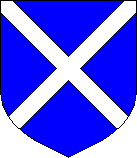
So what does the bonnie Scot fly in this great Banner's stead? There are actually two badges of Scotland that are proper (and legal) for general use, when void of any Crown, etc. They are the single thistle displayed proper on a white field, and the white cross of St. Andrew displayed upon a blue field. Either or both of these official Scottish Badges may be flown as a way of displaying your pride, respect and knowledge of your Scottish heritage. Thus informed I hope to see more of these grand badges flying proudly at events and fewer glaikit imposters claiming to be, through their dislpay of arms, The Sovereign of our noble Scotland. Until then I bid ye Slante!
Laird Wulfric Grimbeald
High Chief of Clan Wulfgard
THE "RAMPANT LION"
This is NOT a national flag and its use by citizens and corporate bodies is entirely wrong. Gold, with a red rampant lion and royal tressure. It is the Scottish Royal banner, and its correct use is restricted to only a few Great Officers who officially represent the Sovereign, including the Secretary of State for Scotland as Keeper of the Great Seal of Scotland, Lord Lieutenants in their Lleutenancies, the Lord High Commissioner to the General Assembly of the Church of Scotland. the Lord Lyon King of Arms, and other lieutenants specially appointed. Its use by other, non-authorised persons is an offence under the Acts 1672 cap. 47 and 30 & 31 Vict. cap. 17.
Baronage of Scotland
Scottish Arms & Armor
The Legend of the Saltire
Home