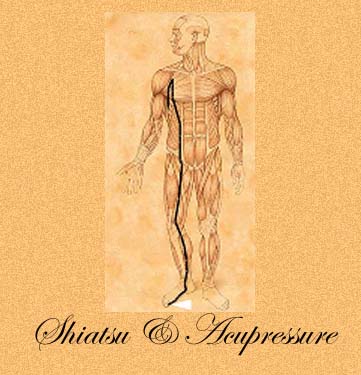
Acupressure and Shiatsu
are Asian body work therapy which can help people with a wide
variety of problems and disorders. They could also be called
"Acupuncture without Needles" because they work with
the same "points" and energy pathways as acupuncture.
"Shiatsu" is a Japanese word meaning "finger pressure",
and although Japanese styles differ slightly from Chinese (Acupressure),
the words are often used interchangably. Shiatsu is characterized
by the application of pressure by the hand, thumbs, or fingers,
along the energy meridians and to the acupoints, to release blockages
in the flow of Qi.. Tui Na is Chinese clinical acupressure massage,
and means "push-pull". Tui Na incorporates pressing,
kneading, rubbing, percussing, point-holding, and other strokes
to release blockages and stagnation of the Qi. There are other
styles of acupressure which primarily focus on point holding.
The client wears loose, comfortable clothing for the treatment;
disrobing is usually not necessary.
The ancient Chinese
developed an understanding of the human body thousands of years
ago that seems, for us Westerners, somewhat strange because it
focuses on a different part of our functioning than conventional
Western medicine. It is based on the idea that something called
"QI" (pronounced "key") flows throughout
the body in channels or pathways called "meridians".
These pathways are the same in everyone, and along the pathways
there are "points" where the practitioner can access
and manipulate the Qi within the patient. All living things have
Qi, and it is sometimes called the "Life Force" or
"Vital Energy". According to Traditional Chinese Medicine,
all illness, whether physical or emotional, is caused by deficiencies,
blockages, or disturbances in the flow of Qi. In health, Qi is
in sufficient amounts and flows evenly and harmoniously throughout
the body. By stimulating the Acupressure points, Qi can be strengthened,
blockages can be released, and correct direction of flow can
be restored. In this way, the body's natural rhythm and balance
is encouraged to restore itself.
What is this Qi or
"Vital Energy" in Western terms that we can understand?
Much research is being conducted around the world to understand
this phenomenon in terms of our Western scientific view of the
body and health. Many theories have emerged, but there is little
agreement among scientists and doctors about what the link is,
even though this bio-electro-magnetic field is recognized and
used in many of our modern diagnostic methods, such as EKG's,
MRI's and others.
These therapies probably
work on at least four different levels. FIRST, in the musculo-skeletal
system: many of the classical acupressure points lie at the points
where the muscles attach to the bones. In these areas are tiny
organelles called "proprioceptors" which tell the muscles
when to contract and when to relax, and how much tension to maintain
even when relaxed. By stimulating those points manually with
shiatsu or acupressure, the therapist can give them an instruction
to relax or change the resting tension. This can quickly and
very effectively induce a relaxation response and better muscular
balance, relieving pain and tension in the receiver.
In the nervous system:
many of the points are located along nerve pathways near the
spine and in the extremities. Different pressure techniques can
stimulate or relax the nerve firing to areas of the body. Since
the nervous system delivers information and instructions from
one part of the body to another, and from the brain to the organs
and muscles, acupressure can effect internal processes very well.
Many people have found that receiving acupressure can lower blood
pressure, improve digestive functioning, help allergies and asthma,
water retention, female organ problems, and many other difficulties
besides just muscular tension and pain.
In the immune and endocrine
systems: No one knows how this works yet, but people often discover,
after receiving regular acupressure treatments for a few weeks,
that their immune system seems stronger. They have better resistance
to colds and viruses, allergies and other immune-mediated disorders
improve. Others who have suffered from hormone imbalances often
start to feel better too, and even medical testing frequently
shows that hormone levels have changed after a series of regular
acupressure sessions.
At the level of emotional
stability and general well-being: it is well known that stimulating
the acu-points causes a natural release of endorphines, brain
substances which induce a sense of comfort and well-being likened
to a "runner's high". I believe this is only one aspect
of how acupressure can help people to achieve better emotional
balance, thus offering help for depression, anxiety, fears disorders,
chronic worry, and anger. Various emotional states can only emerge
out of a certain body chemistry. As the body chemistry begins
to restore a healthier balance, as the muscular, nervous, immune,
hormone, and other systems get into better harmony, a shift in
emotions naturally and comfortably occurs. When the person is
willing to add simple lifestyle changes along with acupressure
therapy and medical management, dramatic changes can take place
in the person's emotional and mental functioning. In addition
to these factors, I believe that many people are simply starved
for healthy touching. We have developed a "touch-me-not"
society, in which most touching experiences for many people occur
only in the contexts of sexual behavior or abuse or punishment.
Humans simply work better when we receive respectful, healthy,
unconditional touch on a regular basis. We need our "strokes".
In addition to the physiological benefits, acupressure fills
a very great need for those deprived of this inate biological
demand.
Many people wonder
what a typical acupressure session would be like. When someone
come to see me for their first visit, I need to ask them some
questions about their condition. I ask how long they have had
the condition, what they have done to help it so far, and what
has worked or not. I ask detailed questions about their symptoms
or pain. I take a simple medical history, to find out what surgeries,
accidents, or illnesses the person may have experienced. Then
the person lies down on my treatment table or a thick mat on
the floor (I work both on the floor, Japanese style, or on a
table like other massage therapists). It is not necessary to
remove clothing, but I do ask the person to remove shoes and
socks, belts, jewelry, and contents of the pockets. Next I feel
the pulses in the wrist, and test for sensitive areas in the
abdomen and in the arms and legs. This helps me to determine
where the Qi energy may be blocked or deficient in the body.
Based on what the person has told me, and what I find in the
pulses and points, I focus the treatment on the points and meridians
where I need to move the Qi. The treatment feels very pleasant
and relaxing. A typical session lasts one hour, but the benefits
continue to manifest for several days after the treatment.
Home
Copyright © 2004
All rights reserved.
For More Information
contact us at
[email protected] |
|
|
|
|
|