Top leadership of Sunni Tehrik among 50 killed by suicide bomber in Nishtar Park
11-4-2006
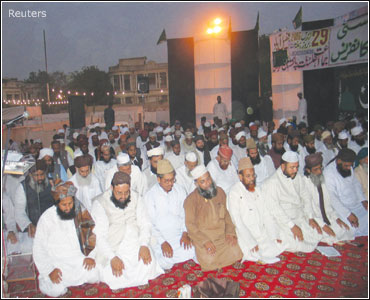
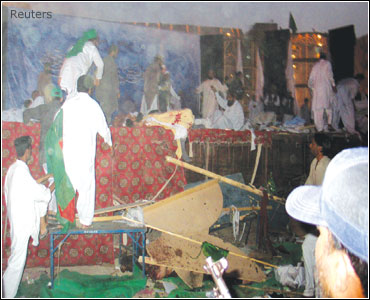
KARACHI, April 12: The entire central leadership of the Sunni Tehrik has been wiped out in Tuesday�s blast at Nishtar Park. Its chief Mohammad Abbas Quaderi, Maulana Iftikhar Ahmad Bhatti, Maulana Ikram Quaderi and Dr Abdul Qadeer were among those who were killed in the blast.
The other prominent leaders of the Ahle Sunnat who were also killed in the tragedy included Hafiz Mohammad Taqi of Markazi Jamiat Ulema-i-Pakistan, Qari Mukhtar Qaderi of Darul Uloom Amjadia, Federal B Area, Haji Mohammad Hanif Billo, President of Awam Ahle Sunnat, and Sahibzada Faridul Hsnain Kazmi.
At least fifty persons including prominent religious personalities were martyred and more than fifty injured as a huge bomb explosion went off here at the Karachi Nashtar Park.
Prominent religious personalities including Haji Mohammad Hanif Billo, Itikhar Bhatti, Abbas Qadri, Akram Qadri and Hafiz Mohammd Taqi have been martyred in the blast incident.
Riots in the nearby areas of the blast site were also reported. Sources informed that two petrol pumps, one fire tender and several cars were set ablaze by the enraged people.
The injured have been rushed to the Jinnah , Civil and Abbasi Shaheed Hospitals for emergency treatments.
Interior Minister Aftab Ahmed Khan Sherpao said he knew of 50 dead. "Till now the dead are 50 but we don't know exactly about wounded," he told.
Television pictures showed dead bodies lying on the ground and wounded being taken to hospitals in vans after the bomb explosion.
"What we know at this point is that there was a blast ... and that there are some injured who are being taken to the hospitals," Jehangir Mirza, police inspector general for Sindh province, told media.
No-one has claimed responsibility for the bomb explosion at what was believed to be the biggest of such events being held in Pakistan.
President Pervez Musharraf and Prime Minister Shaukat Aziz condemned what they described the deadly terrorist bomb attack and asked the provincial government of Sindh to immediately arrest those behind the blast.
They also expressed condolences with the bereaved families.
A senior leader of Jamaat Ahli Sunnat Shah Turab ul Haq Qadri who led evening prayers said that when was leading the prayers the bomb exploded, leading to chaos and the people started running.
Rauf Siddiqi, Home Minister,Sindh province, said that the security forces had checked the stage before it was handed over to the organizers.
Siddiqi claimed that the police and paramilitary forces faced difficulties to reach the site of the blast, as the angry people were not allowing them.
Former Prime Ministers Benazir Bhutto and Nawaz Sharif, president of Mutahida Majlis-e-Amal Qazi Hussain Ahmed and leader of Mutahida Qaumi Movement Altaf Hussain strongly condemned the blast.
The Sunni Tehrik has lost over 65 activists during last 15 years. Its first prominent leader, who became victim of the target killing on May 18, 2001, was its chairman Saleem Quaderi.
Hafiz Taqi started his political career by joining Anjuman Talba-i-Islam in 1974 and was elected its president. Later, he was given ticket by PNA in 1977 and 1979 to contest Sindh Assembly seat but the elections were cancelled. In 1981, he joined Pakistan Istehkam Council of late Zahoor-ul-Hasan Bhopali and in 1985 non-party elections, he was elected MPA and became minister for religious affairs.
In 1993 elections, he was elected MNA on PML ticket. In 2000, he again joined JUP and was made President of its Karachi chapter and by virtue of the post of JUP Karachi president, he became chief of MMA Karachi chapter. After the death of late Allama Shah Ahmad Noorani, he had joined the Markazi Jamiat Ulema-i-Pakistan, led by Maulana Fazl-i-Karim recently.
Haji Hanif Billo, who was President of Tehrik Awam Ahle Sunnat, was a prominent social worker. He hails from Bantwa Memon Jamaat who inherited pharmacy business from his grandfather. Because of his social services, he became chief of All-Pakistan Wholesale Druggists and Chemists Association and Chairman of Haj-Umra Committee Karachi.
Mohammad Abbas Quaderi, 40, was born in Lines Area and got his initial education in the same locality. In the initial stage, he was made in charge of Dawaat-i-Islami of the local chapter, after the formation of Sunni Tehrik, he joined the party and after the death of Saleem Quaderi, became chief of the party.
Iftikahr Bhatti and Akram Quaderi were among founding leaders of the party while Dr Abdul Qadeer Abbasi, 40, was a member of the legal aid committee of the party.
Refering Site
Sunni Tehrik gives 48-hour ultimatum
12-04-2006
KARACHI, April 12: While holding the Sindh government responsible for Tuesday�s blast at Nishtar Park, laving 46 dead and another 150 injured, the Sunni Tehreek on Wednesday gave a 48-hour ultimatum to Islamabad to identify, arrest and publicly hang the culprits otherwise they would announce their future line of action after the deadline.
Speaking at a crowded press conference on Wednesday, Shahid Ghauri, flanked by Engineer Abdul Rehman and Qari Khalilur Rehman Chisti, representing a hurriedly constituted panel after three main leaders of the party were killed in the blast, said the central cabinet of the ST was the target, and it seemed that the terrorists had succeeded in their plan. �But the ST has emerged even stronger after going this devastating attack,� he said. However, they warned that �we can give any call at any time�.
They said, both the killing of the ST�s chief, Saleem Qadri, and Tuesday�s bombings were interconnected as the same forces were behind both acts, they added, without naming any person or party.
Saying that the provincial government had failed miserably in ensuring peace, and protection to life and property of people in the city, they demanded immediate removal of the Sindh government.
Calling for an independent investigation into Tuesday�s bombing, they demanded that the Sindh government should have no role in the probe and the MI and the ISI should be given the task to carry out the investigations.
To a question, Shahid Ghauri said they would nominate the responsible of the Sindh government in the FIR.
Referring to government claims that it was an act of suicide bombing, Ghauri said it seemed that the government wanted to shift its responsibility by terming it suicide bombing.
Without naming anyone, Ghauri said the government was attempting to give a legal cover to the earlier proscribed jihadi outfits.
Condemning both the federal and provincial governments for their inaction, Ghauri said 18 hours had lapsed since the bombings, but not a single official, either from the Sindh or federal governments, had bothered to call us.
He said during the last one year, scores of ST activists had been either killed in target killings or had been arrested across the city, while ST leaders were constantly receiving threats for which complaints had been lodged with the concerned quarters, �but they have simply ignored our complaints and failed to protect us,� he said.
Refering Site
Investigators disclose type of explosive used in blast
19-04-2006
KARACHI, April 19: The explosive used in the Nishtar Park bombing was �C4�, a type used earlier in the abortive attempt to blow up President Pervez Musharraf�s convoy in Rawalpindi on December 14, 2003.
This was stated by the investigators of the Nishtar Park bomb blast. They said that the ballistics laboratory test had established that the highly explosive C4 type material, primarily used by military forces in the world, and now also by Al Qaeda operatives, was used in the April 11 suicide bombing.
In Pakistan, C4 was used in a few incidents, including the attack on the president�s convoy in which the bomb was planted beneath the Chichi Jhanda Bridge in Rawalpindi. The bomb did not explode as the president�s motorcade was equipped with jamming devices. However, it went off as soon as the motorcade crossed the bridge, according to the investigators.
The same type of the explosive was used in the car-bomb blast near the US consulate in Karachi on March 2. Four people, including a US diplomat, were killed in the blast. Another example of C4 use was the suicide bombing at Madinatul Ilm, Gulshan-i-Iqbal, on May 31, 2005. The investigators said that C4 type of explosive was, however, used with mixing of nitrate, sulphur, or fertilizer in some cases to ignite fire.
Investigators said that pellets used in the bomb had been used in the suicide bombings at various places in the past. The modus operandi of the attack in Nishtar Park religious gathering was identical to the suicide attacks at the Ashura procession in Hangu�s main Bazaar on February 9, 2006, the annual religious gathering at Bari Imam shrine on May 27, 2005 and the Madinatul Ilm Imambargah in Karachi on May 31, 2005.
However, the investigators said, the identity of the suicide bomber in the Nishtar Park case could not be established as yet. Efforts were being made in this direction as a team of doctors had reconstituted the severed head of the suspected bomber. The head was collected from the scene of the blast.
Intelligence agencies, on the directives of the authorities in Islamabad, were probing into the case, they said.
A senior investigator said: �We have found some clues that indicated involvement of a sectarian group in the blast, but it would be premature to pinpoint any group or individual at this stage.�
Meanwhile, Federal Interior Secretary Syed Kamal Shah, along with the Director General of FIA, Tariq Pervez, DIG Investigation-I Manzoor Mughal, DIG Investigation-II Mir Zubair Mehmood, Director Special Investigation Group (SIG) Ashraf Zubair, SP CID Operations Raja Umer Khattab and other senior officials visited the scene of the blast at Nishtar Park on Wednesday morning and inspected the place. DIG Mughal briefed the federal secretary and members of the joint investigation team about the suicide attack and the findings of the investigations made so far.
Later, Syed Kamal Shah held a meeting on law and order at the Central Police Office (CPO) and emphasised on progress in the blast investigation process. The meeting was attended by IG Sindh Jahangir Mirza, CCPO Niaz Siddiki, DG Nadra, Sindh, Brig Abid Haider Kazmi and other senior officials.
Sources who attended the meeting said that it reviewed the process of the investigation in the Nishtar Park bombing and was told that a splinter group of the banned Lashkar-i-Jhangvi was involved in the attack on Maulana Saleem Qadri, the founder chief of the Sunni Tehrik who had been shot dead a few years back. The meeting was told that the assailants belonged to the Deobandi sect whereas the victim belonged to Barelvi sect.
The meeting was informed that the second deadly incident had taken place at Bara, in the NWFP, on January 16 this year. In that incident, a clash between Barelvi and Deobandi sects had left 25 people of Deobandi sect dead. The meeting was told that this aspect was being reviewed as the Nishtar Park bombing could be a retort to the Bara incident.
Refering Site
Four Shias picked up in pre-dawn raids
27-04-2006
KARACHI, April 27: At least four persons have been picked up in different parts of the city in an early morning raid in Abbas Town in Gulshan-i-Iqbal and Mehmoodabad reportedly by the intelligence agencies.
Eyewitnesses told Dawn that about vehicles with tinted glasses and mobiles bearing no registration numbers came to Abbas Town and took away Mohammad Ali, an estate agent and Hasan, a dispenser. People said several dozen armed men in civvies surrounded several houses and nabbed the youth.
In a simultaneous raid, Nayyer Zaidi and Nasir Husain were picked up from Mehmoodabad and Soldier Bazaar respectively by armed men in civvies Tuesday morning. Nayyer Zaidi is a central leader of the Pasban-i-Aza.
Condemning the raids, Sindh chief of the Tehreek-i-Islami, Allama Hasan Turabi, told Dawn that since the Nishtar Park tragedy, around 50 to 60 youth have been arrested from different parts of the city.
He condemned the uncalled for detentions, saying the families of the victims have searched almost all police stations, but failed to find whereabouts of their family members.
He said al least families should be informed the whereabouts of their family members.
Allama Turabi expressed his apprehensions over attempts to implicate Mohammad Husain Balti in the Nishtar Park tragedy, questioning the professional expertise of the intelligence agencies probing the case.
Refering Site
Govt names Nishtar Park bomber
15-06-2007
KARACHI, June 15: The Sindh Home Department on Friday issued a statement claiming to have identified the terrorist network behind the 2006 Nishtar Park bombing, which took place on 12 Rabi-ul-Awwal (11 April, 2006).
The suicide bomber is identified as Mohammad Siddiq, son of Isreal, from Seri Karnashi village in district Mansehra, NWFP. He is said to have had links with the Lashkar-i-Jhangvi.
According to the official statement, the network is based in Darra Adam Khel and is led by Amanullah, alias Mufti Ilyas. Other members of the group include Qari Abid Iqbal Mehsood, Mohammad Khalid Khan alias Abrar, Sultan alias Mehmood, Mufti Zakir and Rehmatullah.
Out of the six persons named, Sultan (Mehmood), is already in jail while Mufti Zakir and Rehmatullah have been arrested. The remaining three are still at large.
The statement says that this group has been involved in identifying, preparing and brainwashing people for suicide bombings to be carried out in Pakistan and Afghanistan. The leader Amanullah (Mufti) is said to be expert at making and using the explosive jackets used in such crimes.
Describing the preparations that led up to the Nishtar Park bombing, the statement said that �the group assembled at house no. 2, Islamia Colony, Pahari Wali Gali, Qasba Colony, Orangi on 11 Rabi-ul-Awwal.�
The next day, on 11 April, the bomber Siddiq �performed two Nawafil at the house of Rehmatullah and then prepared himself and wore explosive jacket having 7/8 kilogrammes explosive and 3,000 ball bearings specially designed for suicide bombing.� Subsequently the bomber, accompanied by Khalid Khan (Abrar) and Sultan (Mehmood) went towards Nishtar Park via M.A. Jinnah Road and joined a small rally headed there. As Maghrib prayers started, the statement continues, Khalid and Sultan slipped away. As soon as the prayer ended, Siddiq jumped towards the stage while detonating his explosives.
The Home Department�s statement says that �the motive of Lashkar-i-Jhangvi behind committing this offence was to create unrest and a law and order situation in Sindh in order to avenge the present government�s policy against religious extremism.�
Substantiating the evidence proving the bomber�s identity, the statement said that Siddiq�s parents, Mr Isreal and Mst Zewar Jan, are alive, as are his brothers Mohammed Shafi, Shafiqur Rahman and Mohammad Rafique and sisters Safia and Soba Jan. It adds that a DNA test was carried out at the Dr A.Q Khan Lab, using the bomber�s head and a sample of Mohammad Rafique�s blood. It turned up a positive result, showing that the two were brothers.
The statement claims that the group Siddiq belonged to was also involved in the 14 June, 2004, bomb blast in Orangi Town, an attempt on Allama Hasan Turabi�s life on 6 April, 2006, and Allama Turabi�s assassination on 14 July, 2006.
According to the statement, the Sindh Home Department has notified Rs10 million to solve this case, and �a summary in this regard shall be initiated in order to disburse the subject amount.�
Refering Site
