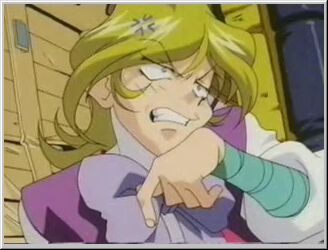
when Otaru and his marionettes accidentally forget to wake Hanagata up before going to a barbecue, Hanagata refuses to listen to Otaru's apologies and throws a tantrum worthy of a five-year-old; pouting, rolling on the ground, and basically demanding attention from everyone in the vicinity. While some may find his behavior in this scene funny or even eccentric and endearing, many would find it both inappropriate and slightly annoying to see a grown man whining over something that seems very trivial. Further, some SMJ fans do not find Hanagata's full-time pursuit of Otaru Mamiya amusing or cute. Although many may agree that Hanagata is not a physical threat to Otaru's safety (due to his own ineptitude and lack of any malicious intentions towards the object of his affections), several fans are troubled by the extreem measures Hanagata often goes to to get his "soul mate's" attention (including sneaking into his bed, hiding in drawers and closets, and following Otaru wherever he goes). In their eyes, Hanagata is nothing more than an obsessed stalker who is unwilling to take repeated "NOs" for an answer. And as such (and given several high-profile cases of stalking that have turned dangerous or deadly in the 1990s), they cannot excuse his behavior nor find it amusing.
Finally, and perhaps most importantly, many people have problems with Hanagata because they feel he is a harmful stereotype of a gay man. And certainly, one does not have to look at this character twice to see evidence for this argument; Hanagata's voice, dress and manerisms (which many could easily describe as "effeminant") all readily bring to mind the negative and cruel ways homosexual men have been often been depicted in art, literature and film since the Victorian era; as dandy, coward, and an 'emasculated' man whose desire should be mocked and scorned because it is somehow "unnatural". This argument is given possibly further and even slightly chilling weight when considered alongside the Shogun's explaination of the 'natural order' of human life and nature in Episode 22 of SMJ. In this conversation with Otaru, the Shogun upholds a traditional heterosexual view of human life, stating that men and women were meant to fall in love, reproduce, and raise families together. At no time in this speech does he make any attempt to explain homosexuality or the apparently homosexual world of Terra Two other than to say that such a situation is 'unusual'. If such a view of life is correct, one may be tempted to ask, then how do Hanagata and his love of men fit into the grand scheme of things? Additionally, Hanagata is often the recipient of jokes, actions and treatment ranging from the insensitive (Lime's nick name "girly man") to the downright sadistic (frequent beatings and even usage as a human shield). While he is not necessarially abused because he is gay, he is often abused by Otaru and the marionettes for making homosexual advances or simply getting in the way of their own designs on their master. Thus, if one may present the argument that Hanagata is simply punished because he is annoying, childish and stubborn, one may also ask why none of the "straight" SMJ characters (such as Faust and Cherry) who are also stubborn and obsessive ever recieve such cold and calculated abuse as "punishment" for their sins.
For the record, however, I do not believe that Hanagata is entirely a negative stereotype, even though I can understand why several people view him as such. While he is certainly one of anime's least "politically correct" characters (and one whom I sometimes worry about liking as lesbian and a supporter of gay rights), I believe that for all his stereotypical behavior, Hanagata is a deeply complex and fascinating character -- if one can look beyond his rather rough and 'inappropriate' surface.
Disagree with me? Think what I've written hits the nail on the head or misses the mark completely? I'd love to read some of your essays on Hanagata. If you have them, pro or con, please email them to me. |