| Singleton Cloggers |
 |
| The North West Tradition Morris dancing is one of the few calendar customs that are popularly seen as archetypically English and is only one of the few with a demonstrable history back to the early modern period. There are a number of references in 15th century sources, the first known being in 1458, and 1494 at least morris dancers were performing at the king's court. 2nd January 1494� Privy purse expenses of Henry VII: For playing of the Mourice daunce �2 (and another on 4 Feb. 1502) (quoted Hazlitt, 1905: 422) The heyday of the Morris in the North-West seems to have been the first half of the 19th century. At this time morris dancing regularly accompanied the rush cart to the Church at the annual wakes holiday in the late summer. For a long time, the North West Morris has been a processional dance, performed whilst moving along the streets. It is worth noting that in Lancashire the procession was, and in some areas still is, a favourite form of celebration. Even today the Whit Walks and annual carnival parades of Lancashire� towns echo this fondness for processions, and it is not surprising that the Morris fits in well with these occasions North West Morris follows the same general pattern wherever it is found. However, versions performed by different teams vary considerably and it is usual to refer to these versions by the name of the place where they were collected or performed. In west Lancashire and the Fylde in particular, there are many traditional dances identified by their places of origin such as Fleetwood, Poulton-le-Fylde, Lytham and more uniquely Weeton and Singleton As has been stated, the Morris has been particularly associated with the annual wakes Festivals during the nineteenth century. However there was a growing opposition to the drunkenness and fighting that often accompanied the rush cart processions. A tract written in Rochdale about 1870 says "no young woman, fit to a be wife, would ever think for a moment about having for a husband any young man that would degrade himself by putting on a fool's dress and go shouting and singing, brawling, swearing, drinking, and often fighting throughout the public streets" Times have changes, however, and the Morris teams were decimated by the Great War and the changes that it brought with it. Fortunately, during the 1920's girls and women's teams became predominant in the north-west and since the 1930's many mixed teams have survived. Costume The North West Morris is probably the most colourful of English dances. The elaborate costumes, together with the large number of dancers that take part, provide a show which stands out among crowds and noisy streets. Costumes are often decorated by rosettes, ribbons, strings of beads and badges. Headgear is often a straw hat or bowler bedecked with flowers, or a velvet cap (like a school cap) decorated with ribbons or a tassel. Clogs are almost always worn, with brass nails and eyelets and bells attached to the laces. Clogs and clog making Clogs were widespread in the British Isles by the mid 19th century though they have always been more popular in the north and west than elsewhere. In 1841 there were said to be 3246 clog and pattern makers in England and Wales and of these more than half resided in Lancashire. There are very few craftsmen skilled in clog making practicing commercially but there has been a resurgence of interest in clogs and clog dance teams account for much of this demand. Music Where possible, music is always provided by a band which nowadays may consist of melodeons, concertinas, accordions, fiddles, flutes, banjos etc. The revival of English folk music is well suited to morris dancing. The revival of the English folk musician is largely reliant upon a good supply of ales and a comfortable inn. Conclusion Who would have believed, as we are now in the new Millennium, that they're are over 750 Morris sides in the UK as well as 250 side in the USA, Canada, Hong Kong, Australia and New Zealand, all covering the six regional variations developed throughout the UK, namely: North West, Cotswold, Border, Molly, Longsword and Rapper. |
 |
| North West Mixed Morris Team |
| WHERE TO NEXT? HOME ORIGINS OF MORRIS NORTH WEST TRADITION EVENTS PHOTOGRAPHS LINKS DAY OF DANCE BUY A BADGE |
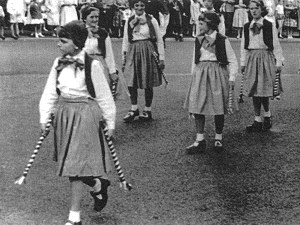 |
| Dancing in the 60's |
| CONTACT US....... |
| Email: |
|
 |