http://www.livingcog.org/
"What's Ahead for America and
Britain?"
|
|
Preface:
The Lost Master Key—Found! What does the future hold for the
world's English-speaking peoples? What really is on the horizon for
America, Britain, Canada, Australia and New Zealand? Heads of government
don't know. Leading analysts of foreign affairs don't know. Neither do the
overwhelming majority of editors and newscasters. But YOU can know! |

[ Click here to
order a FREE printed copy of this booklet. ]
How can you know?
The answers to the really big questions in life, including the very future
itself, are contained in the world's perennial best-seller, the Bible. More
than a quarter of the Bible is prophecy, mostly for our day and beyond.
Astounding? Absolutely, but it is true!
How can you understand these prophecies? Perhaps
the most vital key to unlocking the mystery of Bible prophecy is the one you
will see revealed right here in the pages of this booklet.
Nations such as Egypt and Ethiopia are directly
mentioned in your Bible. What about the big nations that are major players on
the modern world scene? Could it be possible that end-time prophecies would
ignore the United States and Britain, and the British-descended peoples of the
Commonwealth countries?
The vital key to unlocking many Bible prophecies
is the knowledge of the real identity of the English-speaking peoples. These
peoples are identified in the Bible by the name of their ancient ancestor. Who
is that ancient ancestor, and can you prove it?
Why have the British-descended nations come to
possess the richest portions of the globe? Why have they enjoyed wealth and
power without parallel? Rising quickly to prominence after the year 1800,
Britain and America have clearly dominated the 19th and 20th centuries. But
what about the 21st century? Will the English-speaking nations continue to play
a leading role, or is a change ahead? It is vital that you understand what the
future holds for you and for your family. The events of the next few years will
absolutely confound the experts. But you can know if you understand how
to use the lost master key to understanding prophecy.
Though much has been written about Bible prophecy
in recent years, most of these works have been fatally flawed because writers
have not known the master key to Bible prophecy!
Simply put, most Old Testament prophecies are
directed at the House of Israel. Supposing erroneously that all the
references to Israel in prophecy mean the Jewish people and the Jewish state in
the Middle East, most Bible commentators have completely missed the point. They
do not know the modern-day identity of the descendants of ancient Israel. Yet
they could know, for the records of both history and scripture are very clear.
While the Jewish state and the city of Jerusalem
do certainly play an important role in end-time prophecies, not all
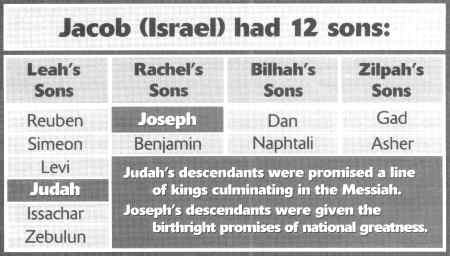
Israelites are Jews. The ancient patriarch Jacob, whose name was
changed to Israel, was the father of 12 sons. One of those sons, Judah, was the
progenitor of the Jewish people. What happened to the descendants of the other
sons?
When the 12 tribes returned to the Promised Land
after their Egyptian captivity, each settled in a different region. Eventually
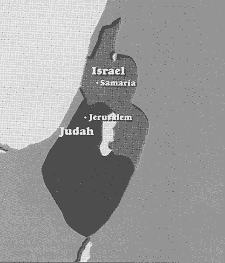
the tribes split into two kingdoms. The southern kingdom, called Judah, consisted
of the tribes of Judah and Benjamin and most of the Levites. The remaining ten
tribes formed the northern kingdom, called Israel.
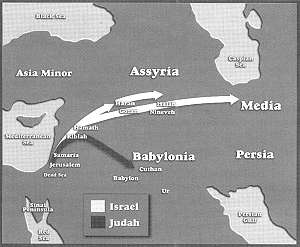
In 721bc, after a three-year siege, the Assyrians
conquered Samaria, Israel's capital. They began a systematic deportation of the
Israelites to the area north of the Euphrates River, in the area between the
Black and Caspian Seas (2 Kings 17).
After swallowing Israel, the Assyrians later
advanced into Judah, the southern kingdom. King Hezekiah, on the throne in
Jerusalem at the time, cried out to God in a heartfelt way, and God intervened
by sending an angel to destroy the Assyrian army of King Sennacherib in 701bc. Judah,
thus spared, continued on for about a century before her independence was again
threatened.
Then, in 604bc, the Babylonians under King
Nebuchadnezzar invaded Judah and advanced on Jerusalem. Judah was made a
tributary state within the Babylonian Empire. Returning again in 597bc,
Nebuchadnezzar took Judah's King Jehoiakim into captivity and placed Zedekiah
upon the throne. Dissatisfied with Zedekiah's behavior, King Nebuchadnezzar
returned approximately ten years later and completely destroyed Jerusalem,
burning the temple and taking most of the Jewish population into captivity in
Babylon.
Decades passed. Finally, in the fall of 539bc,
Babylon fell to the Persian armies of Cyrus the Great. Within a short time,
Cyrus issued a decree allowing the Jews to return from Babylon and to rebuild
their temple in Jerusalem under the leadership of Zerubbabel.
The
"Lost" Ten Tribes
However, and here
is the crucial point that most seem to overlook: THE NORTHERN TEN TRIBES NEVER
RETURNED FROM THEIR CAPTIVITY! Settled in an area hundreds of miles from where
the Jews were taken more than a century later, the ten tribes of Israel
remained completely separate and distinct from the Jews.
What happened to the ten tribes of Israel? History
has called them the "lost ten tribes." Where did they go? The answer
to that question is one of history's most fascinating stories. In fact, the
answer to that mystery is the actual key that unlocks most of the Old Testament
prophecies!
As you may guess, the identity and location of
these ancient peoples reveals who we are in America, Canada, Britain,
Australia, New Zealand and among the British-descended peoples of South Africa.
It explains why we have achieved such national greatness, and what
will happen to us near the end of this present age!
The knowledge of the identity of the descendants
of ancient Israel is revealed by a close examination of scripture together with
the record of secular history. The most highly educated leaders of our modern
world are blind to the true facts of this matter. They are blinded by the
theory of evolution into completely discounting the Bible as relevant for
today. As a result, they fail to see the amazing story laid out in scripture
and its relevance for our future.
Most religious leaders are in the same category. Even
those who claim to acknowledge the Bible as their authority are blinded by the
prejudices of denominational tradition.
But it is not just a question of ancient history!
Your future, your family's future, as well as the future of your nation hangs
on the answer! Where are the "lost ten tribes" of Israel today? As we
shall see, this lost master key to unlocking Bible prophecy has been
found!
Ezekiel's
Dramatic Vision
A young Jewish captive stood on a
riverbank near the southern Mesopotamian city of Babylon. He had been among the
thousands of Jews removed from their homeland more than four years earlier by
the conquering Babylonian armies under King Nebuchadnezzar.
At age 30, in his fifth year of exile, Ezekiel
the priest looked up to behold a remarkable sight. At first it looked like a
whirlwind approaching from the northern horizon. Looking intently, he saw that
this was no ordinary approaching storm. Brilliant flashes of light emanated
from the "whirlwind." Seeing an increasing glow of light as the
"storm" approached, Ezekiel began to identify details within this
remarkable whirlwind.
First he saw four strange-looking angelic
creatures. They had the general shape of men, but each possessed four wings and
four faces. As he continued to stare, Ezekiel noticed gyroscope-like wheels
next to each of these creatures. Then he noticed a great crystalline expanse
stretched over their heads.
As the whole apparatus came ever closer, Ezekiel
was able to discern a brilliant glow of light from above the crystalline
expanse. Within this light he could make out the shape of a throne and of a
glorious Being seated upon that throne. This, we are told, "…was the
appearance of the likeness of the glory of the Lord" (Ezekiel 1:28). At
this point, Ezekiel simply fell upon his face.
Suddenly a voice came forth from the throne and
told Ezekiel to stand up. The God of Israel proceeded to give him a commission.
He was being set as a watchman for the House of Israel (Ezekiel 2:3;
33:7).
This awesome display of glory and majesty deeply
impressed Ezekiel with the importance of his task since, for God to reveal
Himself in such a dramatic way, there must have been a very important purpose
indeed.
Ezekiel's
Commission
Notice that Ezekiel's
commission set him as a watchman not to his own people (the House
of Judah), but to the northern ten tribes of the House of Israel!
Judah was then only partially in captivity; the destruction of Jerusalem itself
lay several years in the future. But the House of Israel had been transported
into a strange land, hundreds of miles from Ezekiel, more than 120 years
before. What would be the point of warning those people, already captive, of
impending invasion and captivity?
Clearly, Ezekiel's message was not for the Israel
of his day! God was not more than a century late in warning them of
future punishment! That would make no sense at all. Besides, Ezekiel never had
a chance to deliver his message in person to the House of Israel. We thus can
see that his message was for the end time, and was written down and preserved
for delivery by God's faithful servants today!
God commissioned Ezekiel to be a watchman. What
exactly is a watchman? In ancient times it was customary to place someone in a
high tower atop the city wall to serve as lookout when danger threatened. It
was the watchman's job to be alert and vigilant, ever scanning the horizon for
signs of an approaching enemy. When he saw evidence of an enemy's approach, the
watchman was to sound a trumpet of alarm.
In the same way, God impressed upon Ezekiel that
if he did not sound the alarm God gave him, and calamities overtook the people
unaware, God would require their blood at his hands. If, on the other hand, he
sounded the alarms but the people failed to respond, they would bear the
responsibility themselves and Ezekiel would be guiltless (Ezekiel 33:9).
The House of Israel in Ezekiel's day was
already in captivity. The generation that suffered the captivity
had received a final warning more than a century earlier by the emissaries of
faithful King Hezekiah of Judah (2 Chronicles 30:1-12). Only a few responded;
the nation as a whole laughed the warnings to scorn, and Israel went completely
into captivity. Now, more than a century later, Ezekiel was given a similar
message of vital importance.
The events that would occur in Jerusalem and
Judah were to be a "sign" to the House of Israel (Ezekiel 4:3). Ezekiel's
warnings were for end-time Israel. In fact, we are told that the warnings are
to be heard near the time of the day of the Lord (Ezekiel 7:19, 13:5, 30:1-3),
the time of God's intervention at the end of this age. Other prophecies in
Ezekiel point to the regathering after the coming of the Messiah.
This will be the time when ancient King David will be resurrected and made king
forever (Ezekiel 37:21-25). Clearly this will take place at the resurrection of
the saints, a time prophesied to occur at Jesus Christ's return to this earth
in power and glory (1 Corinthians 15:50-53; 1 Thessalonians 4:16).
Ezekiel's dramatic vision has great meaning for
us today. It impresses us with the seriousness and importance of the commission
God had for him. Recognizing this, it is vital to understand clearly the
whereabouts in today's world of the descendants of the ancient House of Israel.
Once we understand their identity, we must share with them the contents of
Ezekiel's urgent message.
Ezekiel's message is a message of indictment for
sin, a call to repentance, and a promise of future deliverance and restoration.
While on the one hand it is a message of dire warning of God's impending
judgment, it is on the other hand a message of glorious hope for the future. In
fact, it contains the only real hope there is for our nations. The English-speaking
nations have lost their moral compass and have seemingly lost their way in the
world. Beset with serious problems and challenges at home and abroad, our
peoples lack both the wisdom and the will to respond.
Having fallen from the pinnacle of world power at
the close of World War II, the American and British peoples have seen
increasing challenges in the post-war world. But worse than the challenges on
the world scene, has been the moral slide from within. In the midst of material
prosperity we are beset with moral poverty! There are challenges that lie ahead
in the immediate future of which our leaders and our people do not even dream.
How can you know for sure that the Bible
prophecies relating to Israel relate primarily to the American and British
peoples? What do those prophecies really portend for your future? Read on for
the amazing answers to these and other questions.
The
Northern and Southern Kingdoms
Ancient
Promises Are Made
In Genesis 11:26-32 we are introduced
to Abram, whose name was later changed to Abraham. The rest of the Bible is an
outgrowth of God's dealings with him and the promises He made to Abraham and to
his descendants. The promises to Abraham are the basis of nearly all future
Bible prophecies!
Abram was born into a family that lived in Ur of
the Chaldees, a city in southern Mesopotamia near ancient Babylon. After the
death of one of his brothers, Abram, his father, and other family members moved
a few hundred miles to the northern Euphrates city of Haran. A while after
that, Abram's father, Terah, died and was buried. In the aftermath, God told
Abram, then age 75, to leave the remainder of his family and to go to a land
that He would show him. He promised to make him a great nation.
The promise first given in Genesis 12 is quite
vague. It simply consists of an undefined land that Abram and his family would
afterward be given for an inheritance. Throughout the remainder of Genesis we
read a remarkable story of the unfolding of the promises made by God.
The
Unfolding Promise to Abraham
In Genesis 12:1-3
we have record of the first promises that God made to Abram. God told him that
He would make of him "a great nation," that he would be blessed and
that through him all nations would be blessed, and that God would "…bless
those who bless you, and I will curse him who curses you…" (v. 3).
After Abram and his wife, along with his nephew
Lot, came into the land of Canaan, an incident occurred which led God to
further clarify the promises. Abram and Lot both had large herds and flocks and
strife had arisen between their herdsmen over grazing rights. Abram settled the
issue by offering Lot his choice of grazing land. Lot chose to cross the Jordan
River and to graze his herds in the plain of Jordan, near the cities of Sodom
and Gomorrah.
In the aftermath of the separation between the
two, God reiterated to Abram the promises. "And the Lord said to Abram,
after Lot had separated from him: 'Lift your eyes now and look from the place
where you are-northward, southward, eastward, and westward; for all the land
which you see I give to you and your descendants forever. And I will make your
descendants as the dust of the earth; so that if a man could number the dust of
the earth, then your descendants also could be numbered" (13:14-16). In
Genesis 15 this promise is further amplified. Abram was told that his
descendants would be like the number of the stars (v. 5). He was also given the
boundaries of his inheritance in the Middle East. In verses 18-21 Abram was
told that the land God was giving to his descendants would stretch from the
river of Egypt all the way to the Euphrates and include the territory of
several peoples who were currently occupying the land.
Father of
Many Nations
Abram and his
wife Sarai were both advancing in years and had not been able to have children.
Yet God had told him that he would have descendants who would inherit a land. For
24 years after they left Haran, Abram and Sarai waited and pondered these
promises. Finally, when he was 99 years old, God appeared to Abram once again.
In Genesis 17:6 God promised, "I will make
you exceedingly fruitful; and I will make nations of you, and kings
shall come from you." At this point Abram also learned that he would
become the father of many nations (v. 4). God told him that He was
changing his name to Abraham, meaning the "father of a multitude,"
and Sarai's name to Sarah, meaning "princess." Within a year, he was
told, Sarah would bear him a son (Genesis 17:19, cf. 18:14). Such a thing
seemed too incredible for words, but nevertheless it happened just as God said
that it would and Isaac was born at the appointed time.
Actually Abraham had had a son 14 years before
Isaac's birth, but this son Ishmael was not the son of promise. After ten years
of waiting on God's promises, Sarah had encouraged Abraham to take her maid
servant Hagar and have a child by her. He did this and thereby engendered
problems and conflicts that have endured to this day.
After Isaac's birth, Abraham sent Hagar and
Ishmael away (Genesis 21:14). Ultimately Ishmael married among his mother's
people, the Egyptians, and had numerous children. The Arab nations take their
origin from Ishmael's sons.
Years later, God came to Abraham once again, this
time to put him to the supreme test of his faith. God, who by this time had
been personally dealing with Abraham for decades, told him to take his son
Isaac and bring him to the mountains of Moriah to offer him as a sacrifice to
God. Responding in faith, Abraham did as God asked and was at the point of
offering up his heir and only legitimate son when God interceded and told him
to stop, and instead offer a ram caught in a nearby thicket, as a substitute
for Isaac.
In the aftermath, God reconfirmed the promises to
Abraham as having become unconditional. "Then the Angel of
the Lord called to Abraham a second time out of heaven, and said: 'By Myself I
have sworn, says the Lord, because you have done this thing, and have not
withheld your son, your only son, in blessing I will bless you, and in
multiplying I will multiply your descendants as the stars of the heaven and as
the sand which is on the seashore; and your descendants shall possess the gate
of their enemies. In your seed all the nations of the earth shall be blessed,
because you have obeyed My voice" (22:15-18).
There are a couple of key things to notice here. No
longer are the promises contingent upon future actions of Abraham and his
descendants. Because Abraham has now passed this supreme test of obedience, God
has guaranteed the unconditional future fulfillment of His promises.
Additionally, one other detail is now given. Abraham's
descendants would ultimately possess the "gates of their enemies." A
gate is a narrow passage, a means of entrance and exit. This promise means that
not only would Abraham's descendants become many nations, but they would
control the means by which their enemies must pass to come and go. We will
examine the significance of this remarkable promise later in this booklet.
Promises
Both Spiritually and Physically Fulfilled
"But aren't
all of the promises to Abraham fulfilled in Christ?" some might ask. That
is a question that must be answered directly from the Bible.
Clearly, according to Galatians 3:26-29, all true
Christians are accounted as spiritual children of Abraham and heirs of the
promise. The ultimate fulfillment of God's blessings upon Abraham include the
promise that he and his spiritual offspring would inherit the whole earth
(Romans 4:13; cf. Matthew 5:5). Abraham was promised an everlasting inheritance
(Genesis 17:8), which certainly presupposes the possession of eternal life!
Obviously there was a spiritual aspect to the
promises that God made to Abraham! God's grace was to be extended to all
mankind through the one Seed, Christ (cf. Galatians 3:16). The Messiah,
descended from Abraham, would be the One through whom the blessing of salvation
from sin and the gift of eternal life would become available to all mankind
through God's grace.
However, there was also a physical aspect to the
promises to Abraham. The birthright involved promises of national greatness as
well as agricultural and mineral wealth. In Genesis 13:16 Abraham was told by
God that He would make his seed number like the dust of the ground. Here,
clearly, the reference is to Abraham's numerous physical descendants who would
inherit national greatness and possess the gates of their enemies.
The promises to Abraham include both spiritual
and physical components. They point toward Jesus the Messiah, but they also
point toward the birthright blessings that would be bestowed upon a multitude
of his descendants who would become a great nation and a great company of
nations. This does not mean that the recipients of these blessings are any
better or more special than those who did not receive the blessings. In fact,
we see that those who received the physical blessings have, for the most part,
squandered them and turned from God, for which they will have to face His
judgment.
Israel's
Beginning
Many years after
the promises were first made, God reconfirmed them to Abraham's son Isaac. "Sojourn
in this land, and I will be with you and bless you; for to you and your
descendants I give all these lands, and I will perform the oath which I swore
to Abraham your father. And I will make your descendants multiply as the stars
of heaven; I will give to your descendants all these lands; and in your seed
all the nations of the earth shall be blessed; because Abraham obeyed My
voice and kept My charge, My commandments, My statutes, and My laws"
(Genesis 26:3-5). The promise to Isaac was based upon Abraham's obedience to
God (cf. v. 24).
Isaac and his wife, Rebecca, had two sons. Jacob
and Esau were their names and, in spite of being twins, they were totally
different in temperament and character from the very beginning. God had
revealed prior to their birth that the older, Esau, was to serve the younger,
Jacob (25:23). Yet Jacob, who was a natural wheeler-dealer, was unable to wait
for God to give him the birthright blessings. He contrived to trick his father
so as to secure this for himself on the timetable he and his mother conceived. God
allowed this because it was His purpose for Jacob to receive the promises. Jacob
then had to learn some difficult lessons through experience to bring him to
repentance.
However, let us notice the birthright blessings
that Isaac conferred to Jacob. "Therefore may God give you of the dew of
heaven, of the fatness of the earth, and plenty of grain and wine. Let peoples
serve you, and nations bow down to you. Be master over your brethren, and let
your mother's sons bow down to you. Cursed be everyone who curses you, and
blessed be those who bless you!" (27:28-29). Here two details are
mentioned for the first time. The first is that Jacob's descendants would
possess great agricultural wealth. The second is that they would obtain
rulership over other peoples and nationalities.
After Jacob's deception of his brother, Isaac and
Rebecca told him to travel to the area where his mother's family lived. There
he could find a wife and spend some time until his brother's anger cooled off. Isaac's
parting words were, "May God Almighty bless you, and make you fruitful and
multiply you, that you may be an assembly ["multitude," KJV] of
peoples; and give you the blessing of Abraham, to you and your descendants
with you, that you may inherit the land in which you are a stranger which
God gave to Abraham" (28:3-4).
A short time later, God came to Jacob in a dream
and further amplified the promises. In his dream he saw a vast staircase
reaching up to heaven and angels ascending and descending. "And behold,
the Lord stood above it and said: 'I am the Lord God of Abraham your father and
the God of Isaac; the land on which you lie I will give to you and your
descendants. Also your descendants shall be as the dust of the earth; you
shall spread abroad to the west and east, to the north and the south; and
in you and in your seed all of the families of the earth shall be
blessed" (28:13-14).
Here, for the first time, we learn that the
inheritance God promised to Abraham encompassed more than just the land in the
Middle East. Jacob's descendants were to spread abroad from that inheritance
and affect the entire world. Their inheritance would bring them into contact
with peoples all over the earth.
The story continues in Genesis and we see the
lessons that Jacob learned during the time of his exile from Canaan. Finally,
as he returned to his homeland, God met him at a location afterward named
Peniel. After Jacob had wrestled all night with the Divine Messenger, God told
him, "Your name shall no longer be called Jacob, but Israel; for you have
struggled with God and with men, and have prevailed" (32:28). Jacob-Israel
was the father of 12 sons, who were the ancestors of the 12 tribes of Israel.
The promises to Abraham were being passed down
from father to son and had gradually been expanded. There is much more yet to
come! Abraham had been told that he would produce "many nations" who
would achieve national greatness and also that he would give rise to a kingly
line. This promise was now divided among two of Jacob's 12 sons. Notice the
clear delineation given in 1 Chronicles 5:1-2, "Now the sons of Reuben the
firstborn of Israel-he was indeed the firstborn, but because he defiled his
father's bed, his birthright was given to the sons of Joseph, the son of
Israel, so that the genealogy is not listed according to the birthright; yet Judah
prevailed over his brothers, and from him came a ruler, although the
birthright was Joseph's."
Judah was clearly given the scepter promise of a
line of kings culminating in the Messiah who would be king of kings. But take
note! The birthright promises of national greatness went NOT TO THE
JEWS, but to the descendants of Joseph. Understanding this is the master
key that begins to open up everything else!
Ephraim and
Manasseh Receive the Birthright
Let us look
further at how the birthright promises were amplified for the descendants of
Joseph. An important part of this story occurred a short time before the death
of Jacob-Israel. By this time he and his entire family were living in Egypt
where Joseph was serving as Administrator directly under Pharaoh. Joseph came
to visit his elderly and infirm father and brought with him his two sons,
Ephraim and Manasseh. A little-understood ceremony occurred during this visit.
In Genesis 48:5, Israel informed Joseph that he
was adopting Ephraim and Manasseh-that they would be counted as his and
therefore be counted among the tribes of Israel. Thus Joseph was given a double
portion. After Joseph brought his sons close, Israel embraced them, proceeded
to lay hands on them and set them apart for special blessing.
At this time a remarkable event occurred. Joseph
had purposely arranged the boys so that the older, Manasseh, was standing on
Israel's right side and the younger, Ephraim, was standing on his left side. This
was so that he would place his right hand, signifying the greater blessing, on
Manasseh and the left on Ephraim. Israel, however, crossed his hands and put
the right hand on Ephraim and the left on Manasseh. When Joseph saw this he
tried to correct what he perceived as a mistake on the part of his nearly-blind
father. Israel resisted, however, and explained that this crossing of his hands
was purposeful.
Israel told Joseph that his older son Manasseh
was to become a great people, but that Ephraim was to become a multitude or
company of nations (v. 19). Here we find that a great nation and also a great
company of nations were to spring from the descendants of Joseph. They were
the ones who receive the birthright blessings of national greatness. This
included possession of strategic check points through which their enemies would
have to pass, vast agricultural and mineral wealth, and status as world powers
that would exercise dominance over other nations. Since God had promised that
they would be a blessing to other nations, we know that their dominance as
world powers would be exercised in a benign way overall.
Is there historical record of these promises
being fulfilled? Before we examine that, look at a few more details that unfold
in the book of Genesis. A short time after adopting Ephraim and Manasseh and
conveying the birthright blessings upon them, Israel called all of his sons to
his bedside. He was at the end of his long life and wanted to give his last
admonition and blessing to his family.
Notice what he told them. "And Jacob called
his sons and said, 'Gather together, that I may tell you what shall befall
you in the last days" (49:1). Israel's prophecy that followed was not
for his day or for the time when his descendants would come out of Egypt and
enter into the Promised Land. It was for the end-times! Clearly at the end-time
the descendants of Israel were still to exist as separate, identifiable tribes.
Notice his words for Joseph. "Joseph is a
fruitful bough, a fruitful bough by a well; his branches run over the
wall" (v. 22). This is a poetic allusion to a people who would multiply
and spread out all over. After all, Joseph's sons were ultimately to give rise
to a great nation and a great company of nations. Israel therefore foresaw them
as a great colonizing people. He also conveyed the blessings of heaven
above and of the deep that lies beneath. This implies great mineral wealth
(blessings of the deep) as well as blessings of weather that would provide
great agricultural wealth (blessings of heaven above).
But were these fabulous promises ever fulfilled
for the descendants of Ephraim and Manasseh? The very authenticity of your
Bible as the word of God stands or falls on that point!
After they left Egypt, the tribes of Israel lived
for centuries in the Middle Eastern territory that God had promised. There is no
record of Ephraim and Manasseh ever becoming a great nation and company of
nations prior to Israel's captivity. They never became a
blessing to all the nations of the world before they went into Assyrian
captivity in the eighth century before Christ. Clearly, the fulfillment of the
promises that God made to Abraham and reconfirmed to his descendants DID NOT
occur before ten-tribed Israel disappeared from the pages of your Bible and
then from the pages of secular history.
How these promises were yet fulfilled, as we
shall see, is "the rest of the story!"
Israel's
Captivity and Lost Identity
Before the children of Israel ever
entered the Promised Land, Moses was inspired by God to warn them of the
future. The promises of God were sure, but the TIMING of their
fulfillment was up to God and depended upon Israel's conduct.
In Leviticus 26:1-2 God, through Moses, warned
the Israelites, "You shall not make idols for yourselves… You shall keep
My Sabbaths and reverence My sanctuary: I am the Lord." He went on to tell
them that, "If you walk in My statutes and keep My commandments, and
perform them, then I will give you rain in its season, the land shall yield its
produce, and the trees of the field shall yield their fruit" (vv. 3-4). In
the following verses God detailed blessings of agricultural bounty and peace
that would come upon the nation if it was faithful. In verse 12 He concluded
His promised blessings by stating, "I will walk among you and be your God,
and you shall be My people."
Just as there were blessings for obedience,
however, there were serious consequences for disobedience. If Israel went into
idolatry and forgot God's Sabbaths, then God would punish the nation for its
actions. In verses 16 and 17 He detailed the punishments of diseases and of
enemy incursions into their territory which would result. What would happen,
if, after repeated punishment, Israel persisted in rebellion against God and
His laws? Verse 18 tells us, "And after all this, if you do not obey Me,
then I will punish you seven times more for your sins." The Hebrew
word here rendered "seven times" can refer either to length of time
or to intensity of punishment.
Seven Times
Punishment
In Daniel 4 we
read of a dream that King Nebuchadnezzar of Babylon had. In the dream he was
told that he would be punished for his pride by losing both his kingdom and his
sanity. In this dream he was told that "seven times" would pass
before his restoration. In the historical fulfillment of this dream, it is
apparent that the seven times were a period of seven literal years.
What were the seven times of Israel's punishment
promised in Leviticus 26:18? If this indicated a duration of time, how long was
it to last? Understanding the significance of Israel's seven times punishment
opens up history to far deeper meaning than you have probably ever understood
before.
First, let us answer the question concerning the
length of the "seven times." How many days would "seven
times" be? In Revelation 11 and 12 we find keys to understanding this.
Revelation 11:2-3 equates two periods of time:
42 months and 1,260 days. This is simple to understand, as there are exactly
1,260 days in 42 months of 30 days. In Revelation 12:6 we find another mention
of 1,260 days, but this time that figure is paralleled in verse 14 by the term,
"time, times, and half a time." We have already seen that 1,260 days
is equated with 42 months, which is exactly three-and-a-half years. Clearly
then, the Bible equates "time, times and half a time" with a
three-and-a half-year period of 1,260 days.
"Seven times" is double the length of
"time, times, and half a time" (or three-and-a-half years). Therefore,
seven times would represent a duration of 2,520 days (twice the length of the
1,260 days). How long a period of punishment upon Israel would these 2,520 days
represent in Bible prophecy? To understand this, look at another incident of
punishment on Israel. Numbers 13 and 14 give the account of Moses sending 12
spies, one from each tribe, to investigate the Promised Land. Ten of the spies
brought back an evil report that discouraged the people and caused them to
refuse to enter the land. God was greatly displeased with the people's lack of
faith. Notice the consequences that followed, "According to the number of
the days in which you spied out the land, forty days, for each day you shall
bear your guilt one year, namely forty years, and you shall know My rejection
['breach of promise' KJV]" (Numbers 14:34).
Israel's disobedience led to a 40-year delay in
entering the Promised Land and inheriting the promises God had made to their
ancestors. The 40 years of punishment were figured on the principle of a day
for a year. A similar point is made in Ezekiel 4 about punishment on Judah and
on Israel. In this account, the prophet Ezekiel was told to lie upon his left
side each day for 390 days to symbolize the duration of God's punishment upon
Israel. Then, he was told to turn and to lie upon his right side each day for
40 days in order to show the punishment of Judah. Next, Ezekiel was told,
"…I have laid on you a day for each year" (v. 6). In other words,
once again a day equaled a year in the fulfillment of certain Bible prophecies.
With each day representing a year in the
fulfillment of Israel's punishment, seven times would represent 2,520 years. What
is the full significance of this period of time? We will shortly see the
amazing answer. But first, let us examine why Israel went into captivity at
all.
Why the Ten
Tribes Went into Captivity
In Leviticus 26,
God made it plain that if Israel began to worship idols and to break His
Sabbath, He would work through punishments to get their attention. Fulfillment
of this prophecy is seen throughout the book of Judges as Israel lapsed into
sin and God allowed terrorist raids by surrounding nations to disrupt Israel's
peace and its economy. Sometimes these nations actually brought Israel under
direct rule for years. This cycle continued for more than three centuries
before the monarchy was established.
After the death of King Solomon the kingdom of
Israel split into two totally separate nations. The northern ten tribes chose
Jeroboam the son of Nebat as their king, while Judah remained loyal to
Rehoboam, Solomon's son. Shortly after the division of the kingdom, Jeroboam
made a decision that affected the ten tribes of Israel for the remainder of
their history.
We read this crucial story in 1 Kings 12. Jeroboam
began to fear that the ten tribes would, in the future, long for reunion with
Judah. He decided that going up to worship God at Jerusalem during the festival
seasons each year would lead to nostalgia for "the good old days." He
feared a future yearning for the time when they had been one nation under
David's dynasty in Jerusalem. This, he believed, would lead eventually to
displacing himself or his descendants.
As he pondered this problem, Jeroboam came up
with what he considered the solution. He called the people together and
announced some changes. To make things more convenient, he told them that
henceforth they would have two worship sites in northern Israel from which to
choose. This way they would no longer have to go all the way to Jerusalem. He
established his new sites of worship at the city of Dan in the north and at
Bethel in the south. At each location a golden calf would be the object of
worship. Additionally, the Levitical priesthood would be replaced by men loyal
to Jeroboam and his new religion. We are told that, in fact, Jeroboam made
"priests of the lowest of the people" (v. 31). As if all of this were
not enough, he also introduced a change in the timing of God's annual
festivals. The Feast of Tabernacles, which came in the seventh month of God's sacred
calendar, was postponed until the eighth month.
Throughout the remaining 200 years of northern
Israel's existence as an independent nation, many dynasties came and went. Regardless
of who was king, however, we are told over and over that "he departed not
from the sin of Jeroboam the son of Nebat who taught Israel to sin" (cf. 1
Kings 15:34, 16:19; 2 Kings 3:3, 10:29, 13:2, 6, 11, 14:24, 15:18, 24, 28,
17:22). The ten tribes totally disregarded God's admonitions to their ancestors
through Moses. They worshiped idols, violated God's Sabbaths and, in general,
simply disregarded God's laws.
The consequences were inevitable. God had warned
centuries earlier, through Moses, that a "seven times" punishment
would come upon them if they persisted in disobedience. Finally, in the
mid-eighth century, armies of the mighty Assyrian Empire invaded Israel.
Israel's King Menahem bought a respite by giving
Assyrian King Pul a large sum of money to withdraw. A few years later, however,
during the reign of one of Menahem's successors, Pekah, the Assyrians returned
under Tiglathpileser. This time the Assyrians subjugated much of the eastern
and northern part of the kingdom. Several tribes, including much of Reuben,
Gad, and Naphtali were taken into captivity and transported to Assyria. During
the reign of Pekah's successor, Hoshea, things worsened. The Assyrians returned
under their new king Shalmaneser and exacted tribute from the remnant of
Israel. Then they returned a few years later and laid siege to Samaria. After a
three-year siege Samaria fell. The Assyrians then began to deport the
population of ten-tribed Israel en masse.
Captivities
of Israel and Judah
Israel's
Last Chance
This deportation
took years to accomplish. Before it progressed very far, a righteous king came
to the throne in Judah, the southern kingdom. This king, Hezekiah, assumed
complete authority in 714bc, upon the death of his father Ahaz. He had been
joint ruler with his father for several years, but did not have independent
authority until his father's death. He, in sharp contrast to his father, was a
man who sought with his whole heart to follow God. He initiated a revival in
Judah at the very start of his sole reign. He opened the temple in Jerusalem
and called upon the people to repent and rededicate themselves to the worship
of the true God.
Hezekiah told the people, "For our fathers
have trespassed and done evil in the eyes of the Lord our God; they have
forsaken Him, have turned their faces away from the habitation of the Lord, and
turned their backs on Him… Therefore the wrath of the Lord fell upon Judah and
Jerusalem, and He has given them up to trouble, to astonishment, and to
jeering, as you see with your eyes. For indeed, because of this our fathers
have fallen by the sword and our sons, our daughters, and our wives are in
captivity. Now it is in my heart to make a covenant with the Lord God of
Israel, that His fierce wrath may turn away from us" (2 Chronicles
29:6-10).
This revival under Hezekiah not only offered
Judah a reprieve from the sword of the Assyrians, which was destroying the
kingdom of Israel just north of them, it was also a last chance for the northern
ten tribes to avert complete exile. Notice what King Hezekiah did: "And
Hezekiah sent to all Israel and Judah, and also wrote letters to Ephraim and
Manasseh, that they should come to the house of the Lord at Jerusalem, to keep
the Passover to the Lord God of Israel… So they resolved to make a proclamation
throughout all Israel, from Beersheba to Dan, that they should come to keep the
Passover to the Lord God of Israel at Jerusalem, since they had not done it
for a long time in the prescribed manner" (2 Chronicles 30:1, 5). Hezekiah's
messengers warned the remaining inhabitants of the northern kingdom: "Now
do not be stiffnecked, as your fathers were, but yield yourselves to the Lord… For
if you return to the Lord, your brethren and your children will be treated with
compassion by those who lead them captive, so that they might come back to
this land…" (vv. 8-9).
What was Israel's response? "So the runners
passed from city to city through the country of Ephraim and Manasseh, as far as
Zebulun; but they laughed them to scorn and mocked them. Nevertheless
some from Asher, Manasseh, and Zebulun humbled themselves and came to
Jerusalem" (vv. 10-11). By and large Israel ignored King Hezekiah's
warning and his call to repentance-the final warning they were to receive. In
the years immediately following, the Assyrians completely depopulated northern
Israel and brought in people of Babylonian stock to resettle there. These
newcomers were later known as Samaritans, taking their name from Israel's
capital city.
Israel had begun an odyssey that would not
conclude for many centuries-2,520 years would pass before the descendants of
Israel would begin to receive the birthright blessings promised their
ancestors. For 2,520 years-a year for a day-they would experience God's
"breach of promise."
Israel's
Lost Identity
In Exodus
31:12-17 God instructed Moses that His Sabbaths were to be a sign between Him
and Israel forever. A sign is something that identifies. The Sabbath is a
perpetual reminder of who God is and who His people are. As long as Israel kept
the Sabbath, they maintained their identity.
To this day, the people of Judah have maintained
their identity, regardless of what far-flung corner of the world in which they
may live. They have retained the sign of the Sabbath and have never lost sight
of who they are.
Israel, on the other hand, from the time of King
Jeroboam has abandoned God's Sabbaths and substituted its own days of worship. As
a result, captive Israel did not stand out as different from the surrounding
nations and peoples. Those whom they met did not associate them with the Jews,
and eventually most Israelites forgot their true origin.
Many of the customs that Israel carried into
captivity were borrowed from the pagan nations around them. At the time of
Israel's Assyrian captivity, the prophet Micah was in Judah. He warned Israel
of their impending punishment and why it was to come. "For the statutes of
Omri are kept; all the works of Ahab's house are done; and you walk in their
counsels, that I may make you a desolation and your inhabitants a hissing. Therefore
you shall bear the reproach of My people" (Micah 6:16).
Who was Omri and what were his statutes? What did
this have to do with Israel's lost identity?
Captive
Israelites Become Known as Cimmerians
In captivity,
Israel lost even its national name. Having abandoned their sign of identity
that God established, the Israelites have become lost to most secular
historians. However, they were certainly not lost to God. Notice the message he
inspired the prophet Amos to record in the years prior to Israel's captivity. "'Behold,
the eyes of the Lord God are on the sinful kingdom, and I will destroy it from
the face of the earth; yet I will not utterly destroy the house of Jacob,' says
the Lord. 'For surely I will command, and will sift the house of Israel among
all nations, as grain is sifted in a sieve; yet not the smallest grain shall
fall to the ground'" (Amos 9:8-9).
In 1 Kings 16 we read of Omri and of his rise to
power. He overthrew his predecessor, Zimri, and established a powerful dynasty.
Though he only reigned 12 years, he established the capital city of Samaria and
put laws in place that guided the nation through the rest of its history. His
role as lawgiver was so established that 150 years after his death, and many
dynasties later, the prophet Micah still referred to Israel as keeping
"the statutes of Omri." Clearly rejecting the laws that God had given
through Moses, the House of Israel chose instead to keep the laws enacted by
Omri. "Omri," we are told by scripture, "did evil in the eyes of
the Lord, and did worse than all who were before him" (v. 25).
Plainly, then, the statutes of Omri included
pagan religious practices. His son Ahab was married to Jezebel, daughter of
Ethbaal priest-king of the Baal worshipping Sidonians. Though many of the
outward trappings of Baal worship were later eliminated by a subsequent king,
Jehu, Israel never really returned to God.
Notice the comments of Langer's Encyclopedia
of World History regarding the extent of Omri's influence. "Omri
established a long-lived dynasty. He built a new capital at Samaria and renewed
alliances with Tyre… He also reconquered Moab as we learn from the Mesha
inscription. Omri was evidently a strong king. The Assyrians called Israel
after his name, Bit Omri (Khumri)" (1968 edition, p. 44).
The history of the ancient world, apart from what
is recorded in scripture, comes down to us in the writings and monuments of the
great empires of antiquity and in the writings of the Greek historians. The
Assyrians, in their monuments, did not use the name "Israel," but
rather referred to the "Khumri." This is the name by which Israel was
known in captivity. This name, and variants of it in the languages of
neighboring peoples, is the name by which the people of Israel are identified
in secular history.
The people who were identified on Assyrian
monuments as Khumri were called in the Babylonian language Gimmirra (or
Gimiri). The Greek geographers such as Herodotus called them Cimmerians. Thus,
the names by which captive Israel is identified in secular history are the
names by which others called them, and those names varied in spelling and
pronunciation according to the language of the writer.
Israel's
Migrations
What happened to
the Israelites who were taken captive by the Assyrians? The Bible tells us that
they were settled near the River Gozan and in the cities of the Medes. Gozan
was a tributary of the northern Euphrates River. The cities of the Medes were
in the area just south of Armenia, between the Black and Caspian Seas.
The apocryphal book of 2 Esdras, written a
century or so prior to the time of Christ, records the tradition that had been
preserved among the Jews. "Those are the ten tribes, which were carried
away prisoners out of their own land… and he [Shalmaneser] carried them over
the waters, and so came they into another land. But they took this counsel
among themselves, that they would leave the multitude of the heathen, and go
forth into a further country, where never mankind dwelt… And they entered into
Euphrates by the narrow passages of the river" (13:40-43).
To say that the migrating Israelites followed the
"narrow passages of the river" simply means that they went northward
through the narrow mountain passes of the headwaters of the Euphrates. This
took them north of the Caucasus Mountains and on to the northern shore of the
Black Sea. This is exactly where history places the Cimmerians, who later
traveled up the Danube and Rhine River basins into northwestern Europe.
Lempriere's Classical Dictionary locates
the Cimmerii "…near the Palus Maeotis" (p. 149). Palus Maeotis was
the name the ancient Greeks gave to the large lake at the northern tip of the
Black Sea, now called the Sea of Azov. From this area some of the Cimmerians
migrated directly up the river system into northwestern Europe, while others
invaded Asia Minor, and after being pushed out also went up into northern
Europe.
Regarding the Cimmerii-Israelites' entrance into
northwestern Europe, M. Guizot in The History of France from Earliest Times
to 1848 states: "From the seventh to the fourth century B.C., a new
population spread over Gaul, not at once, but by a series of invasions, of
which the two principal took place at the two extremes of that epoch. They
called themselves Kymrians or Kimrians… the name of a people whom
the Greeks placed on the western bank of the Black Sea and in the Cimmerian
peninsula, called to this day Crimea" (p. 16). Called Gauls or
Celts by the Romans, these people spread through what is modern France and into
the British Isles.
The heaviest periods of this migration into
northwestern Europe were shortly after the original Assyrian invasions, and
again almost 400 years later. In 331bc, Alexander the Great defeated the Medes
and the Persians. Those Israelites who were still in the ancient area of the
Medes were now free to leave. Interestingly, this marks 390 years from the fall
of Samaria to the overthrow of the Medes (721bc-331bc)-the exact period that
Ezekiel had prophesied for the House of Israel in Ezekiel 4:5.
Another ancient name by which the exiled
Israelites were known is "Scythian." A vast area of what is today the
Eurasian plain of Russia was anciently called Scythia. Various peoples
inhabited this huge area, including many tribes of exiled Israelites. According
to the Greek historian Herodotus, "…the Persians called them Sacae, since
that is the name they give to all Scythians" (The Persian Wars,
VII, 64). The word Sacae or Sakae is ultimately derived from Isaac, ancestor of
the Israelites. This is the true origin of the names Scotland, Saxon, and
Scandinavia.
The Scots preserve the story of their Scythian
origins in the most famous document in Scottish history, the Declaration of
Arbroath. This declaration was written in 1320 and signed by Robert the Bruce
and his nobles. In it is the statement that the Scots "…journeyed from
Greater Scythia by way of the Tyrrhenian Sea… they came twelve hundred years
after the people of Israel crossed the Red Sea [ca. 250bc], to their home in
the west where they still live today." The original of this ancient
letter, called by many "Scotland's most precious possession," is on
display in a glass case in the Register House in Edinburgh. To the parchment is
attached the seals of the 25 subscribing Scottish nobles.
Thus we see that the ten tribes of Northern
Israel were uprooted from their homeland in the eighth century before Christ,
and transported to a different area by their captors. Losing their identity,
they became known to history by a variety of names. Cymri, Celts, and Scyths
are but a few. Today, guided by ancient records, we can trace the migrations of
these peoples from the Black Sea to the British Isles and northwestern Europe.
How does all of this fit in with the prophecies
of your Bible? Read on for the startling answers.
The
Birthright Promises Are Fulfilled
Anciently, God made remarkable
promises to Abraham and his descendants. We have already seen that the northern
ten tribes were uprooted from their homes and that they ultimately migrated
into northwestern Europe. What became of the fulfillment of the promises to
Abraham?
Look at the remarkable way in which God has
intervened in history to accomplish His purpose and to fulfill His word.
Seven prophetic times-2,520 years-went by from
the time of Samaria's fall and Israel's captivity in 721bc. This brings us to
1800ad and the time when, according to scripture, Abraham's descendants would
begin coming into possession of the birthright promises. The remarkable story
that unfolded in the history of the English-speaking people after 1800 is
astounding.
To fully understand what happened and to put it
into perspective, let us briefly look at the history of Europe. By the close of
the 11th century after Christ, most of the European migrations were completed
and nations were mostly in the areas in which we find them today. The
Israelites had arrived, in waves of migration extending over centuries, in the
new lands that they were destined to inherit. After all, God had anciently told
Jacob that his descendants would spread abroad to the north, the west, the
east, and the south (Genesis 28:14).
Throughout the ten centuries from Rome's collapse
until the 15th century, Europe was totally dominated by the Catholic church and
was in the throes of poverty, ignorance, and warfare. Much of this period has
traditionally been called the "Dark Ages" by historians. In the last
half of the 15th century, three milestone events took place. The first was the
fall of Constantinople to the Turks in 1453. This brought an influx of scholars
and Greek manuscripts of the New Testament into Western Europe. Secondly, in
1456, Johannes Gutenberg perfected the use of moveable type and the printing
industry was born. This made possible the widespread diffusion of knowledge. In
1492, Christopher Columbus sighted land, thus beginning the unbroken connection
between Europe and the new world of the Americas.
At this same time, England finally emerged from
the internal strife of the War of the Roses. At last a stable government
emerged, under the Tudor dynasty of Henry VII. Over the next century a
remarkable transformation began to occur in England. Literacy spread, Catholic
control was overthrown, and the tiny island nation began to develop into a
sea-power.
The year 1588 was a benchmark in England's
history. Spain had set out to conquer England and restore it to the fold of the
Catholic church. In pursuance of this goal, a vast Armada set sail from Spain. Shattered
by storm winds off the coast of England, the Armada was defeated and little
England was saved.
Notice what Sir Winston Churchill, in his History
of the English-Speaking Peoples, wrote. "But to the English people as
a whole the defeat of the Armada came as a miracle. For 30 years the shadow of
Spanish power had darkened the political scene. A wave of religious emotion
filled men's minds. One of the medals struck to commemorate the victory bears
the inscription 'Afflavit Deus et dissipantur'-'God blew and they were
scattered.' Elizabeth and her seamen knew how true this was" (vol. II, p.
131).
This miraculous victory guaranteed that England
would not come back under the domination of the Papacy and set the stage for
future religious freedom in England. An awareness of God's role in English
history fueled a newfound interest in the Bible. This interest resulted in the
translation and widespread dissemination of the Bible during the reign of Queen
Elizabeth's successor, King James I.
Throughout the 16th and 17th centuries English
sailors and explorers set out across the globe. This marked the beginnings of
England as a sea power and set the stage for future commercial and economic
greatness.
Still, when 1800 came, England and her former
American colonies, the fledgling United States, possessed only a small portion
of the world's land and wealth. In Europe, Napoleon was attempting to put
together a vast continental empire with France at its head. Instead of that
effort being successful, however, something altogether different occurred.
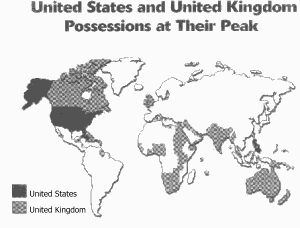
Over the following decades, England emerged in
possession of the vast British Empire. It was the largest that the world had
ever seen. Over one quarter of the world's land and people were under the
British flag by the end of the 19th century. The United States, in 1800 still
clinging to the eastern seacoast, had completely spanned the North American
continent within five decades. The most powerful company of nations, the
British Empire, and the greatest single nation, the United States, emerged
right on schedule. The year 1800 marked the time when the 2,520 years of
withholding the birthright concluded.
The British
Empire Emerges
"How had the
British done it? How, in the first place, did a peripheral island rise from
primitive squalor to world domination? And how did they, between the [world]
wars, still manage to keep their rickety empire together with little visible
effort?" (The Europeans, p. 47). This was the question posed by
author Luigi Barzini and it has been echoed by many.
While other nations set out with a cohesive plan
to conquer vast stretches of territory and to build an empire, the British, it has
been said, stumbled into theirs in a fit of absentmindedness. How did such a
remarkable transformation come about?
Canada, a vast trove of agricultural and mineral
wealth, came almost unbidden into the British Empire. After England's victory
over France in the Seven Years War (1756-63), many in Parliament argued against
even accepting Canada from France, warning that "…its scanty trade in
beaver skins would not offset the burden of defense and administration…" (A
History of England and the British Empire, by Hall & Albion, p. 463). In
fact, "Halifax [Nova Scotia] was the only community in America founded by
direct action of the British government" (p. 456).
Australia and New Zealand were no less thrust
upon Britain as part of the empire. Of Australia, it has been said that the
1851 discovery of gold: "…precipitated a colony into a nation" (p.
664). The population jumped from 250,000 to almost a million in a little over a
decade. As for New Zealand: "The home government long resisted the efforts
to bring New Zealand under the British flag… So New Zealand went its lawless
way until the actual planting of regular English settlers necessitated more
definite control" (p. 664).
Over the course of the 19th century Britain came
into the possession of territory in every far-flung corner of the earth. Among
these possessions were virtually all of the strategic sea-gates. Possessing the
"gates of their enemies" was one of the blessings that God had
promised to Abraham on behalf of his descendants. These narrow passages,
through which sea traffic had to pass, were of inestimable value to Britain,
both in terms of commercial value of trade and for security purposes during the
two world wars of the 20th century. British control of the Suez Canal and the Straits
of Gibraltar as well as of the strategic Isle of Malta was crucial to Allied
control of the Mediterranean during World War II.
With Australia, New Zealand, and Canada, Britain
came into possession of some of the richest agricultural land on earth. The
vast fields of grain and the innumerable herds of sheep and cattle represented
a fulfillment of God's ancient promises to Abraham. In addition, there was the
vast mineral wealth of Canada, Australia, and South Africa. Britain itself came
to control much of the Middle Eastern oil reserves. Her possessions and
pipelines there helped provide the Allies the oil that was needed to fight
World War II.
Overall, British influence was beneficial for the
whole world, just as God anciently prophesied that it would be. It was the
British Navy that wiped out the international slave trade in the early 19th
century. The British and Foreign Bible Society, headquartered in London, was
responsible for the Bible being translated into virtually every language and
made available for the first time to peoples all over the earth.
Throughout the empire itself, British rule was
not enforced by huge occupying armies. In fact, during the 19th century, the
British army was quite small. It was called "the thin red line." In
vast India, inhabited by scores of millions even in the 19th century, it was
the British civil service, never more than several hundred, that ruled. They
administered justice, collected taxes, and enforced the laws. "They alone
came into direct contact with the native population… they worked hard and
efficiently… corruption was unknown among them, and they had triumphantly
upheld justice, peace, and order for several decades" (p. 738).
Tiny little England emerged, practically
overnight, to rule the greatest, most extensive empire that the world had ever
seen. That empire developed into a great company of nations held together by
allegiance to a common crown. Where else can anyone point to the fulfillment of
the ancient promise that Jacob claimed for his grandson Ephraim? Clearly, God
had kept His word to Abraham!
The Throne
of David
God made a
remarkable promise to King David of ancient Israel. Speaking through Nathan the
prophet, God told David: "When your days are fulfilled and you rest with
your fathers, I will set up your seed after you, who will come from your body,
and I will establish his kingdom. He shall build a house for My name, and I
will establish the throne of his kingdom forever. I will be his Father, and he
shall be My son. If he commits iniquity, I will chasten him with the rod of men
and with the blows of the sons of men. But My mercy shall not depart from
him, as I took it from Saul, whom I removed from before you. And your
house and your kingdom shall be established forever before you. Your throne
shall be established forever" (2 Samuel 7:12-16).
God explained to David that while he might punish
his descendants for their sins, he would not remove the kingdom from their line
as he had done with Saul. What happened to that line of kings? History records
that King Zedekiah, a descendant of David, was the last king to sit upon the
throne of Judah in Jerusalem. In 586bc Nebuchadnezzar of Babylon took Zedekiah
captive to Babylon, burned the temple, and destroyed the city of Jerusalem. Notice
the statement in 2 Kings 25:7, "Then they killed the sons of Zedekiah
before his eyes, put out the eyes of Zedekiah… and took him to Babylon."
Did God's promise to David fail?
For the rest of the story, notice the prophecy
that God inspired Ezekiel to record in Ezekiel 17. It starts out by posing a
riddle that describes an eagle coming to a large cedar tree and cropping off the
topmost branch. This small branch was taken to the "city of
merchants" (v. 4). What is this riddle describing? Verse 12 tells us,
"Say now to the rebellious house: Do you not know what these things mean? Tell
them, Indeed the king of Babylon went to Jerusalem and took its king and
princes, and led them with him to Babylon."
That is not the end of the story, however. God
went on to tell Ezekiel in verses 22 and 23: "I will take also one of the
highest branches of the high cedar and set it out. I will crop off from the
topmost of its young twigs a tender one, and will plant it on a high and
prominent mountain. On the mountain height of Israel I will plant it; and it
will bring forth boughs, and bear fruit, and be a majestic cedar. Under it will
dwell birds of every sort; in the shadow of its branches they will dwell."
We have already seen that the "top
branch" of the cedar symbolized Judah's last king, Zedekiah. A twig coming
out from that branch would be one of his children. As we have also seen, his
sons were killed. This "tender" twig must clearly refer to one of his
daughters! God talks of her being taken to a high mountain (used in Bible
prophecy to symbolize a nation) where she would be "planted" and
would grow into a great tree. This shows that she would marry and produce
offspring and that the dynasty would continue! Also note, while David's line
had been reigning over Judah, it would now be "replanted" ruling over
Israel.
Irish history records the remainder of this
story. It tells of the prophet Jeremiah and his scribe Baruch coming to Ireland
after the fall of Judah with a young princess and the coronation stone, called
in Gaelic lia fail. In ancient Irish records, the princess was named Tea
Tephi. She married the son of the High King of Ireland. Their descendants
reigned from Tara in Ireland for many centuries. Later, in the days of Kenneth
McAlpine, they transferred their place of rule to Scone in Scotland. This same
dynasty continues on down to today in the person of Queen Elizabeth II, a
direct descendant of Tea Tephi and her husband. God has fulfilled his promises
to King David just as He said!
The United
States and the Blessings of Manasseh
What of the
United States of America? Are the American people also truly descended from
ancient Israel? Look at the plain record of our history.
The first permanent English settlement in what is
now the United States was Jamestown, Virginia in 1607. A few years later the
Pilgrims landed at Plymouth Rock in Massachusetts. Throughout the 17th and 18th
centuries settlers from the British Isles flowed into what became the United
States. Actually, as Professor David Fischer points out in his important book, Albion's
Seed, there were four main waves of immigration during those two centuries
to the future United States. These waves of migration had their origin in
specific parts of the British Isles and came to particular areas of the
American colonies.
New England, for instance, was settled primarily
by immigrants from East Anglia. Certain parishes of this south-eastern part of
England were almost emptied of population between 1629 and 1641, as whole
family groups migrated en masse. "Today, East Anglia seems very rural by
comparison with other English regions. But in the early 17th century, it was
the most densely settled and highly urbanized part of England, and had been so
for many centuries" (Albion's Seed, p. 43).
Overwhelmingly, the immigrants who settled the
United States before the Civil War came from northwestern Europe. Most were
from either the British Isles or certain parts of northern Germany. These
immigrants established the character of the American nation and have provided
most of the nation's leadership until this day. Even some whose ancestors
immigrated later from other parts of Europe may well have Israelitish
background. After all, the prophecy was made by Amos that the House of Israel
would be sifted through the nations like corn through a sieve, but not a grain
would be lost (Amos 9:9).
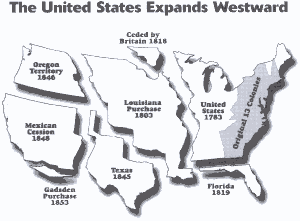
Beginning in 1803 with the Louisiana Purchase,
the United States began a rapid territorial expansion that led to its spanning
the continent within one generation. The territory acquired by purchase from
Napoleon, at less than a nickel an acre, included the richest farmland on
earth-the American Midwest.
Because of its combination of agricultural and
mineral wealth, America was destined to lead the world in per capita wealth. Whether
in grain and cattle, or in its coal, iron, and petroleum production, America
has had matchless bounty. As an example, during World War II the East Texas oil
field alone produced more oil than the combined production of all the Axis
powers. The prophecy of aged Israel to his grandson Manasseh, that his
descendants would become the greatest single nation, has certainly been
fulfilled in the United States of America.
Additionally,
with the acquisition of the Panama Canal and various island dependencies gained
in the latter 19th century, the United States has also possessed the gates of
its enemies. America, in combination with Britain, controlled virtually every
strategic passageway on earth through most of the 19th and 20th centuries.
At their pinnacles, the American and British
nations have possessed or controlled an overwhelming share of the world's
wealth. There are simply no other nations that can even compare with the wealth
and power that has been exercised by the English-speaking peoples.
With great blessings also come great
responsibilities, however. In addition, there are particular dangers for these
nations of which they are warned in that book which became ubiquitous
throughout the English-speaking world-the Bible.
A Warning
for the Modern Nations of Israel
Moses was
anciently inspired of God to set down a reminder for our people in the midst of
our fabulous wealth and bounty: "For the Lord your God is bringing you
into a good land… a land in which you will eat bread without scarcity, in which
you will lack nothing… Beware that you do not forget the Lord your God by not
keeping His commandments… lest-when you have eaten and are full, and have built
beautiful houses and dwell in them… when your heart is lifted up… then
you say in your heart, 'My power and the might of my hand have gained me this
wealth'" (Deuteronomy 8:7-17). Our nations are admonished, "And you
shall remember the Lord your God, for it is He who gives you power to get
wealth, that He may establish His covenant which He swore to your fathers, as
it is this day" (v. 18).
One of the great dangers of wealth and plenty is
a self-centered, materialistic outlook. Instead of being the most thankful of
peoples, we have become the most self-indulgent.
Our national greatness was not achieved because
of innate superiority. Rather, our possession of the fairest portions of the
earth is the direct result of faithful Abraham's obedience and God's promises
to Him. Moses reminded our ancestors, "The Lord did not set His love on
you nor choose you because you were more in number than any other people, for
you were the least of all peoples; but because the Lord loves you, and because
He would keep the oath which He swore to your fathers…" (Deuteronomy
7:7-8).
Israel was called to be a holy nation to God. Today,
we have direct access to God's word in an unparalleled way. Yet the conduct of
our people and our leaders falls far short of what God enjoins upon us. In the
midst of plenty we are unthankful and disobedient to the God who blessed us. Just
as God dealt with our ancestors of old, so also will He deal with us today.
America and Britain, and all the
British-descended peoples, are on a rendezvous with God's judgment!
What's Ahead
for Our Nations
In 1897, the year of Queen Victoria's
"Diamond Jubilee," one of Britain's best-loved poets struck a somber
note. The British Empire was at its height. In that context Rudyard Kipling
wrote Recessional, a poem that was strikingly prophetic. "God of
our fathers, known of old / Lord of our far flung battle line / Beneath Whose
awful Hand we hold / Dominion over palm and pine / Lord God of Hosts, be with
us yet, Lest we forget-lest we forget!" He went on to add, "Lo, all
our pomp of yesterday is one with Ninevah and Tyre! Judge of the Nations, spare
us yet / Lest we forget-lest we forget!"
A century later, the American and
British-descended peoples have forgotten their God. God's direct warning to our
forgetful nations thunders down through time, "Then it shall be, if you by
any means forget the Lord your God, and follow other gods, and serve them and
worship them, I testify against you this day that you shall surely perish"
(Deuteronomy 8:19).
How have our nations forgotten our God and His
laws? The most fundamental national building block, the family unit, has been
shattered by divorce and illegitimacy. We have "gay pride" parades in
the streets of major cities from London to San Francisco to Sydney. Abortion is
the silent holocaust that has taken the lives of millions of unborn babies. Violence
escalates until people draw back with fear at the thought of walking the
streets of our cities after dark. Greed, materialism, and immorality have
seemingly been woven into our national fabric.
The messages of the ancient prophets are as
descriptive of our national condition as any newscast. "Alas, sinful
nation, a people laden with iniquity, a brood of evildoers, children who are
corrupters! They have forsaken the Lord, they have provoked to anger the Holy
One of Israel, they have turned away backward" (Isaiah 1:4).
There is even a lack of shame at our national
conduct. "The look on their countenance witnesses against them, and they
declare their sin as Sodom; they do not hide it. Woe to their soul! For they
have brought evil upon themselves" (Isaiah 3:9).
The
Watchman's Message
As we saw earlier
in this booklet, God commissioned the ancient prophet Ezekiel as a watchman to
the House of Israel. "So you, son of man: I have made you a watchman for
the house of Israel; therefore you shall hear the word from My mouth and warn
them for me" (Ezekiel 33:7). What is God's message to modern Israel,
preserved for our day through the pen of the prophet Ezekiel?
"Now, son of man, will you judge, will you
judge the bloody city? Yes, show her all her abominations!… You have
become guilty by the blood which you have shed, and have defiled yourself with
the idols which you have made…" (Ezekiel 22:2-4). In addition to violence
and idolatry, God inspired Ezekiel to indict Israel for immorality, including
adultery and incest (vv. 9-11). Also, he talks about the breakdown of the
family structure and the grinding down of the needy and defenseless (v. 7). Additionally,
God thunders at our peoples, "You have despised My holy things and
profaned My Sabbaths" (v. 8).
The book of Ezekiel contains an indictment of our
national sins, a call to repentance, and a proclamation of God's impending
judgment. It also goes on beyond the coming judgment to look forward to a time
of national repentance and of restoration after Christ's return.
Collectively our peoples have turned further and
further away from God in our actions, even while still calling themselves
"Christian nations." Our national sins are an affront to Almighty
God, Who has poured out upon us the choicest blessings of Heaven!
There are coming on the English-speaking peoples,
the modern-day House of Israel, problems that we can scarcely imagine. God
declares that He will "break the staff of bread" (Ezekiel 4:16). He
speaks of a time of famine and desolation when the cities will be laid waste
(12:20). As unthinkable as such things may seem to modern Americans, Canadians,
and Britons, God Almighty says that such things are coming!
A great supra-national union in Europe, even now
shaping up, will become the seventh and final revival of the old Roman Empire. This
system, according to Revelation 13 and 17, will come to dominate the entire
world for a brief period of time. It is this powerful European superpower which
will ultimately attack and subjugate the American and British people. It will
also occupy the Jewish state, called Israel, in the Middle East.
Our people are complacent and materialistic. They
have forgotten their Maker and ignored His instruction book, the Holy Bible. Yes,
there is a day of reckoning coming! Most of you reading this booklet can expect
to see it come in your lifetime.
There is a way of escape for you and your family,
however. "'Do I have any pleasure at all that the wicked should die?' says
the Lord God, 'and not that he should turn from his ways and live?… Therefore I
will judge you, O house of Israel, every one according to his ways,'
says the Lord God. 'Repent, and turn from all your transgression, so that
iniquity will not be your ruin. Cast away from you all the transgressions which
you have committed, and get yourselves a new heart and a new spirit. For why
should you die, O house of Israel? For I have no pleasure in the death of one
who dies,' says the Lord God. 'Therefore turn and live!'" (Ezekiel 18:23,
30-32).
God's desire is for repentance, not punishment. For
many, however, God will only get their attention through severe national
punishment. Many simply will not pay attention to a message of warning until
their world comes crashing down upon them. What about you?
God's Church is taking Ezekiel's message of
warning and of hope to the modern-day House of Israel. It is vital that you,
and all of the people of our Israelitish nations, understand what God's word
says is in store-and then that you act upon that understanding!
Unfolding
Events of the Years Ahead
Coming threats of
catastrophic economic and social collapse will set the stage for some
soon-coming events, according to Bible prophecy. In answer to growing fears,
there will suddenly emerge onto the world scene a powerful and charismatic
leader in Europe. In alliance with a religious leader who will ignite an
emotional mass hysteria through what the scripture terms "lying wonders"
(2 Thessalonians 2:9), this military-political leader will use deceit to
achieve great power. He will lead a revived Holy Roman Empire, called in
scripture "Babylon the Great" (Revelation 17, 18).
This European union of church and state will promise
universal prosperity and will exercise worldwide economic dominance for a short
while. Ezekiel 27, using the figure of the ancient commercial city of Tyre,
speaks of this global economic combine which will include nations of Europe,
Africa, Latin America, and Asia-along with Israel and Judah (v. 17). Portions
of Ezekiel 27 are paraphrased or quoted in Revelation 18 where the end-time
system, called Babylon the Great, is described.
The English-speaking nations will not prosper for
long in connection with this system, however. In fact, they will ultimately be
overpowered and destroyed by it militarily. Prior to military attack and
occupation, devastating weather problems, combined with internal civil strife
("tumults in the midst" cf. Amos 3:9) will bring our nations to the
point of internal collapse.
"My people are destroyed for lack of
knowledge," God inspired the prophet Hosea to write (Hosea 4:6). We have
rejected the knowledge of God and His ways. The more we have prospered
materially, the more our sins have increased (vv. 7-8). It appears that
immorality and substance abuse have sapped and destroyed our national spirit
(v. 11).
God inspired Amos to prophesy of this time of
serious drought and water rationing, coupled with massive crop failures and
disease epidemics (Amos 4:7-10). "Therefore this will I do to you O
Israel; and because I will do this to you, Prepare to meet your God, O Israel! For
behold, He who forms mountains and creates the wind, who declares to man what
his thought is, and makes the morning darkness, who treads the high places of
the earth-the Lord God of hosts is His name" (vv. 12-13).
Jeremiah the prophet calls this coming time of
national calamity "the time of Jacob's trouble" (Jeremiah 30:7). He
states that it will be a time worse than any other time in human history. Jesus
Christ spoke of this very same period of time in Matthew 24:21, "For then
there will be great tribulation, such as has not been since the beginning of
the world until this time, no, nor ever shall be." There surely cannot be
two times of trouble worse than any other, so clearly the Great Tribulation is
a time of trouble and punishment for Israel. Punishment is not the end of the
story, however!
Future
Deliverance and Restoration
The prophet
Ezekiel speaks of a future time when Israel will be regathered after the return
of the Messiah in power and glory. "'The Gentiles shall know that the
house of Israel went into captivity for their iniquity, because they were
unfaithful to Me… According to their uncleanness and according to their
transgressions I have dealt with them, and hidden My face from them.' Therefore
thus says the Lord God, 'Now I will bring back the captives of Jacob, and have
mercy on the whole house of Israel…then they shall know that I am the Lord
their God, who sent them into captivity among the nations, but also brought
them back to their own land, and left none of them captive any longer'"
(Ezekiel 39:23-28).
Isaiah also looked forward to that time when God
would again choose Israel and restore them to their own land (Isaiah 14:1). God
would give them rest from their sorrows, their fears, and the hard bondage they
had experienced (v. 3). Israel would be regathered from captivity and would
"blossom and bud, and fill the face of the world with fruit" (27:6). They
would begin to rebuild the old ruined cities which had lain desolate and
deserted for a period of years (61:4). Our people, after the coming punishment
of the Tribulation has finally brought them to repentance, will be regathered
from the nations of their future captivity. God inspired Ezekiel to describe
the true national conversion of Israel which will follow. This will be a
prelude to the conversion of the whole world. "I will cleanse you from all
your filthiness and from all your idols. I will give you a new heart and put a
new spirit within you… I will put My Spirit within you and cause you to walk in
My statutes, and you will keep My judgments and do them" (36:25-27).
Christ will have returned and the saints will
have been resurrected to rule and reign with Him (Revelation 20:6). Again, we
see in a number of places that ancient King David will be among those
resurrected and he will actually be the direct ruler over regathered Israel
(Ezekiel 37:24). Each of the 12 Apostles will be directly ruling over one of
the 12 tribes (Luke 22:29-30).
At this glorious time, when God's Kingdom will
rule over all nations with Christ governing directly from Jerusalem, "'The
wolf and the lamb shall feed together, the lion shall eat straw like the ox,
and dust shall be the serpent's food. They shall not hurt nor destroy in all My
holy mountain,' says the Lord" (Isaiah 65:25).
So, what's ahead for America and Britain? God's
coming judgment! Punishment for our national sins lies just over the horizon. It
will come swiftly and severely, and amaze the whole world. This colossal
punishment will shake our nations far more than anything that has occurred
before! For most, it will eventually produce a depth of genuine repentance and
a return to God unprecedented in modern times (Ezekiel 36:24-32).
There are two ways to learn our lessons in this
life, the easy way or the hard way. Our nations as a whole appear destined to
learn their lessons the hard way.
What about you, personally? Will you heed the
warnings contained in this booklet, which come directly from God's word? Or,
will you have to learn your lessons by hard experience?
We can show you the way to escape this coming
holocaust if you are willing. You must be willing not merely to believe in God
and in His Son, Jesus Christ, but to do what God commands. You must be willing
to SEEK GOD in a way you have never done before! You must be willing to
"come out" of this modern Babylon-its ideas and practices, its false
religions and philosophies-and devote yourself to earnestly study and to
"live by every word of God" (Luke 4:4).
The choice is yours to make! May God help you to
choose wisely and rightly.