Confucianism
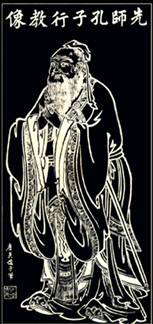
Confucius was born
during the Han dynasty and was raised in a very poor family. When he grew into
adulthood he rose among the lower ranks politics until he resigned and became a
teacher traveling around
Some of the most important parts of Confucianism are its writings that hold the core of the philosophy. These are The Four Books and The Five Classics
· The Great Learning
· The Doctrine of the Mean
· The Analects of Confucius
· The Mencius
· The Classic of Poetry
· The Classic of History
· The Classic of Rites
· The Classic of Changes
· The Spring and Autumn Annals
Confucianism has set of morals that aren’t necessarily strict rules that must be followed but more of guidelines of how to live. It says that one should try to live in righteousness. There isn’t anything necessarily wrong with watching out for your own self interests but you should do that while still doing what is right and moral. It can be said as “doing the right thing for the right reason”. You were also supposed to have empathy and try to understand others. This led to a early version of the Golden Rule, he said “What one dose not wish for oneself, one ought not do to any one else; what one recognizes as desirable for oneself, one ought to be willing to grant others.”
Confucius also said that “A virtuous man has three awes”
1. Awe for Heavens decree.
2. Awe for great men.
3. Awe for Saints words, when worshipping God, one must feel as if He were visibly present.
Confucius also had a process know as the Great Learning, this was a process of self-development that helped you live even in the common life. These are Investigation of phenomena, Learning, Sincerity, Rectitude of purpose, Self-development, Family-discipline, Local self-government, Universal self-government.
Confucius also said that Society was made up of five relationships
1. Husband and wife
2. Parent and child
3. Elder and younger brother
4. Ruler and minister
5. Friend and friend
The last and most important of Confucius’s teaching were his five virtues. The first and most important of these virtues is Jen. Jen means goodness or benevolence it is the ability to see what makes someone human. The second virtue is Li, is the virtue of relationships, it is knowing how to handle all relationships and knowing the structure of society. The third virtue is Yi. Yi is righteousness; it is the ability to recognize what is right and wrong and what the proper thing to do is in certain situations. The fourth virtue is Chun-Tzu, Chun-Tzu is being the perfect gentleman, and it is being selfless and wants nothing more but to help others. The fifth and last virtue is Te, this last virtue is the virtue of an honest government and how a government is considered good. A government is considered good if it can maintain a sufficient economy, a sufficient military and the confidence of the people
Sources
http://philosophy.lander.edu/oriental/main.html
http://religion-cults.com/Eastern/Confucianism/confuci.htm