Amad�n
Aka Amad�n M�r or Amad�n na Bruidne (Meaning "Fool of the Forth"). This is one of many types of Irish faeries. The Amad�n are to be feared as even a faint touch from one can cause instant and complete paralysis. Can cripple, disfigure, or kill humans with his touch. They are sometimes known because of this, as the stroke lads. The touch can be counteracted by praying. They are particularly dangerous to criminals or to people who walk in the moonlight, and are particularly active in the month of June.
Aughisky
(pron. agh-iski)
See each uisge.
Banshee
The banshee in Irish Gaelic, is called 'bean sidhe', which means 'supernatural woman'. She is envisioned with a sunken nose, scraggy hair and huge hollow eye sockets. Her eyes are fiery red from continuous weeping. She wears a tattered white sheet flapping around her. She wails outside the door of someone who is about to die, but only for old families. All the best clans have their own private banshee. They are very closely related to the bean-nighe.
Barguest
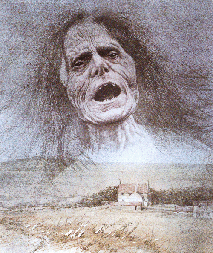
Aka Shriker or Teurst. Irish goblin with horns, claws, rows of sharp teeth, glowing red saucer eyes and clanking chain. Appears as a donkey, pig, calf, human, or shaggy black dog. In the shape of a black shaggy dog with red eyes it is an omen of death. Upon the death of a prominent figure, it rounds up all the dogs in the community and leads them on a procession through the streets, howling.
Bean-nighe
(pron. ben-neeya)
Aka Washer of Ford. This variation on the Banshee could be found in the legends of Ireland, Scotland and Brittany. The name 'Bean-Nighe' means washerwoman. She is called this as she is usually seen washing bloody garments at the water's edge. This is said to be the clothes of a person who is going to die. She is a little old woman wearing black or green clothes, has one nostril, one tooth, and her feet are red and webbed like those of a duck or goose. If a traveller sees her before she spies him, he will survive, however, if she spies him first, he will die. In the Scottish Highlands, it is thought that only those about to die can see her. It is also said that if you see her and are able to get between her and the water, she will grant three wishes. She will answer three questions, but will also ask three of her own, that have to be answered truthfully. Anyone who dares to suck her breast can call himself her foster child and is under her protection. It is said that these spirits are the ghosts of women who died in childbirth and that they are fated to perform their task until the day when they would have normally died.
Bendith y Mamau
(pron. ben-dith uh momay)
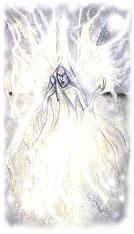
Bendith y Mamau (meaning Mother's blessing) is a clan of faeries in Carmarthenshire country in Wales. These ugly creatures (which could be the result of interbreeding between faeries and goblins) are known to kidnap children. In doing this, they replace the kidnapped child with one of their own, called a crimbil. If a child is recovered from the Bendith y Mamau, they do not remember anything, except notions of sweet music.
Black Annis
Black Annis dwells in the moors and hillsides of the Scottish Highlands. She is witch-like in appearance with blue skin and a single piercing eye, often described as a hideous old hag. If she captures human beings, she eats them, and she is usually reported as sitting on a pile of bones outside a cave. If human beings aren't available, she will eat sheep or deer.

Bodach
(pron. buh-THAHK or budagh)
Aka Bugbear or Bug-A-Boo. In Scottish Gaelic bodach means 'old man'. This is a spirit or bogie that looks like a shrivelled old man and slides down the chimney of a house and either steal children or terrorize them, poking and pulling at the child, thus inducing nightmares. It is said that the bodach will only bother naughty children, and in defence a child cand put salt in the hearth, as the bodach will not cross salt. He can also take the shape of a dark, grey man (Bodach Glas) and is a death omen in this form.

Bodach na Croibhe Moire
Meaning "Gods of the Great Tree", these can be found in Cornwall, England. Little old men created when an oak tree sends up shoots. Their food is poisonous. They were created by the god D�ire and lived on the Isle of the Derricks before it sank into the misty sea during the First Age of the Sun.
Bogle
The bogle is closely related to the puck. It is a Scottish hobgoblin that sometimes causes mischief to those who have committed petty crimes, on behalf of the victims. Can be seen through the keyholes of closets and play tricks on travellers at night. They can shape shift into dark clouds, dogs, an animated sack of corn, or humans.
Brownie
The name brownie comes from the telltale brown, ragged clothes that these small hobgoblin-like creatures wear. Brownies have small, flat faces with pinhole nostrils and are known to be quite hairy. Although they are normally solitary creatures, brownies are sometimes seen in groups. Unlike many hobgoblins, brownies are generally devoid of mischief and enjoy living in harmony with humans. If a brownie is treated well, often, they will perform many tasks and chores. For these chores, a brownie is never to be repaid directly. If a brownie is given a reward, they will vanish forever. However, by leaving something like a small treat for a brownie (their favourite treat being a bowl of milk), which they could happen upon, a brownie will be most grateful. If a brownie is offended (and they are easily offended), they will leave and take with them the good luck that surrounds brownies. Sometimes, if they are greatly offended, they can become a boggart, plaguing the house for ages. Some people think that brownies and faeries are from a vanishing race of Neolithic people that were driven underground by armed invaders. Others think that brownies are descendants of Lar, a deity who protected hearth and household.
Bucca
The bucca is a hobgoblin from the legends of Cornwall. They are commonly thought to live in tin mines, and in this way are very similar to the kobold of German tales. The bucca are often associated with sailors and stories say they travel on sea breezes. They are considered useful to sailors as they are known for their ability to foretell shipwrecks, but they need to be "paid" with offerings of part of the fisherman's catch or a few breadcrumbs.
Buggane
The buggane is a goblin from the Isle of Man. A shape-shifter, it is often seen in the form of a horse or a calf, although sometimes it appears semi-human, with long hair, teeth and nails. It is a water-spirit and almost always lives near a waterfall.
Bwbachod
(pron. boo-bach-ad)
Aka Bwca (pron. boo-ka). This is a Welsh household spirit. In many ways, it is like a brownie, performing tasks when appreciated, but becoming mischievous and destructive when offended (and are easily offended). Bwbachods detest non-drinkers and ministers of the church.
Ceasg
(pron. kee-ask)
A Scottish mermaid, the ceasg are half-human, and half salmon. They are known to marry humans and the offspring of this combination are great sailors. If captured, a ceasg will grant three wishes. The ceasg is also known to use her beauty to lure sailors to her, and they never return.
Coblynau
This Welsh race of little people lives in the mines. The sound of their knocking brings good luck, a sign that a rich vein is near. Although ugly, they are good-natured. If angered, they are known to throw stones at humans. See also Knocker.
Corrigan
A corrigan is a Celtic female faerie. A native of Brittany, she is said to have been one of the ancient druidesses, and therefore malicious towards Christian priests. Corrigan is fond of pretty human children, and is is known to steal away healthy human babies and replace them with changelings. She is set on causing mischief and mayhem for Christians.
Cyroeraeth
See Gwrach y Rhibyn.
Each uisge
(pron. ech-ooshkya)
In Ireland called the Aughisky. Much like the Kelpie, these Celtic water horses found in the Scottish Highlands and in some parts of Ireland do not like humans. Unlike the Kelpie, the each uisge prefers lochs and sea inlets. The each uisge takes the appearance of a beautiful horse and beckons for a traveller to mount. As long as the each uisge is ridden in the interior, it is rather harmless. But the merest glimpse or smell of water would mean the end of the rider. After he carries the unsuspecting victim into the water, it will tear him apart and devour the entire body except for the liver. The creature also assumes human shape, woos maidens, and can be recognized only by the waterweeds in his hair.
Ellyllon
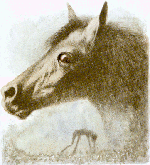
They are tiny, diaphanous fairies whose food is toadstools and fairy butter, a fungoid substance found in the roots of old trees and in limestone crevices. Their queen is Mab. They are much like brownies, as they will help out with household chores. Also like the brownies, they will leave the house if they are offended, or if their privacy is invaded.
Fachen
Aka Fachan or Fachin. The Irish version of the old Scottish monster known as Direach Ghlinn Eitidh. It is known to pursue and mutilate travellers, eventually killing them. It is like half a body, pitch black in colour and covered with feathers, each having a tuft of them, which grows like a comb on a cock's head. It has one mangled hand that grows from the centre of its chest, and one leg that grows out of its body at an angle. It also has one eye set in the middle of its forehead. It has a large, dark blue mane of feathers, which it will ruffle before attacking, to look more menacing. The creature is said to wield a chain, which he can use to destroy an orchard in a single night.
Fenoderee
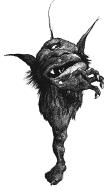
The Fenoderee is the name of a Manx brownie. Unlike most brownies, he is the size of a human, and possesses supernatural strength. Supposedly he is a faerie that was cast into the world of mortals for falling in love with a human girl. Although he is a singular creature, it seems he can be in more than one place at a time as many farmers have claimed to see him. Helpful like a brownie, he will desert a family if they give him a gift of clothing.
Gruagach
(pron. groo-ah-gak)
Seen in the Scottish highland as a green clad woman herding the cattle. Also appear as males, which are beautiful and wear red and green clothes. In Ireland they are often giants. They are looked upon as the guardians of cattle, bold warriors and brilliant sorcerers. The name means "the long haired one" and is a quite accurate depiction of Gruagach whose long hair is supposed to portray rays of the sun.
Gwrach y Rhibyn
This faerie, always a woman found in the Welsh culture is the warning of death. Her name means "Hag of warning". She is a very hideous woman, with a withered and ghastly face, tangled hair, black teeth, withered, out of proportion arms, and bat-like wings, even though it is thought she might have been one of the mother goddesses. Heard only at crossroads or near a river, the cry of the Gwrach y Rhibyn was accompanied by splashing water. Sometimes the hag of warning will "ride" inside the body of the person she is going to warn, until they get to a crossroads or stream where she will begin shrieking. This type woman is considered the Welsh version of the Bean-Nighe.
Gwragedd Annwn
Welsh water faeries, beautiful Lake Maidens who occasionally take mortals to be their husbands. One well-known legend tells of a young man who used to graze his cattle by a small lake near the Black Mountains. One day he saw a most enchanting creature rowing gently to and fro in a golden boat on the surface of the lake. He fell deeply in love with her and offered her some of the bread he had brought from home for his midday meal. She answered that the bread was too hard and disappeared into the depths. The young man's mother gave him some unbaked dough to take with him the next day and he offered this to the faerie but she answered that it was too soft and again disappeared. On the third day he took some lightly baked bread, which passed. Three figures rose from the lake, and old man with a beautiful daughter on either side of him. The girls were identical and the father told the young farmer that he was willing to offer him the daughter with whom he was in love if he could point her out. The farmer would have given up in despair but one slightly moved her foot and he, recognizing her slipper, won her hand. The young farmer was warned that he would lose his wife if he ever should strike her three times causelessly. The Gwragedd Annwn had some curious faerie ways; would weep at weddings and laugh at funerals, which led her husband to strike her, and she was forced to leave him. Though the sons she had left behind with all of their faerie teachings became great physicians.
Gwyllion
(pron. gwith-lee-on)
The evil mountain fairies of Wales. They are hideous female spirits who waylay and mislead travellers by night on the mountain roads. They are friends and patrons of the goats, and might indeed take goat form.
Hag
There are different forms of hags. In Celtic mythology a hag is an ancient spirit, usually seen carrying rocks in her apron which, when dropped, can cause mountains to form. It is said that if two hags are heard arguing, you should retreat indoors, for it may begin to rain boulders and trees. There is also and Irish hag that helps out in the household with the spinning.
Hobgoblins
(pron. HAWB-gahbluns)
British goblins that are not harmful. They are hearth spirits from Hartlepool who live in kitchens and watch over bread and tend babies. They are small, wizened, shaggy, humanlike creatures with no toes or fingers and sometimes no nose. They were created by the Fomori people in year 237 of the Second Age of the Sun. They can make people invisible with a green salve from secret Kerrismoor herbs. They keep sick children company, taking them on fantastic adventures, and drive away fever and pains.
Kelpie
A Kelpie, in Scottish legend is a creature that is said to be in league with the devil. Usually it is a black beast, part horse and part bull, with two sharp horns. It has the ability to change its shape and usually when it does, it will take the form of a beautiful white horse. When a tired traveller stops by a lake to rest or to have a drink, he will see a horse, apparently peacefully grazing. If he mounts the horse, the Kelpie dives into the water, but besides wet clothes, the rider gets away unharmed.
Knocker
They live in mines and are usually good-natured. With a knocking sound they point out where the rich veins are to be found. Although they are usually friendly towards miners, they can play strange tricks. For a knocker there is nothing funnier than to scare miners by changing its ugly face to something even more horrible, while performing strange dances. A little piece of miners-food must be left for the knockers, or else they become mad and that would bring bad luck. Whistling and cursing they dislike as well and that is usually rewarded by the throwing of (harmless) gravel. In the hundreds of abandoned tin mines in Cornwall, knockers are still waiting for miners, in order to lead them to hidden, rich veins. See also Coblynau.
Leprechaun
Mainly found in Irish folklore, the leprechaun is a small faerie dressed in green with a leather apron, silver buckled shoes, a red cap, and spectacles at tilting on the end of his nose. Leprechauns are called fairy cobblers, for they make shoes for elves (but always one shoe, never a pair). Although they are quick to shun humans, leprechauns, like brownies, like to play tricks on humans. According to popular belief, a leprechaun possesses a treasure (usually a pot of gold) which a human may obtain if he succeeds in capturing one, which is extremely difficult. Even after capture, a person may not take his eyes off of him for an instant, for then he will vanish. When they finish their daily tasks, leprechauns like to organize wild feast, during which time they are referred to as cluricauns (pron. kloor-a-kawn). These (often drunk) cluricauns can then be seen riding in moonlight on the back of a dog or a sheep.

Nuckalavee
The Scottish or Irish version of a centaur. It is said that the breath of this beast brought the plague to Ireland. A monstrous horse with legs that are part flipper, a huge mouth and one fiery eye and, rising from its back joined to it at the waist, a hideous torso with arms that nearly reach the ground, topped by a massive head that rolls from side to side as though its neck was too weak to hold it upright. Worse than this though is the horrible appearance of the creatures flesh, for it has no skin. Black blood coursing through yellow veins, white sinews and powerful red muscles are exposed. The Nuckelavee has an aversion to fresh running water and the pursued have only to cross it to escape.
Phooka
An Irish Goblin with a variety of rough beast-like forms. He appears sometimes as a dog or a horse, or even a bull, but is generally jet-black with blazing eyes. As seemingly friendly, shaggy, sway-backed pony Phooka offers the unwary traveller a welcome lift; but once astride he is taken for a wild and terrifying gallop across the wettest and most thorny country, eventually to be dumped headlong into the mire or deposited in a ditch. The chuckle is that of the Phooka as he gallops away.

Phynnodderee
A Manx hobgoblin combining the properties of the Scandinavian troll, the Scottish brownie and the Irish leprechaun. The phynnodderee drives home sheep and helps in the harvesting if a storm is brewing. He possesses great strength.
Pixie
Pixies are usually found in the counties of Somerset, Devon, and Cornwall. Usually no larger than a human hand, a pixie is human-like with red hair and green eyes. They have upturned noses and malicious smiles. They usually wear tight fitting green clothes. Pixies have the ability to change their size at will. They are tricksters who like to lead humans astray. However, they can be foiled if a man wears his coat inside out. Their origin is not known, but it has been said that the pixies were the first to welcome the faeries when they arrived in England. Then, fearing that they would be taken over, the pixies waged war on the faeries. According to another myth, pixies were originally Druids who resisted Christianity, and the more they resisted the smaller they grew. Yet another myth tells of a race of people who were not good enough for heaven, nor bad enough for hell and were doomed to wander the earth forever. They love to steal horses and ponies and make nocturnal rides on their backs over the heaths and moors, while entangling the manes of the animals. Even inside houses people are not safe to their tricks, such as throwing small objects at the inhabitants. Although pixies like to play, they are hard workers as well. They work on the fields the entire night for some bread and cheese. Farmers embrace the presence of pixies and do certain things to please them, and therefore keep them on the farm. At night, farmers will leave a bucket of water out so mother pixies can wash their babies, they'll leave milk out for them to drink and they'll sweep the hearth so that the pixies have a clean place to dance.
Puck
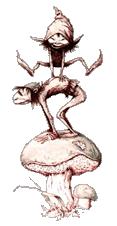
Pucks are pixie-like creatures that reside in the southern counties of England. Pucks, unlike pixies are on good terms with faeries. Having no interest in domesticated animals, pucks are beneficial to all plants and wild animals. Mischievous like many spirits, pucks like to play harmless tricks on humans. Their tricks can, however, become quite severe in revenge of a maiden who has been scorned by her lover. They enjoy dancing to the sounds of a flute. They were sometimes called (by Shakespeare and others of that time) Robin Goodfellows. In that time they were in the form of satyrs. Puck however from Shakespeare�s A Midsummer Night's Dream, was not a puck, but rather a hobgoblin.
Redcap
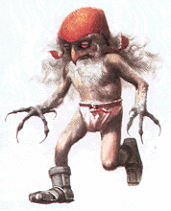
A malevolent goblin, redcaps are easily distinguishable for their namesake red hat and fiery red eyes. Their caps are red because they dip them in the blood of their human victims. Redcaps wears iron boots, but are swift on their feet. They reside in castles and watchtowers along the English-Scottish border; however, they move their residence often to avoid detection. Redcaps have sharp eagle's talons with which they kill humans. Short and stock, redcaps have long white beards and look like old men. Like any goblin, all that is needed to repel them is the use of holy words.
Roane
Irish name for the Selkie.
Selkie
Aka Silkie or Selchie. Living off the coasts of the Orkney and Shetland islands, these seal-people live under the water. Their normal appearance is human, however, they have sealskins with which they swim through the sea. When Selkies come ashore, they hide this sealskin. If a man finds a selkie maiden's sealskin and can successfully hide it from her, he can force her to marry him. Should she ever recover the skin, she will immediately return to sea, leaving her husband behind. The male Selkies are responsible for storms and also for the sinking of ships, which is their way of avenging the hunting of seals. They say that male selkies can take human lovers.
Spunkie
Spunkie is a goblin similar to the Scottish Kelpie. Spunkie is popularly believed to be an agent of Satan. His special victims are travelers who have completely lost their way. He attracts his unfortunate victims by the means of a light that appears to be a reflection of a window, which is apparently not far away; but as the victims proceed toward it the light recedes like the rainbow. However, the victims still follow the gleam until Spunkie successfully lures them over a precipice or into a morass.
Urisk
Living in the Scottish highlands, the Urisk is a faerie that is part-man part-goat. It is said that they live in waterfalls. At times they will help farmers with their tasks. Although they are not evil creatures, they will sometimes terrorize people by following them through lonely places.
Will-o'-the-wisp
Will-o'-the-wisps are the faint lights seen on marshes and bogs on still nights after sunset. Usually a soft bluish light, but also reddish or greenish in appearance. In folklore, they are thought to be imps or pixies leading victims to danger in swamps and heaths. Sometimes they are believed to be the spirits of stillborn children flitting between heaven and hell.
My result on a "What kind of Myhtical Creature are you?" test:
You are a fairy!
You're very wise and fair, and are very cautious
when it comes to meeting new people. But if
you feel they're worthy, you'll keep and
respect them forever.
Fairies are known for their hard outsides and soft,
warm insides.
Take the test yourself!
-carina
