LANCASHIRE AGRICULTURE IN 1849
Review of William James Garnett's 1849 prized report in the Royal Agricultural Society of England Journal concerning the state of agriculture in the county of
Lancashire.
This is an assignment I had to do in
an agro-ecological history class. I have no idea why I'm posting this here. To
the zero people who are going to read this throughout, have fun.
Comment using:
[email protected]
(Specify what name or how much of it you want to see
appear, specify what you are commenting about)

Literature Used
Garnett, W.J., 1849. Farming of Lancashire. Royal
Agricultural Society Journal. 10:
1-51.
Supplemented by information from;
Howe, H., 1888. Tile drainage in Ohio.
State of Ohio. Accessed at http://ftp.rootsweb.com/pub/usgenweb/oh/franklin/history/6.txt
Kerridge, E., 1973. The Farmers of Old England. Rowan and Littlefield, Totowa, New
Jersey, 180 pp.
Manchester and the Northwest Region of
England. Accessed at http://www.manchester2002-uk.com/history/victorian/Victorian3.html
Prothero, R.E.,
1917. English Farming Past and
Present. Benjamin Blom, New York,
504 pp.
Ryder, M.L.,
1983. Sheep and Man. Gerald Duckworth and Company, London, 846 pp.
http://www.nationalsheep.org.uk/breeds/lonk.htm
http://www.shropshire-sheep.co.uk/
TABLE OF CONTENTS
Introduction
Geography
Drainage
The Textile Industry
Animals
Crops and Practices
Conclusion
INTRODUCTION
The 1840s were tumultuous years in terms of
agriculture and industrialization in England. In 1840, Justus Liebig published his seminal “Chemistry in
its Applications to Agriculture and Physiology”, giving farmers a better
understanding of why they had to fertilize and rotate their crops. Different techniques of drainage were
also tried in various ways across the country in the first half of this
century. Furthermore, railways
were developing very fast and steam power was on the verge of being a
widespread innovation. Factories
had an important grasp on many important cities. It is in this context that, in the 1840s, the Royal
Agricultural Society of England organized a contest asking participants to
submit a detailed account of the state of agriculture in their counties. William James Garnett wrote the prized
report for Lancashire, and thus he gives us the unique opportunity to observe
rural life of this period. It was
published in 1849. Through
Garnett’s sometimes bitter lines, it becomes evident that Lancashire was a
county often ill-farmed, but a county that still had its share of innovative
and inventive spirits. His
writings also strongly show that the daily life of the farmers and the labour
was strongly tied to the land they had to work. The present report will first describe the main aspects of
the geography of Lancashire, and will then proceed into linking them to
different features of the county such as its preponderant drainage systems, its
ubiquitous industrialization, its animals and its crops and common field
practices.
GEOGRAPHY
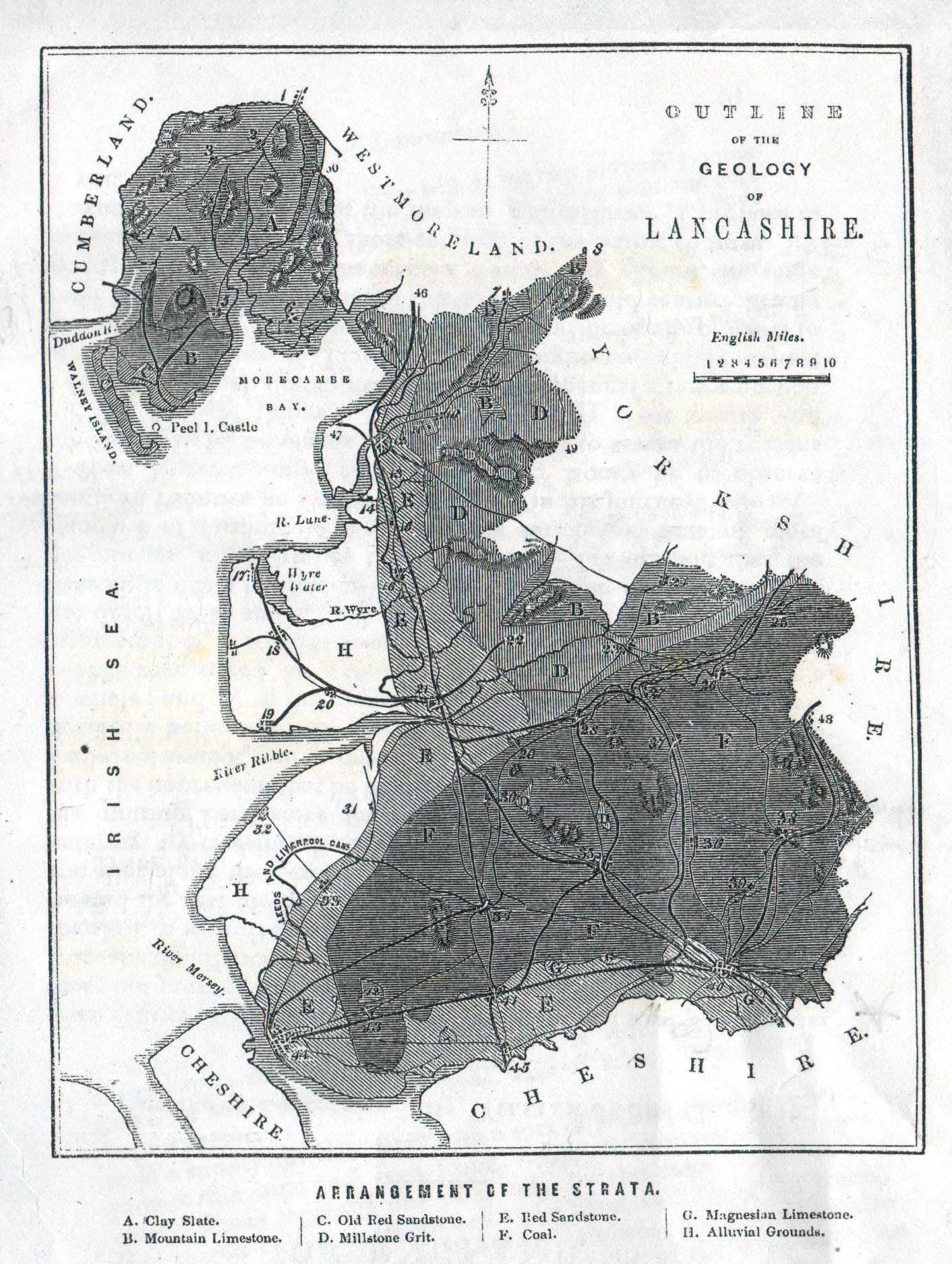
The
county of Lancashire is situated in the northwest of England. Three major rivers cross the county
from east to west, flowing to the Irish Sea with which Lancashire shares a
relatively extensive coast. The
southern river, the Mersey, is the natural border separating Lancashire from
Cheshire. Rivers Ribble and Lune are
the other two rivers crossing the county, splitting it in roughly three equal
parts. This was especially true
then; today, the political boundaries have changed slightly, especially in the
north. In 1849, some land west of
the Morecambe Bay was part of the county; this land is now part of
Cumbria. This is important because
Garnett, in his report, divided the county into what was then three generally
equal sections: the Northern Division (north of River Lune), the Middle
Division (between River Lune and River Ribble) and the Southern Division (south
of River Ribble). Garnett
specifies that those divisions are more than arbitrary; they mark differences
in soil, climate and people.
One of the most striking physical factors
giving Lancashire its unique state of cultivation at the time is certainly the
excess moisture of the county.
Indeed, Garnett states that, at the time, the city of London was known
to receive 20 inches of rain yearly, whereas the average across the county of
Lancashire was no less than twice as much, which means 40 inches. Furthermore, there appears to be a
gradient from the southwest part of the county to the hills of the northeast in
terms of precipitation, which is expected considering the that moisture comes
from the sea. It seems that the
air’s water, as it is lifted by the topography when approaching the hilly
northeast, condenses and falls.
The bottom line though is that the whole county is a place of heavy
precipitation. The gradient from
the flat southwest to the hilly northeast is much more pronounced in terms of
temperature. The southwest is
usually mild and pleasant, but the air of the north-eastern hills can be chilly
and piercing. The challenges that
those conditions imposed at the time are already perceptible. The hills discussed here form a long
row separating Lancashire from Yorkshire.
The next physical aspect of the county to strongly influence its farming
are the vast coal-fields covering a large proportion of the Southern
Division. In 1849, this source of
energy had brought a surprisingly high number of factories to the cities,
especially in the city of Manchester, where the textile industry was blooming.
Apparently, agriculture specialists of this
era were adepts of attributing the rural characteristics of a region solely on
the basis its geology. Garnett did
describe the geology of the county in fair details. Some of the major features
of the county are its large mosses and bogs, especially in the Southern
Division (the most known one being “Chat-Moss”). The rest of the Southern Division’s soils are mostly
potentially productive clays and loams.
On the other hand, the Middle and Northern Divisions’ soils are lighter,
often alluvial or peaty, but as in the Southern Division, they need to be well
prepared to expose their full production potential. The Northern Division especially has a substratum made of
metalliferous limestone materials.
This being said, one must not forget that Lancashire has a relatively
extensive coast on the Irish Sea side.
The usually stiff soil of the county sometimes give way to large patches
of sandy material associated with this type of geological situation. Also, the aforementioned coal-fields
were mined intensively in areas that aptly became known as the “mining
districts”; Garnett described the soil affected by mining as “burrowed like a
rabbit-warren” and the land surface apparently collapsed on itself due to the abandoned
channels, causing damage to fields.
Another portion of Lancashire’s geography are the discussed eastern
hills, often only thinly covered by a poor sheet of soil. Some hills go as high as 1800 feet in
altitude. Garnett described the
hills of the north as highly picturesque and beautiful, and to this day this
area is one of England’s favoured tourist spots. This region also has a grittier substratum and a steeper
topography allowing faster natural drainage. This contrasts with the southwestern zones where the
important marls used to reclaim dry and peaty areas were found.
This whole description is very broad; England
is a land of extreme variability and Lancashire is no exception to the
rule. However, this is sufficient
to have a good picture of what the county offered to the farmers of 1849 in
terms of challenges and gifts.
DRAINAGE
Garnett’s
essay lengthily discussed the sole practice of drainage. This is no surprise given the physical
situation of Lancashire discussed in the previous section. Garnett made it a point to ensure that
his reader sees the county as a land that must have been fully muddy. The Southern Division appears to be
especially difficult in terms of excess of water. The soil was apparently “cold and difficult to work”. It is evident that it required a lot of
effort, because even nature apparently could not use this land efficiently;
Garnett described the natural landscape of this area as very bleak, with a few
distorted and stunted trees that “show rather than hide the nakedness of the
land and scarcely deserve the name of hedge-row timber”.
Fortunately,
people had already started studying drainage techniques by 1849. Common knowledge has it a certain James
Smith, in 1823, used drainage and deep ploughing to transform a rush-grown
marsh into a garden; he used buried stones in his design. This was an improvement over plain open
furrows since those were reputed to wash away the tilth and nutrients by
preventing percolation. Pipes on
the other hand were relatively new; a certain John Reade is recorded as the
first to use clay cylinders in 1843, and a certain Thomas Scragg as a person
who patented a pipe-making machine in 1845. The Royal Agricultural Society of England was most likely an
offspring of the increasing desire for advancement and improvement in
agriculture. At the time,
“improving the land” was certain to raise your reputation by much. So Garnett treated the drainage of the
bogs and mosses such as Chat-Moss and “its kindred wastes” almost in terms of
heroic actions. This is surely in
contrast with today’s interests in preserving any sort of wetland. Chat-Moss was a large morass 7 miles
west of Manchester, covering 6000 acres.
It was believed at the time that the mosses were formed because of the
valley hollows topography of the Southern region. Decaying vegetation could have clogged a channel, flooding
an area and creating a positive feedback loop of drowning and accumulating
vegetation. However, the potential
of all those mosses was very much recognized early on, and the people of
Lancashire seemed to take pride in their mastering of moss reclamation, which
was not equalled by anyone in England.
Successfully draining a moss was certain to bring great returns, and
landowners saw the value of their land increase dramatically. But the draining of those fields was
not simple. When the House of
Commons wanted to build the Liverpool Manchester Railway, they sent a surveying
team on the Chat-Moss, and they found that a boring rod, once forced through
the surface peat, would fall under its own weight through a layer of water 34
feet deep. This water was retained
there by the region’s stiff clay.
The fact that they indeed built the railway on top of this moss,
therefore producing a “floating” railway, is astonishing. For the farmer however, the goal was
not to remove all this water, but rather make the surface peat workable. The labour that first worked the land
had to wear large flat pieces of wood under their feet in order not to sink in
the peat, and they even equipped the working horses with the same piece of
gear. In the case of Chat-Moss,
many attempts were done before success was attained. In an attempt to do too much, Mr. Roscoe of Liverpool
created his drainage in a too widely spaced fashion, and a lot of money was
thus wasted. It was a certain Mr.
Reed who finally achieved the deed.
Ditches were dug 66 yards apart, 4 feet wide and 3 and a half feet deep. However, any digging in the floating
mass had to be done in steps, waiting for the first portion of the hole to dry
and consolidate before digging deeper.
The cross-drains were done 10 yards apart and 3 feet deep. This is deeper than the average drain
at this era (2 to 2 1/2 feet), most likely because the water table depth would
vary much more in peaty material than in mineral soil. Dry surface sod would be buried in the
cross-drains, being hydrophobic, this material would act as the drain. This method became a standard in terms
of draining the mosses of Lancashire.
However, there was a bit of overshoot, and some people involved with
Chat-Moss publicized their method in other parts of England, trying to convince
the people to dig their drains deeper, sometimes as much as 4 feet. In many parts of the country this was a
catastrophe; many subtleties of the method therefore only worked in Lancashire.
Eventually, clay tile drains were used. The county almost fell short of tile
drains despite tileries appearing everywhere; a specific tile machine produced
almost 600,000 tiles in one year.
The price of drains was around 19 shillings for one thousand tiles of 2
inches, or 30 shillings for the same amount of 3 inches units. But, when potatoes became popular, some
pieces of 4 acres were let at a price between as much as 8 to 12 pounds per
year, and one acre could yield enough potatoes to make 37 pounds. This being said, early drains were not
without problems, they often became clogged by roots and easily collapsed,
rendering them useless, and in metalliferous deposits, iron cankers would even
form inside with similar consequences.
One interesting finding in Garnett’s text is the air-drain. He described the admission of a draught
of air in the drainage system as the “great secret of thorough
tile-draining”. It is simply done
by regularly having a drain being connected to the surface air. The increased drying of the interior of
the drain would surely make water penetrate the drain faster due to the
increased suction.
In
other parts of the county, drainage was sometimes less necessary and consequently
used more rudimentary techniques.
A good example of this is the region of the poorer eastern hills of the
Middle Division. The topography
itself allowed for faster natural drainage, but even this was often not
sufficient. Garnett sarcastically
described their technique, which harked back to the early days of that century,
when James Smith drained his marsh with stones. They would indeed bury stones at a depth of less than 2 feet
in most cases, and the spacing between drains would be 9 to 12 yards. The spacing was similar to the one used
in mosses, but the depth was certainly shallower. The practitioners of this technique had the foresight of
using a minimal slope to reduce soil erosion. However, at the time of Garnett’s research, even in this region,
some tile drains were starting to appear, showing how this technology was
gaining in popularity. Since the
drainage required was minimal, they could use even shallower depths, and in
general the operation would cost less.
The story is even more different in the Northern Division, where talk of
drainage is far less prominent.
This area still used what is called the “horseshoe tile” drain. The horseshoe tile originated in
Northumberland; instead of being cylindrical, the drain was indeed shaped like
a horseshoe, and was installed with its wide flat part at the bottom. It is important to understand that
sometimes, the wide part was not closed; at the time of this report, they would
often add a piece at the bottom called “sole tile”. Nevertheless, the practice was relatively minor in the area,
with only 4 tileries in existence, two of which were owned by the Earl of
Burlington. There were 25 tileries
in the whole county in 1849.
Garnett
reminded his readers that drainage systems are highly dependent on their
outlets. He discussed how farmers
were worried about the material outwash from the tributaries to the main rivers
(Wyre, Lune, Ribble). According to
him, constant floods and washings from the hills brought large quantities of
sandy materials to the rivers, and when those rivers approached the sea and
widened, their slower movement allowed those materials to settle. The rivers’ power was not enough to
carry and erode those materials away to the sea in sufficient time, and the
drain outlets were starting to be submerged. Garnett complained that Ireland had Acts that “empowered
landed proprietors in Ireland to sink, embank and remove obstructions in
rivers”, and that England had not created such laws. The proprietors were only allowed to clean their own
ditches, but not the main river bodies.
But they needed not to be reminded of cleaning their own ditches because
this practice was primordial to the success of their drainage system. The problem sometimes came when ditches
at the end, or on the boundaries of their properties needed to be
maintained. The temptation was
strong to concentrate on what affected the farmer himself. With time though, holding the
proprietors responsible for this maintenance work became a condition to moss
reclamation under common accord.
Garnett convinced the readers of the
importance of drainage in the largest portions of Lancashire in 1849. Most of the best land would not live up
to its potential without a reliable drainage system. Garnett went as far as criticizing the large amounts of
money that went into railway planning and building when there were large
projects of potentially very lucrative drainage pending. He specifically referred to a railway
project in Morecambe Bay that was undermining the drainage of a potential 80000
acres of land north of the river Wyre.
It should be clear by now that moss reclamation was the pride of
Lancashire farming.
THE
TEXTILE INDUSTRY
All was not pride for Garnett when he wrote his essay. In fact, the first few paragraphs of
the text paint a very dreary portrait of the county. The first sentence of it mentions how Lancashire was very
important and influential, and how “its importance and influence do not arise
from the excellence of its farming”.
Apparently, the county was in fact “famous as the worse farmed county
between London and Edinburgh”. So,
whereas the technical advances made in moss drainage were impressive, an
“ailment” offset a lot of the agricultural qualities of Lancashire. This ailment was industrialization,
which was a very strong movement in the county. Although most industrialization happened in the Southern
Division, notably in Manchester, its repercussions were felt in a range much
wider than the immediate surroundings of this city.
The textile industry rooted itself deeply in the city of
Manchester. This happened due to a
complex of reasons. The first
factor was mentioned earlier; the coal-fields supplying energy to the
industry. There was also the
construction of a well thought network of canals in the city, linking it with
water bodies and the possibility for easy ship transportation, as the
construction of the Manchester Ship Canal demonstrated. Also, as it was also mentioned earlier,
railways were being constructed at a fast rate in England. In fact, between 1830 and 1838, 56 Acts
were passed in England to lay 1800 miles of rails. Manchester held a large railway network. The geographical location of Manchester
was perfect to receive raw material from boats and from the rest of England. Also, the energy source and the labour
was abundant and at hand. Because
of the same network system, distribution of the finished work was also fairly
efficient. All of those aspects of
the city of Manchester made it “the Warehouse of the Western World”, or even
“Cottonopolis” or “King Cotton”.
As one might imagine, this booming textile industry offered
intense competition for labour, and made it difficult for farmers to retain
farm workers, who went on to become factory employees. In a way, Manchester became the
blueprint for rural exodus, which is still a strong phenomenon today. Garnett witnessed this movement and
described it, inserting a certain amount of social comments. After having generally described
Lancashire as a bleak county, he reassured his readers that a large portion of
the population was indeed great in wealth and intelligence, and that the reader
would be right in expecting better from them. Garnett readily pinpointed the Southern Division as
responsible for the state of affairs in Lancashire. According to him, it was the most ambitious part of the
population who decided to leave the plough to work in the manufactures and
engage in trade. He said that the
appeal to make a fortune rapidly was very great, and this explained their
departures. He found the movement
unsettling because he equated this ambition with capital, skill and
enterprise. Therefore, he
concluded that the “the inhabitants of the towns greatly exceed in acuteness
and intelligence their fellows in the country districts”. This apparently would have left the
Southern Division of Lancashire empty of people with the will to do any sort of
agricultural improvements, because those who stayed were “content to live and
die as their fathers had done before them”. Of course, this excludes some of the moss success stories
presented earlier. In addition to
this, it can be said that the people who became rich in the midst of this
industry, seeing the deserted and drab landscape of Southern Lancashire, when
time came to reinvest their capital in land, were certainly not tempted to put
their money back in their home county.
Garnett specified that those people were usually older, not tempted by a
life of agricultural improvements, and would rather invest in a more secure and
fertile soil in southern counties.
Clearly, the agriculture of Lancashire was suffering, considering the
Southern Division is the main division of the county. Three quarters of Lancashire’s working force were engaged in
commerce and manufactures.
The social aspects just depicted were certainly not the
only damaging features of the industrialization of the Southern Division. Already in 1849, although the word was
not in common use, the inhabitants of Lancashire easily observed
pollution. It is a type of
pollution that is foreign to most of us nowadays. Its effect was very direct and clearly visible on the
vegetation. There is the example
of a farm, property of a certain Mr. Bankes, which was situated near Newton,
halfway between Liverpool and Manchester.
This farm used common practices of drainage, cultivated the common stiff
heavy loam of the region, and produced acceptable crops of swedes and
oats. However, the farm happened
to be the neighbour of a factory from which a massive chimney 300 feet high
arose. Garnett said that it was
“continually vomiting forth its pestilential breath from some extensive
chemical-works”. The effect of
this seemed straightforward: apparently, for miles surrounding this chimney,
the natural vegetation was manifestly withered, and the impact on the crops was
decidedly observable. So much in
fact that in the neighbourhood the farmers were gathering to create a Society
to defend their interests, under the command of Mr. Wilson, the occupant of the
aforementioned farm owned by Mr. Bankes.
The goal was to eradicate the factory totally; since no name is given
for the factory, it was impossible to know whether or not they succeeded. This once omnipresent filth contrasts
with the current status of Lancashire, which again, is now one of England’s
most popular tourist county.
Preston, in the Middle Division, is about as far North as
the manufactures went.
Consequently, in this division, Garnett found “the air pure and the sky
clean”. He knew, just by looking
at the inhabitants, that they were not factory employees, for they looked much
sturdier. The Northern Division
was pretty much free of the intense pollution of the South. Both the Middle and Northern Division
did not have the set of circumstances that gathered the textile industry in the
Southern Division. However, they
were not spared from the rural exodus, and lost a large part of their
population to the factories of the South.
Indeed, the farms could not compete for labour, and as was explained
before, this left the land forsaken in places. Yet, this had the positive impact of giving some of the best
conditions in England to those labourers who decided to stay in the farming
business.
ANIMALS
In
giving a detailed account of the two most prominent features of Lancashire
farming (drainage and industrialization), Garnett ended up discussing farm
animals very sparsely in his report.
This is odd considering the pride taken in animal breeding in England. However, there is no sheep breed named
“Lancashire”, and the cattle used in the county were not exclusive to it,
especially at the time of the report.
To have a better idea of the history of livestock in Lancashire, much
information from outside Garnett’s report was necessary.
According
to Garnett, sheep was not an important part of the livestock of the
county. A few breeds are mentioned
without many details.
Interestingly enough, the sheep that get most attention are not of a
precise breed. Indeed, the farmers
of the eastern hilly districts of Lancashire used a type of black-faced breed
somewhat extensively, especially in the eastern moors of the Middle
Division. However, Garnett saw
those farmers as highly old-fashioned, almost barbaric at times. He mentioned that they did not care
about good breeding and that their sheep were consequently of poor
quality. The inhabitants
apparently had “few wants beyond the actual necessaries of life”, and still
used their hands to perform tasks that were performed using more suitable
instruments in other parts of the county.
Since in 1849, all the black-faced sheep Garnett talked about were
considered rather feeble in quality, it seems evident that those sheep either
became or merged with the Lonk breed.
Lonks are known to be native from the hills, and the association of Lonk
breeders is still situated in Burnley, Lancashire, which happens to be where
those “lesser” black-faced were in 1849.
Those sheep are apparently adapted to harsh conditions, and originally
came from Scotland, probably competing with the other sheep of England only
where they could endure bad environments that the others could not. For the longest time, the wool of the
black-faced sheep was not prized, and this is still evidently apparent in
Garnett’s report. They tended to
have more hardy and hairy fleece, which made it less desirable for processing,
but it seems that this fact was both a mixture of truth, prejudice and
speculation. That being said, the
tougher wool would definitely be an advantage in the wet, cold and thorny
conditions of a moor. Later, the
Lonks became known as the sheep that could live in some of the worse
conditions, feeding on the poorest grazing areas and giving value to
potentially useless land. However,
Garnett never explicitly mentioned the Lonks. Again, the farmers of the east did not practice sheep
breeding. Yet, those sheep were
perfect for them, especially in the few centuries before Garnett’s report,
because they could barely grow adequate crops to feed themselves, and needed
sheep that could feed in the moors. In Garnett’s days, they were left to feed on poor hill
pasture until November, then brought back and fed on butter and tar to prevent
scab diseases. The farmers would
not even build sheds for the sheep, they would simply leave them in enclosed
plots and the younger animals would often get a disease resulting from exposure
to cold and wetness. Their main
quality was considered to be that they survived winter in the moors. Lonks of today represent one of the
biggest breeds and both males and females have curled horns. The rest of the sheep breeds mentioned
in Garnett’s report are discussed briefly because their introduction to the
county was still at the state of “trial”.
An example of this is the Shropshire Downs, which was introduced a few
years before 1849 in the Southern Division. Interestingly, they are another black-faced sheep, they are
known as hardy and have the advantage of resisting diseases such as the scab
and foot rot very well. It is
believed that the Shropshire Downs is the result of the crossing of the South
Downs and the more resistant native hill sheep also found in Shropshire. Consequently, they combine the
qualities of hardiness from the hill sheep with the higher quality wool of the
South Downs. In fact the South
Downs itself was tried in Lancashire, and it responded well in the right
regions. For the most part though,
if sheep were to be used in Lancashire, they had to be resistant to diseases,
cold, moisture, and poor feed.
Lancashire’s
most well known animal was certainly the long-horned cattle. The space between the animals’ horns’
tips was usually at least 4 feet.
This type of cattle was not native, or restricted to Lancashire by any
mean, but they were reared in the county for many years. At the time of the report though, the
long-horned cattle had mostly vanished and Garnett mentioned them as a past
glory. Yet there were still a few
to be found in the county.
Long-horned cattle were known as animals good for all purposes: easy to
fatten, producing good milk, strong bones and muscles for ploughing and
hauling. Their milk was especially
good, because it could produce a lot of the curd wanted for cheese making, as
opposed to the more watery milk produced by other breeds. They were also good meat, and they grew
fast, rapidly helping in the farm work.
This was all before the industrialization, when the plains of Lancashire
(western Middle Division and Southern Division) were still clean, and pasture
abundant. The cattle were usually
born in one of the counties north of Lancashire, and brought to the county to
be reared on its plains. The
climate and situation of Lancashire made it the place where it was the most
logical to rear the animal. The
climate was too wet for sheep farming, and the grass not rich enough for the sole
purpose of fattening. They also
only had a very short period during which they could grow a bit of corn type
crops to feed the cattle. So, the
farmers of Lancashire, 200 years before Garnett’s report, were in the business
of having long-horned on their plains and using them for work; they became
experts at handling them. They
would sell a part of the milk to the nearby Cheshire Cheese County whose cheese
makers were happy with the rich curds they could use, and eventually Lancashire
farmers would sell their animals to midland counties of the south, or other
graziers who could fatten the animals better. Consequently, Lancashire became part of a chain where
long-horned cattle were born in the north, reared in Lancashire, and
slaughtered further south. Garnett
still praised some of the long-horned’s qualities, even its creamier milk. In 1849, they had given way to the
short-horned cattle, which Garnett described as finer in bone and hide and
higher in fatting quality. There
was a tenant named Mr. Daniel, who held on to the now despised long-horned,
because he preferred their stronger constitution and milk quality. Mr. Daniel argued that his cattle took
longer to raise, but lasted and reproduced for a longer period. He apparently said that 7 quarts of his
cows’ milk would produce as much cheese as 10 quarts of a short-horned’s
milk. The shift from long-horned
to short-horned therefore seems to originate from different needs, which in
1849, with the popularity of breeding, seemed to concentrate on meat and shape
instead of environment adaptability and long-term production of a good (milk,
in this case). However, with the
advent of the railways, the dairy products of Lancashire were starting to be
popular once again in 1849; the merchants could now easily reach the North,
where there was a traditional good reputation in this matter.
Finally,
Garnett mentioned that pigs and horses were the most popular animals of the
county. This being said, he spent
less than half a page talking about them.
He did not even give a single breed name. The horses were bred, but were “not first-rate class”. Apparently, the farmers of Lancashire
loved these animals, but did not bother giving the breeding any thought. The farmers actually bought high
quality racing stallions from Col. Peel at prices as high as 100 pounds, but
the breeding was miserable and the value of the animals decreased with each
generation. It appears that they
mated them with “miserable and broken-down mares”. The pigs were the only compliment Garnett had. He said in a few lines that most
cottagers had at least a pig, and always a good one. The reasons why Garnett did not give further details on this
matter are obscure at best. It can
be supposed that the pigs, along with cattle, would produce a good proportion
of the animal manure the county used as fertilizer.
CROPS
AND PRACTICES
Last, but not the least, it is necessary to
take a look at Garnett’s account of the plants used and of other interesting
aspects of agricultural practices which could be found in 1849 Lancashire. The Southern Division will be explored
first and from there we will move northward.
The Southern Division was the most densely
crowded, and the cities required large amounts of butter and milk to supply the
labour. Consequently, a great part
of the land, especially closer to the cities, was kept in grass-lands to feed
the animals. Another interesting
aspect is that much of the territory was split in small properties and holdings,
with rents of 2 to 4 pounds per acre.
Garnett condemned this farming very much, and believed the farmers were
of an inferior education class.
They sometimes retained the backward habit of growing two white crops in
a row, only allowing the grass to grow by itself after. Garnett was angry at how unwilling to
change their habits the farmers were.
Those farms had a questionable source of fertilizer; since they were
close to the cities, they could easily obtain town-manure. This material was carried via canals,
and consequently used close to water bodies. It is horrible to imagine the leaching to the river that
must have happened as they applied the town-manure in liquid form with
hoses. Further away from the
cities however, there were two other types of farms. The most discussed ones are, again, those that had to deal
with the drainage of mosses. The
farmers working those lands quickly realized which crops grew best on them;
turnips, oats and potatoes. As we
might imagine, moss is a very fluffy, light and rich type of soil. Still nowadays, this type of earth is
used to grow vegetables. Most root
crops do very well because of the fact they have very little physical
restriction. Garnett specified that
wheat and clover were not advisable on this type of land. Marling, referring mostly to adding
clay to a light soil, was not to be done in mosses. Even if a saying in the days of Jethro Tull went “He who
marls moss suffers no loss”, marl actually impaired the growth of potatoes. They would use a mixture of lime and
salt instead, which was both easier to carry and more efficient. Lime in particular probably contributed
to reducing the ubiquitous acidity of peat mosses. Since cultivating mosses was still an ongoing experiment,
there was no prescribed rotation.
It is interesting to note that potatoes were a Lancashire innovation in
England. They were imported from
Ireland and started spreading from the county around 1728. At first, the crop was not accepted at
all, and it was seen as “swine food” for the longest time, until eventually
people decided that it tasted good boiled, or roasted with butter or
sugar. In the context of old
agrarian tradition, any new crop was likely approached uneasily. Finally, the Southern Division also
held a few traditional type farms.
One of the most praised farms was owned by the Earl of Derby, and worked
by Mr. Neilson. But then, it was
well situated, on a patch of lighter soils close to Liverpool. He used a rotation of wheat, vetches
(clover-like), turnips and mangolds (beets), beans and finally wheat or
barley. The beans, turnips and
mangolds would be drilled at a specific spacing, but the wheat was
broadcast. Very interestingly, one
of his implements was a steam engine of 6-horse power that he used in a variety
of operations. This was very new
technology. Also, Mr. Neilson had
probably been inspired by those days of railway mania; he had a system of light
movable railway that could be placed where necessary in the field in order to
bring the crop back to the farm yard.
This was apparently most useful in wet weather, reducing damage done
across the fields. Mr. Neilson
actually used a lot of bones dissolved in sulphuric acid as a fertilizer. He hired as much as 100 people at a
time, with 14 horses, to get the harvesting done quickly. There was another farm of the same type
around, but in both cases potatoes had failed, especially when compared to the
results obtained on the organic soils.
In general though, Garnett agreed that the Earl of Derby and his tenants
were one of the county’s few prides.
Starting from the Middle Division, the farms
were already less affected by the large towns’ pollution. However, as described before, the land
had been quite emptied from its population, and Garnett described many of the
farms as miserable. The rotations
appeared to be much simpler, except in the few mosses present, which seemed to
be managed in similar ways as those of the Southern Division. In one of the mosses of this part, they
had found remains of blackened oak trees of a size “equal to the timber of the
tropics”, and large horns of elks and deer. Some of the mosses in this area were renowned as the best
potato growing lands. One of the
farms even had a moveable railway as found in the Southern Division. A difference from the Southern Division
however was the process of burning the moss after draining, which likely
rendered some of the minerals held in humus available to the plants. An example of the simpler rotation
(outside of mosses) is oats, oats again, one crop of vegetables, then back to
oats or barley, then pasture or hay.
The last step (pasture or hay) was often prolonged for a year or more if
necessary to sustain some livestock.
The farmers would also practice fallow sometimes, which Garnett did not
seem to regard very highly. But if
a farmer did not have enough labour, it was logical to let the soil rest
instead of inefficiently exploit it.
In the Fylde, another farm used a similar system, a 7 years rotation
where the land was always one-seventh of turnips, and the rest an amalgam one
seventh of wheat, pasture, grass oats and beans. The climate there was wet and uncertain, so having all those
crops at once must have increased stability of income. Some farmers mentioned to Garnett that,
even though they had a rotation, they liked to keep different options opened
depending on the conditions on particular years. This part also had more marling happening. The new fertilizer in the Middle
Division is the Peruvian guano. In
fact, guano was new in general; England received 1,700 tons of it in 1841, and
220,000 tons in 1847. Apart from
this, there were a variety of common fertilizers used. The lime and salt combination was
already mentioned, but throughout Lancashire, sea-sand, bones, ashes and
farm-yard dung were commonly used.
Finally, in the Middle Division, permanent meadows and pastures were
only found on the windy and stormy eastern hills of the district, where the
black-faced sheep were reared.
The Northern Division apparently had the best
agriculture, however, it was also the smallest division. The district of Furness in particular,
has a rich sandy soil, and was one of the few redeeming features of
Lancashire. On the other hand,
this district was on the other side of the Morecambe Bay, and as Garnett puts
it, “seems to belong rather to Cumberland and Westmoreland than to this
county”. According to him, the
difference in farming quality was clearly visible at the surface, and was
staggering. Of course, this
variation comes from the difference in geographical situation. This is one of the few places where the
soil naturally drained well enough.
In Furness, the farms were much larger (compared to the small holdings
of the Southern Division), and rents were as high as 600 pounds per year. The usual crop was very good, and they
grew a common set of plants; wheat, oats, barley and turnips, although wheat
was not found as much as in other parts of the country. Note that there were virtually no
potatoes grown there. Two types of
farms existed; those owned by large landed proprietors (Earls), and those
smaller than 40 acres, usually owned by people called “statesmen”, who had no
will to grow and lived on their small but sufficient inheritance. Of course, the latter was perceived as
the worse kind of farmers, but Garnett acknowledged that they were progressing
well. Garnett also mentioned a
farmer named John Patterson, who despite having some of the best land in
Lancashire still used fallow periods.
He clearly stated that he had to do so because of the scarcity of the
labour; the effect of the industry was felt all over Lancashire. Another aspect, which Garnett somehow
discussed more for this Division, was tenancies; they were often yearly. To ensure that the farmers received the
benefits of their improvements, the proprietors had a compensation clause for
“unexhausted improvements”, which was common in Lincolnshire. Here, it was mainly concerned with the
addition of fertilizers, from bones to guano to rape-dust. The clause insured an outgoing
pro-active tenant that he would receive some of the revenues of the farm for a
number of years following his departure, depending on the type of improvement
he had performed.
CONCLUSION
In
1849, many aspects of Lancashire’s agriculture were directly dictated by the
county’s geographical situation.
It received a lot of excess moisture, and had areas of mosses, which
lead to most agriculture requiring drainage. This drainage was sometimes an impressive accomplishment by
itself. Lancashire was perfectly
situated to receive raw materials for the urban textile industry, leaving the
farms’ fields emptied of its workers.
Also, Lancashire’s animals were not yet bred in any organized way, the
county was only starting to do some trials in that domain, and its poor and wet
moors produced tough but miserable sheep.
Finally, whereas the county could produce good vegetables in its peat
mosses, notably potatoes, the rest was farmed in a fairly conventional way in
terms of crops, rotations and fertilizers, although the lack of labour was
always damaging. The areas
around the city were mainly grasses used to supply the urban population in
animal products.
Clearly,
as everywhere else in England, one of the key features of agriculture in
Lancashire was its high spatial variability. Garnett made a statement that is still highly relevant
today; “nothing has been so fatal to the progress of agricultural improvement
as the dogmatical assertion of the absolute necessity of conforming to or
adopting one practice”. A certain
Mr. Bullock Webster even wrote a list of important points in considering
drainage, and the first few ones mentioned that “no general rule can be laid
down”, and that “any one system for all soils is an absurdity”. Today, in North American, we have much
to learn from those rules, since we live in a regime where agriculture is
sometimes practiced in a very similar way across areas one hundred kilometres
wide. Garnett specified that there
had been the creation of organisms such as the “Agricultural Schools and
Farmer’s Clubs” (reminiscent of our own agro-environmental clubs) that
contributed to the funding of agricultural libraries, where books were
apparently avidly borrowed by concerned people. Agriculture is not a domain of exception: education is the
key.