CAMEL
Back to the main
page
Comment
using:
[email protected]
(Specify what name or
how much of it you want to see appear, specify what you are
commenting about)
Albums reviewed:
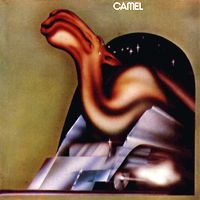
1973 - Camel (8-)
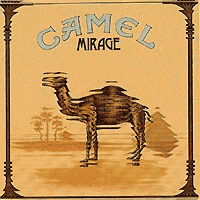
1974 - Mirage: (9+)
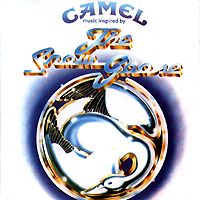
1975 - The Snow Goose (10)
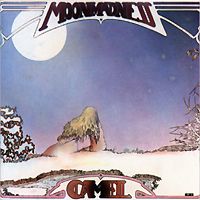
1976 - Moonmadness (7+)
1977 - Rain Dances (7)
1977 - A Live Record (9)
1978 - Breathless (9+)
1979 - I Can See Your House From Here (6+)
1981 - Nude (8+)
1982 - The Single Factor (6)
1984 - Stationary Traveller (9)
1991 - Dust and Dreams (8-)
1996 - Harbour of Tears (8)
1999 - Rajaz (8+)
2002 - A Nod and a Wink (6+)

1973 Rating: 8- 1) Slow Yourself Down 2) Mystic Queen 3) Six Ate 4) Separation 5) Never Let Go 6) Curiosity 7) Arubaluba … BONUS TRACKS: 8) Never Let Go (Single version) 9) Homage to the God of Light (Live) Best song: NEVER LET GO |
Descriptor: |
First album by Camel… Camel is a severely underrated band and is also one of my personal favourite bands. If Steve Hackett didn’t exist, Andy Latimer would be my guitar hero, actually, I often wonder who I prefer; it depends of the mood really. While Steve Hackett is more of a background subtle guitarist, Latimer is a fully assumed romantic and emotional guy who pours his soul into his guitar melodies. The melodies are usually not too complicated, but so gorgeous and energizing! Anyhow, many of those characteristics are not quite fully fledged yet on ‘Camel’.
Indeed, this album sounds rather blunt, the production is a bit muddy, but this does not prevent it to be one of the band’s most energetic releases. I hear Peter Bardens’ Santana influences all over the place, especially when it comes to the live track Homage to the God of Light (Bardens died of cancer in 2002, rest in peace my friend). Oh by the way, Peter Bardens is the keyboardist. All the tracks here are at least quite entertaining, filled with the mystical fluffiness of the production. This is enhanced by the fact that the album feels a bit out of place when you consider what other bands in their vein were releasing at the time… That only adds to the weirdness of it all. Curiosity passes by me without me noticing; the bassist Doug Ferguson sings on it and I just can’t hear him. Arubaluba (guitar oriented), Six Ate (rhythm change oriented), Separation (straightforward oriented) will provide the aforementioned energy. Slow Yourself Down has one great rhythm that changes directions all the time with a catchy chorus. This one and Never Let Go are the only tracks that survived the years and still appear in concert. The lyrics of Never Let Go are those of a teenager, but hey, gotta love that mellotron-flute sounding solo in the middle. In any case, while I think many fans overlook this one a bit too much, you should get something else first.
Simon Lac, November 20th 2004

1974 Rating: 9+ 1) Freefall 2) Supertwister 3) Nimrodel – The Procession – The White Rider 4) Earthrise 5) Lady Fantasy Best song: LADY FANTASY |
Descriptor: |
This is where it all falls into place. ‘Mirage’ is one of the band’s strongest albums, and it is generally the one I use to introduce younger people (like me!) to Camel. Of course, you have no chance with a Nickelback fan, but somebody who can appreciate a good 70s melody has no reason to dislike it. The cover is quite appropriate, although it would be even more if there were no Camel cigarettes. They had to change the cover in the U.S.A. because of legal problems, but in Europe they were approached by the company to distribute cigarettes at shows, they even proposed renaming the album, but dropped the offer when Peter Bardens suggested “20 sticks of cancer” or something like that.
The music itself drops a bit of the not-as-well structured energy of the preceding album, and gathers plus recombines it in a great support for superb melodies. Indeed, while the typical Camel melodies were not yet in place on ‘Camel’, it is here that it all sets up. Only during Freefall do I think I am still listening to the self-titled album, and starting from Supertwister, you only hear great melodies over powerful jams, or nice rhythmic sections with solos exchanged from Latimer to Bardens. Lady Fantasy is the usual choice for this one, it has a powerful effect because the main theme of the song is repeated at the end in a glorious way, and it’s one of the band’s best themes. Nimrodel comes close, with its Lord of the Rings inspired tale; sounds like a marching army coming in a city, the long jam rocks. Earthrise is perfectly explained by its title (no really!). Anyway, this album is pretty close to perfect, it was my first Camel album and has a special spot. When I take this one out, I’m definitely going for the desert and isolation mood, yet, this is far from a quiet album. Again, it must have something to do with the production…
Simon Lac, November 20th 2004
1975 Rating: 10 1) The Great Marsh 2) Rhayader 3) Rhayader Goes to Town 4) Sanctuary 5) Fritha 6) The Snow Goose 7) Friendship 8) Migration 9) Rhayader Alone 10) Flight of the Snow Goose 11) Preparation 12) Dunkirk 13) Epitaph 14) Fritha Alone 15) La Princesse Perdue 16) The Great Marsh Best song: LA PRINCESSE PERDUE |
Descriptor: |
Bestseller for Camel, this didn’t happen for no reason. ‘The Snow Goose’ was inspired by Paul Gallico’s short story (in fact the album is officially “music inspired by… etc.”). He didn’t want to be associated with the band, but I suppose in the end he sold a few more books with this whole thing (I, for one, sought the book, although I could only find it in a library). It’s, in very short, the story of Rhayader: a deformed man who lives in isolation in the south of England (in those marshes). He maintains a lighthouse, where he also takes care of lost birds. One day a little girl (Fritha) brings him a hurt Canadian show goose, and they take care of it (that’s special because when he goes to town, everybody some sort of evade him). Eventually the goose is healed and leaves, and Fritha also stops visiting Rhayader. And now for a spoiler, World War II has Rhayader trying to rescue people in Dunkirk, in the north of France, he succeeds but is killed in action. Fritha is sad that she didn’t visit Rhayader towards the end, and a snow goose is seen protecting Rhayader’s body.
There is not a single word on the album, so the story is told with the music, and it is just perfect. Rhayader’s surreal person is captured in the elf-sounding theme of Rhayader. The long distance flights of the birds are also captured by a fast but “windy” rhythm. One of my personal favourite is Flight of the Snow Goose, which has a powerful riff well sustained by the bass guitar that draws a clear picture of the snow goose flying. Everything is very light on the album, it’s a windy, bright and sunny disc that still is able to convey the melancholy of the story. The only heavy moment is the battle of Dunkirk, which, while it doesn’t sound violent, surely sounds action-packed (you can hear the build-up and approaching event). The peak of it is La Princesse Perdue; it uses an orchestra to back the band members. That track is a kind of medley of the whole album, but it’s much more emotional, and it reminds you of how much frost and melancholy is jammed in the album. Anyhow, if you’re the light romantic type, start with this one, if you’re more of a rocker, you should start with ‘Mirage’. Note that I kept talking about the muddy production of the early Camel albums, well this one is quite clear, no muffle.
Simon Lac, November 20th 2004
1976 Rating: 7+ 1) Aristillus 2) Song Within a Song 3) Chord Change 4) Spirit of the Water 5) Another Night 6) Air Born 7) Lunar Sea Best song: LUNAR SEA |
Descriptor: |
This is definitely a fan favourite, but for some odd reasons I could never climb in that boat. The album cover is pretty eloquent when considering what it sounds like, and that makes it even more odd because that cover announces something I should adore. First, Camel hired Rhett Davies to engineer the whole thing. There is a distinct change from ‘The Snow Goose’ in terms of sound. It’s like they wanted to give it an intimate feel while still being very spacey; to their credit, it works darn well. Oh by the way don’t ask me if that’s a girl, two persons, or a rock with lichen on it, I have no idea (talking about the cover again). There is a bit of pointless noodling here and there sometimes, like the odd Aristillus, which in my opinion is a pretty awkward way to start an album (it DOES have that cool but short middle section though). Song Withing a Song is a very normal number, but it’s very well done, classy, and the instrumental section has a constant rhythm with synths from Bardens that send you flying. I personally find Another Night boring and long. That song sounds as if they wanted to do a straightforward rocker that wasn’t too loud; they somewhat succeed but they should definitely cut it, because I fall asleep. It is notable that Chord Change shows one of Latimer’s first memorable guitar solos on a slow paced music. Finally, it all ends with one of my top 3 Camel songs: Lunar Sea. This is one sums up the whole “looking at the earth from another planet” feel of ‘Moonmadness’. I know there is no sound on the moon, but I’m convinced that if I’d go on a lunar sea, it would sound and feel like that. That introduction sounds like you’re in your space suit and you see Earth rising at the horizon! I especially enjoy the finale when Latimer, bassist Ferguson and drummer Andy Ward (who is very good) start to play a jerky rhythm in a synchronized way. You might like ‘Moonmadness’ a lot, I’m just often quite underwhelmed by the song 3 to song 6 suite. Some other days though…
Simon Lac, November 20th 2004
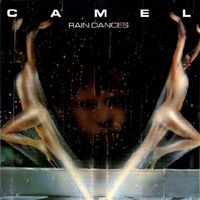
1977 Rating: 7 1) First Light 2) Metrognome 3) Tell Me 4) Highways of the Sun 5) Unevensong 6) One of These Days I’ll Get an Early Night 7) Elke 8) Skylines 9) Rain Dances … BONUS TRACKS: 10) Highways of the Sun (Single version) Best song: UNEVENSONG |
Descriptor: |
Doug Ferguson, the good old bassist, is taken out of Camel. Actually, it’s still unclear to me if he left by himself, or if Andy Latimer had the obligation to kick him out due to some technicalities. The band was definitely heading towards a jazz-pop path, and it suited neither Ferguson’s style, interest and maybe abilities; my guess. Camel recruited Richard Sinclair, bassist with Caravan, who is an awesome player, with a warm and jazzy tone; just what they were looking for.
So yes, on ‘Rain Dances’, Camel decidedly goes to the pop-jazzy avenue. Some of the jazz stuff had started on ‘Moonmadness’ when you come to think of it, but it’s really not clear, whereas here, numbers like One of These Days… and Skylines leave absolutely no doubt; they have those bubbling bass lines and intriguing rhythms. Note that One of These Days… also sounds like a disco tune. Throughout the album you will hear bass guitar arpeggios from Sinclair; this is really what sticks with me after a listen of ‘Rain Dances’. The atmosphere of the album is quite hard to describe, it’s a very mixed bag that goes from quite high to extremely low. While Metrognome is just boring (I can’t stand the way it’s sung), Highways of the Sun is likely the band’s worse song, yes, even worse than some of their 80s songs; the synthesizer riff is a piece of totally unpleasant and shame-inducing failed pop schlock. However, First Light and Unevensong are classic Camel stuff. Especially the latter, it contains one of the band’s most kick-ass finale and tells a lot about them; use a simple great uplifting melody of a few notes, and repeat it over and over again with just the right accompaniment, Andy Latimer is the pro in that department. One notable thing is that Brian Eno contributed to Elke, you can hear it, it’s nice, but that’s about it. So, you’ll ask me “what the hell does this album sound like!?”; I can’t tell really. Again, what will stick are the groovy bass lines and the type of winding and very late-70s-ish synthesizers Bardens is using. It does however paint a good picture of the late 70s and how progressive rock had to deal with it. I’m quite amazed Camel were able to go through this era without completely ruining themselves.
Simon Lac, November 21st 2004
1978 Rating: 9- *** = tracks added in the 2002
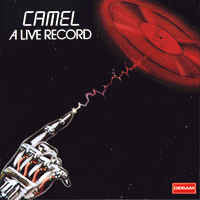
remaster DISC 2: 1)-17) The whole of ‘The Snow Goose’ with (***) an intro track plus: 18)*** The White Rider 19)*** Another Night Best song: (It’s a live album) |
Descriptor: |
At this moment Camel decided to release an anthology in the form of a live album. Well it works darn fine, but the new remastered surely helps it a lot. In fact, I would stay away from the old version of it since this one is available and adds a ridiculous amount of songs. A lot of the stuff that is added is from ‘Rain Dances’ since they didn’t want to release the same tracks twice in the same year. While many performances pale a bit when compared to their studio versions (Lunar Sea and Lady Fantasy), many of the new additions really gain a lot from the live performance. Everything that was great about First Light and Unevensong is boosted, and Metrognome manages to sound okay. However, they totally annihilate Never Let Go; it’s not meant to be a jazz improvisation. The second disc however has lots of meat; the whole of ‘The Snow Goose’ is performed with new energy, must be the Royal Albert Hall or something. They used an orchestra that night, and I rarely heard a better use of an orchestra. You don’t really pay attention to it most of the time, but it pops out at exactly the right moment, it’s extremely efficient. As far as I know, this is THE live Camel album to get, with over 2 hours of great music. It also acts okay as a “best of”, but some of the power of key tracks is sometimes missing… Once again, hooray for ‘The Snow Goose’.
Simon Lac, November 21st 2004
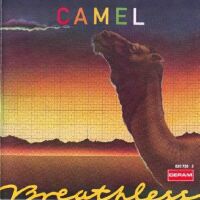
1978 Rating: 9+ 1) Breathless 2) Echoes 3) Wind and a Prayer 4) Down on the Farm 5) Starlight Ride 6) Summer Lightning 7) You Make Me Smile 8) The Sleeper 9) Rainbow’s End Best song: ECHOES |
Descriptor: |
There are mad people on this planet. They say ‘Breathless’ is a bad album. Sure, it contains its load of cheesiness, but it’s so saturated by this warm feel I don’t care about that most of the time. It would be a perfect album if it weren’t for this “can’t play this song in public” factor. I know this is a pretty lame excuse not to give it what it deserves, but that feeling is a bit haunting sometimes. I said in my ‘Rain Dances’ review that it was a good picture of the late 70s feel, well I think ‘Breathless’ is an even better one. The disco uplifting tinged songs are pretty well balanced by the syrupy but intoxicating ballads. Wait a minute, I sound like I’m describing a random late 70s disco album here, but there IS Camel sound all over the walls on this. Starting with Echoes; one of my top Camel songs, again illustrating Latimer’s skill at building a riff that carries you over somewhere, gotta love all those mid-sections, I really like the section between the two sung verses. Even the controversial Down on the Farm is far as bad as they’re going to tell you; for sure, the pastoral farm sounds and verses can be a bit embarrassing, but the main theme of it and the chorus is some of the catchiest work by the band, and we should all thank bassist Richard Sinclair for that one. There’s also Summer Lightning that says everything about the album. It’s the best disco song ever, period. It’s almost pure disco, but the sung melody is incredible (listen to that backing jerky guitar riff!) and the way it ends with a warm Latimer guitar solo over the disco beat is maybe the highest point of the album. Unfortunately it’s followed by some of the reasons why this album is not perfect; You Make Me Smile has an ugly synthesized beat with ugly lyrics that you would definitely want to skip it at a reunion (you could blush). So, it’s all about a warm summer evening, and the rhythmic section based on Andy Ward (GREAT DRUMMER!) and Richard Sinclair is at its peak in terms of cozy grooves. It’s really sad that Sinclair has to leave here. So does Peter Bardens, for conflicting interests reasons, it’s the end of a legacy! Get this album and drop the pride.
Simon Lac, November 21st 2004
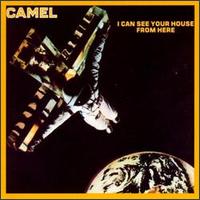
1979 Rating: 6+ 1) Wait 2) Your Love is Stranger Than Mine 3) Eye of the Storm 4) Who We Are 5) Survival 6) Hymn to Her 7) Neon Magic 8) Remote Romance 9) Ice Best song: ICE |
Descriptor: |
The departures mentioned above hurt the band quite bad. Bardens and Sinclair have left; they were respectively responsible for Camel’s late Santana influences and jazzy warmth. Now that they are gone, we’re left with a much colder album. By the way, I’d like to mention that the album’s cover is NOT a spaceship, but rather it is a “crucified astronaut” looking down at the Earth and saying “I can see your house from here!” (based on a joke of those days that ended with similar words that Jesus said to Mary when he was on the cross, in fact, the album was supposed to be called “Endangered Species”). So, with no jazz and warmth, we’re left with pure late 70s synthesised arena type pop. Most of it is okay, just not very distinct or poignant… The best of those pop numbers is the opener Wait, about gambling, that has a nice interplay between the two new keyboard players (the keyboard theme is awesome). The second number is a lame song reminiscent of ‘Rain Dances’ Highways of the Sun, except it’s slightly more tolerable. There are two short and nice instrumental tracks that have a slightly more recognizable Camel sound. Most of the rest is quite forgettable though and very constant in mood (a kind of “what year is it?” mood), except for Remote Romance; this one is not too bad, the boys are fooling in the studio with their electronic apparatus, quite ridiculous but acceptable. The album would get a pretty low mark if it were not for ICE. This track happens to be my favourite Camel song. It’s quite weird how it ended up on this album. It’s a very soft instrumental, that starts with the most gorgeous slow piano and guitar melody. From there, it goes into a heart tearing slow electric guitar solo accompanied by a synth mood that reminds me a bit of Pink Floyd. A synthesiser also does some soloing here and there, and succeeds extremely well. Some drum rolls bring back to the main guitar theme, this time, with increased built-up back-up, and I’m once again torn to shreds by this! It falls back to quiet, and ends on a very soft barely audible acoustic-electric guitar number. You have to hear this to believe it, and if you tell me it’s stereotypical of something or whatever, you have absolutely no heart; go get one. Note that most of ICE was recorded on a one-time improvisation; awesome isn’t it? Andy Latimer wanted to re-do some parts, but Phil Collins, who appears on this album in places, convinced him not too; only for that, I can’t hate the bald guy. Ice does share some of the “cold in space” feel of the rest of the album, but there’s a fire inside. The track carries the album.
Simon Lac, November 21st 2004
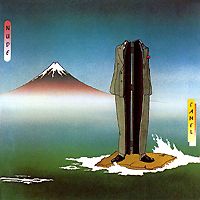
1981 Rating: 8+ 1) City Life 2) Nude 3) Drafted 4) Docks 5) Beached 6) Landscapes 7) Changing Places 8) Pomp & Circumstance 9) Please Come Home 10) Reflections 11) Captured 12) The Homecoming 13) Lies 14-15) The Last Farewell Best song: CAPTURED |
Descriptor: |
Well, after dangling with pop, Latimer decided that was enough. They were releasing singles after singles; none of them ever caught much attention, so why bother? They could do some good pop, and this album illustrates it, but Camel decidedly turned back to their roots and went for a concept album along the lines of ‘The Snow Goose’. ‘Nude’ is based on those stories you probably heard of some Japanese soldiers that were stranded on a tropical island for almost 30 years after World War II was over, and when they were found, they still considered themselves “on duty”. Only, Nude (the character) decides to try to go back to his island because he just could not adapt to life in society after all those years. One of the biggest success of this album is that it is very efficient at differentiating the “city” mood from the “isolated island” mood. When I walk in the streets of Montréal, I can almost hear City Life in my head because it catches so much of what it is to live in a city; the lyrics are perfect, Latimer’s delivery is honest, and the constant 80s rhythm fits just well. Even the saxophone solo works in that direction. The moment when Nude is drafted is also a great piece and the guitar solo illustrates sadness against vision. Follows the battle, which is a dramatic synthesised driven groove covered with Latimer’s aggressive guitar. The section where Nude lives on the tropical island is perfectly illustrated by a series of “natural” instrumentals, although the whole thing is honesty a bit too long. Captured (when Nude is captured to be brought back to the civilized world) is full of synths and saxophone conjugating in tension. All the way through, you can perceive the fact that Camel jumped in the 80s, and succeeded at creating a great progressive rock album that was not trying neither to be a 70s one, or a 80s missed prog-pop album. It was going to take another 10 years before Camel would release something of that kind again.
Simon Lac, November 21st 2004
1982 Rating: 6 1) No Easy Answer 2) You Are the One 3) Heroes 4) Selva 5) Lullabye 6) Sasquatch 7) Manic 8) Camelogue 9) Today’s Goodbye 10) A Heart’s Desire 11) End Peace … BONUS TRACKS: 12) You Are the One (Edited version) Best song: CAMELOGUE |
Descriptor: |
Andy Latimer is finally alone, all of the original Camel members are gone except him. Indeed, in 1982, they said drummer Andy Ward suffered a hand injury, but it was actually a suicide attempt due to depression. However, this album has a host of invitees, among which are a few Alan Parsons Project members, former keyboardist Peter Bardens (appearing on one song) and ex-Genesis member Anthony Phillips. This mingling means Camel loses a large part its original identity. What you will hear when you put this disc in your player is a suite of unoriginal 80s pop songs. So I take them as that. From this point though, it’s clear that there are no reasons why those songs should be less popular than any others of that era. They’re actually better than most of what I remember hearing on the radio when I was a kid. If you are totally disgusted by 80s pop, maybe you should stay away from ‘The Single Factor’. There are many Camel albums you should get before. Sasquatch is the only track Andy Latimer still bothers about, and I don’t really like it personally, it’s fine; it is an instrumental based on as simple rhythm and some guitar soloing here and there, accompanied by Phillips’ 12-strings, there’s something completely wrong about the part just after the main riff though. My personal favourite section goes from Manic to Today’s Goodbye (this one has vocal harmonies reminiscent of Foreigners or something like that, wait, I don’t really know Foreigners). Camelogue in particular seems to predict a bit what is to come on the next album; it’s a very slow going song about the story of Camel, it has a perfect rhythm to walk to, and a groovy bass accompaniment. Selva and End Peace are the most Camel-ish bits, trying to be a bit like Ice, they are okay, only they both sound almost the same.
Simon Lac, November 21st 2004
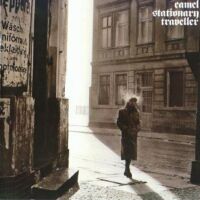
1984 Rating: 9 1) In the Arms of Waltzing Frauleins 2) Refugee 3) Vopos 4) Cloak and Dagger Man 5) Stationary Traveller 6) West Berlin 7) Fingertips 8) Missing 9) After Words 10) Long Goodbyes … BONUS TRACKS: 11) Pressure Points (Extended mix) Best song: FINGERTIPS |
Descriptor: |
‘Stationary Traveller’ is the last album that Camel made for a company. Following this album, there were many years of justice, lawyers, and obstacles. Andy Latimer finally established his company in the early 90s, Camel Productions. As for the album itself, be aware that I possess the newest version of it, re-released in August 2004 by Camel Productions (and signed by Andy Latimer himself!). There is a difference in that Latimer structured it the way it was originally intended to be. He added the opener In the arms of Waltzing Frauleins and transformed the original opener Pressure Points into a bonus track, finally putting the complete mix.
When I heard this album for the first time, I was flabbergasted really! While ‘The Single Factor’ represented some okay-ish 80s pop schlock, this one actually totally “feels” like the 80s in a fully positive way. The production is slick, everything is clear, bass lines are thrilling, and rhythm is complete, accomplished. They still had relations with Alan Parsons Project in those years, but ‘Stationary Traveller’ beats mostly anything APP did during the 80s. The whole thing is a set of songs inspired by the situation in Germany during those years, and the separation of East and West Germany. The songs are not really “scary” or anything, but while they often have a constant rhythm that almost sounds uplifting, they do capture a sense of gloom and dirt. The most traditional number is the instrumental title track featuring Andy on the pan flute. It is another one of those Ice inspired tracks, but succeeds at this much better than anything else in the rest of the band’s catalogue. The first few songs use constant “low grooves” to set the mood of the dustiest parts of Berlin, and from there, it shifts to hope and trying to reach something better. West Berlin also has a constant 80s groove of drum machines, but clearer this time, and the chorus is absolutely gorgeous “and I’m looking out over West Berlin, feeling freer than I’ve ever been, when the sun sets over West Berlin, I’ll be leaving, I can’t come back again”. Fingertips is the definite highlight, it’s a quiet slow-tempo song featuring beautiful fretless bass by David Paton, the chorus says it all “don’t let it slip through your fingertips”. Another saxophone solo manages to sound great, even if I usually dislike this instrument. The rest of the album is okay, nothing stands out, but nothing can bring this album down. I’m not even ashamed of this music even if it’s decidedly very era-specific. There was underground music in the 80s, like Sonic Youth, but when I think of the general sound of the 80s, looking at it on the bright side brings up this album.
Simon Lac, November 21st 2004
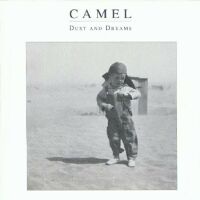
1991 Rating: 8- 1) Dust Bowl 2) Go West 3) Dusted Out 4) Mother Road 5) Needles 6) Rose of Sharon 7) Milk n' Honey 8) End of the Line 9) Storm Clouds 10) Cotton Camp 11) Broken Banks 12) Sheet Rain 13) Whispers 14) Little Rivers and Little Roses 15) Hopeless Anger 16) Whispers in the Rain Best song: HOPELESS ANGER |
Descriptor: |
[Here, insert a lot of dealing with justice and courts, problems with record companies, Andy moving to California and starting his own record company...]. 'Dust and Dreams' was extremely well received by the fans and Camel Productions were quite surprised by its success. Maybe it was just the long time without any album that made it so popular, I couldn't tell. But 'Dust and Dreams' is indeed a pretty good return. And it fits its era very well... I have a weird relationship with the dust bowl events of the USA Midwest. I've heard a lot about it during my undergraduate years because the dust bowl was caused by soil erosion due to a combination of drought and bad agricultural practices... The loss of land forced people to move to California and such places where they worked in cotton or fruit plantations. The concept of 'Dust and Dreams' is based on Steinbeck's "Grapes of Wrath".
The album is very much like 'Nude' in that it is composed of many instrumentals and is punctuated by vocals. This is a return to form for Andy Latimer; he drops the Alan Parsons Project pretensions for good and returns to what he really has always been... The second half of 'Dust and Dreams' is basically entirely instrumental. The instrumentals seem to be very quiet and have a "crystalline" feel to them. They give a feeling of loneliness and crystal beads of water somehow. I guess that's also when the drums are quiet too; I'm not a fan of the drum production. You know, those overly clear drums... They ruin songs like Mother Road for instance, a rather bland straight rocker. Vocal songs like Rose of Sharon, featuring a beautiful voice duet that could be seen as cheesy but isn't to me, manage to be the best vocal parts because they are quiet and have nice bluesy guitar and atmospheric synthesizers. It's the case for Go West and its mood-setting predecessor Dust Bowl. I chose Hopeless Anger as my favourite track here because it stands out from the rest. It is quite punchy and has the only crunchy guitar of the whole album. In the same manner, Cotton Camp and Broken Banks, other instrumentals, manage to push a gorgeous uplifting guitar melody on you. I guess this shows that a slight problem with 'Dust and Dreams' is its sameyness. But the album isn't overlong and the despair of the dust bowl is quite well captured I find. It's really that, a crystal feel mixed with dust on a cloudy day.
PS; my copy of this is signed by Andy Latimer. Did I mention my 'Stationary Traveller' was signed also? Oh yes I did. Nobody cared that's all.
Simon Lac, October 14th 2005
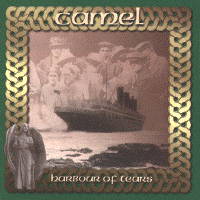
1996 Rating: 8 1) Irish Air 2) Irish Air (Instrumental Reprise) 3) Harbour of Tears 4) Cohb 5) Send Home the Slates 6) Under the Moon 7) Watching the Bobbins 8) Generations 9) Eyes of Ireland 10) Running from Paradise 11) End of the Day 12) Coming of Age 13) The Hour Candle (A song for my father) Best song: WATCHING THE BOBBINS |
Descriptor: |
Andy starts to do like every artist in the 90s and 2000s, and decides that 4-6 years between albums is acceptable. I don't know... It's just annoying hehe. I mean, everybody, leave me alone with countless boxsets, live releases (4 formats of course), and compilations with one extra song on them; I just want new muzak damn it! End of today's editorial. Wow! I managed to get a Japanese release of this album! Now I can't compare soundwise, I haven't heard the "normal editions". It's just neat to have a Japanese booklet that only has the lyrics in English, and consequently be unable to read the liner's note... AWESOME.
'Harbour of Tears' pretty much follows the 'Dust and Dreams' format. Bunch of instrumentals, bunch of vocal tracks. This album finds Andy looking back at his Irish roots after his dad died. Famine brought many Irish people to America of course. Once more, going west for food... Did I hear that anywhere before? Oh yeah, the PREVIOUS album. I forgive though, Andy is a romantic guy, and the music is pretty much on par with what it was on 'Dust and Dreams'. In fact, I'd say the album starts out generally better than 'Dust and Dreams', but sort of fizzles in some of the instrumentals like the Genesis imitation Coming of Age. For instance, Send Home the Slates plays the role Mother Road wanted to play, but is much better. The lyrics are more memorable and sort of funnily interesting, and the guitar buries the drums. There is sure more variety on 'Harbour on Tears' than on the 1991 album. Andy doesn't hesitate as much to explore the feeling of hopelessness with more rhythm this time around. The bluesy Watching the Bobbins, with its recognizable guitar riff, is a fine example of that. Another thing I want to point out is that Andy doesn't overdo the "irish" thing at all. The album opens with a beautiful Irish air, and here and there a line will remind you of it. The instrumentation is a nice touch but it's not evidently trying hard to be Irish. It's pretty well done. Listen to the beautifully quiet End of the Day.
My view on the situation is that the vocal songs telling the story with words are much better on 'Harbour of Tears', whereas the instrumental tracks are sort of better on 'Dust and Dreams'. 'Harbour of Tears' just sounds like a more daring experiment. And to those who complain about the 15 minutes or so of wave crashing on the shore at the end of the album... Is it that hard to push stop? I mean, it takes all its meaning when looking at the second title of the last track. I don't usually listen to it. I wish it had been recorded at higher volume, it would be great to fall asleep to.
Simon Lac, October 14th 2005
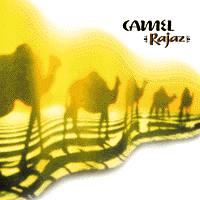
1999 Rating: 8+ 1) Three Wishes 2) Lost and Found 3) The Final Encore 4) Rajaz 5) Shout 6) Straight to My Heart 7) Sahara 8) Lawrence Best song: SAHARA |
Descriptor: |
As opposed to many of the more classic Camel albums that are "conceptual", 'Rajaz' is a "thematic" album, a bit like 'Stationary Traveller'. It does not really tell a story, but is inspired by a general feel or place. And what better theme is there for a band like Camel than desert melodies? "Rajaz" is indeed a type of melody sung by Arabic people to the rhythm of a camel's steps. The album is slightly inspired by Arabic themes, but not overly. There is a feel of sand around it, but it's not in the instrumentation.
Some people find 'Rajaz' boring. It is true that it is more subdued than other Camel albums. It is also quite more personal. The blues taste is omnipresent and Andy features his wonderful Les Paul guitar sound whenever he can (I can only imagine he'd use this fabulous Gibson guitar that he has). You should just sit there and listen to his melodic sense. It's great to finally have an album that puts so much emphasis on his guitar. This also means that many of the more artificial synthesizer sounds are put in the background... But even when they are there, they sound far less "80s"-ish than on the two previous albums. The most Arabic thing on the album is the second part of The Final Encore, a song composed entirely of Camel puns; it's not extraordinary but when the melodic end comes on this slow camel pace, it's striking. It is true that most songs are slightly too long though. Rajaz is a slow song carried softly by acoustic guitar, but it overstays a bit. Same goes for Lawrence. 'Rajaz' is generally slow, except on two highlights; Three Wishes and Sahara, which are almost the only places where you will hear traditional weird "prog rhythm changes". Sahara is the best of the two because it merges all of the best aspects of the album, with a very subdued bluesy beginning (and end) and a fiery guitar melody suite. Oh and you should notice how the annoying drum production of the 80s is finally gone. In other places, the pace is tranquil, and it's really all about Andy's bluesy guitar. An easy comparison would be with Pink Floyd's Gilmour's guitar stylistics, although I find Andy Latimer has a better sense of melody, especially these days. Andy also shares more than he used too, particularly on the almost corny sounding Shout (an acoustic ballad with meaningful lyrics). There is also Straight to My Heart, a gorgeous song about memories of listening to music and guitar when he was a child. This particular song also has a fabulous traditional Camel guitar riff. Again, just listen and imagine the guitar maestro in the shadow and his minimalist guitar sounds. It's an avenue that hadn't quite been explored in Camel, and I'm glad it's now available on 'Rajaz'. I seriously think that 'Rajaz' is the closest we get to Andy's soul.
I do think that 'Rajaz' is the best album of the Camel Productions years of Camel. Not by much though; Andy Latimer managed to keep up a pretty good quality standard in the 90s.
Simon Lac, October 15th 2005
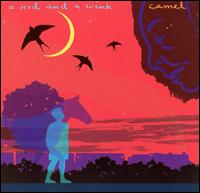
2002 Rating: 6+ 1) A Nod and a Wink 2) Simple Pleasures 3) A Boy's Life 4) Fox Hill 5) The Miller's Tale 6) Squigely Fair 7) For Today Best song: SIMPLE PLEASURES |
Descriptor: |
The last Camel album (as of today anyway... one apparently is coming next year) is probably their most controversial (maybe even more than 'Breathless'). Andy's albums were becoming increasingly personal. I think 'A Nod and a Wink' is an attempt to continue in that direction. It is far from being as efficient as its predecessor though... The album is thematic again, centered around nostalgia mostly. Thinking of old loves, old friends (especially considering Peter Bardens' death, which was quite recent in 2002), old tales... Many of the topics are great. In fact they most likely are the best part about the album. The theme and the lyrics (except for one very notable exception) are the highlight... It's the musical ideas that are a bit lacking.
I really loved 'A Nod and a Wink' the first month I had it. Oddly, I started to lose interest thereafter. It seems many of the individual melodies are interesting, but it frankly feels as if they have been randomly and awkwardly stuck together. This is very evident on the title track for instance, which just sounds like a bunch of ideas stuck together with no direction. I'm glad Andy's flute is back though, and the mellotron! Should be right there UPFRONT... One of the best moments is Simple Pleasures, however it is also the song that reminds the most of 'Rajaz', with the bluesy Sunday afternoon feel. It is truly nice though... Quite a moving image; the one of an aging man reminding himself of a past love with a bit of wine in his kitchen, by the window... A rather fantastic song. Andy's singing is good throughout the album. Like in the opening of A Boy's Life; again, the lyrics are simple and pure. This one is pretty, and has a typical Camel uplifting melodic section. But then the rambling comes back with the first truly annoying Camel song in more than 20 years; Fox Hill. Maybe, I say maaaaybe, it would have been acceptable in a 5 minutes form, but now, in its mastondontic 10 minutes of embarrassing story-telling, it's... annoying. The usual comparison is 'Trick of the Tail' era Genesis stories, but Genesis' stories weren't that... anyway... The music is quite unimaginative too. Admittedly the flute part is nice. And don't tell me I lost my child's heart; that's simply not true. The truth is that you need to have a good connection with your child at heart to enjoy Camel in the first place. Fox Hill however, is just a bit too much. Miller's Tale suffers from the "patched up work" syndrome too and is hardly memorable. And the fake synth sounds that had been hidden on 'Rajaz' are a bit upfront here (fake voice chorus sounds should be BANNED). Squigely Fair is the only instrumental, and while it sounds pretty good, it just brings nothing new, especially since it's once again glued together oddly, leaving you with very little to hang on to. It's good that the album ends on something relatively simple and touching. For Today is of course reminiscent of Ice, but it has lyrics dedicated to people who had to jump from the World Trade Center, and it tells you over and over again to "never give a day away, always live for today". It's pretty nice. I once had it among my favourite Camel songs but now I sort of doubt it deserves to be there. Definitely a highlight here though.
I'm really looking forward to hear Andy's next album. However, I do agree with the critics of 'A Nod and a Wink'. The album plods a bit and the musical ideas are patched up awkwardly. It doesn't entirely prevent this album to be a moving experience in places. Still, this is sadly the poorest release from Camel Productions.
Simon Lac, October 15th 2005