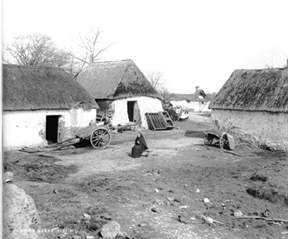
 The horrors of the Great Famine began in 1846, when a "blight of unusual character" ruined acre upon acre of Irish farmland. Shortly after they were collected, potatoes decayed at an unprecedented rate, turning into a slimy black "mass of rottenness." Peasants who had no choice but to consume the rotting produce fell ill with typhus, dysentery and cholera.
At the time, scientists believed the Great Famine was caused by "static electricity" (witnesses reported huge electrical storms immediately preceding the blight), smoke from railroad locomotives or even "mortiferous vapours" rising from underground volcanoes. Today, experts agree that the blight was caused by a fungus indigenous to Mexico.
Or was it?
Before the blight of the potatoes, there were some who believed it was the potatoes themselves that were a "blight on humanity." Newspaper articles (usually appearing in the Humorous Notes section) reveal stories of unexplained movement in potato crops and "sinister magic" (which more closely resembles a rudimentary form of mind control).
Under British rule, Irish Catholics were only allowed to rent small plots from far-off British Protestant landlords. This forced the Irish peasants to abandon their traditional crops in favor of a relatively recent addition to their diet: The potato. A single crop of potatoes could support a family for a year, while grain would take three times as many acres.
Some scholars believe that Britain's motives were more sinister than economic repression or religious persecution.
From J.T. Watson's The Famine Experiment:
For the first time in recorded history, here was a people whose diet consisted almost entirely of potatoes. The side-effects of malnourishment were ghastly. Families grew weak, pale, listless. If fighting British oppression was still in their hearts, it was no longer a feasible option. They were slaves not only to the British, but to their diet. In the years before the Irish potato famine, the people of Ireland were becoming, if you'll excuse the colorful expression, like Zombies."Perhaps more sensational than theories on mind control are the reports that in the years preceding the blight, random crops of potatoes underwent some sort of metamorphosis. Stories sprang up about bad crops and of creatures even more frightening and fantastic than those found in Irish folklore.
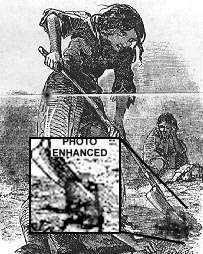
The Illustrated London News, 1843:More information can be found in Bad Harvest (Henry Gibson, 1972). Viewed as sensational fiction in academic circles, Bad Harvest suggests that this mutant strain of potatoes and the recent "monster" sightings were one and the same.
"I knew at the time that there was something wrong about it [the potato crop]," said one T. O'Donnell from the bog land of Gurranenatuoha. "It changed, the whole crop had gone bad." O'Donnell sold his crop to one Frank Keane for 30 Shilling. "I wouldn't dare eat one," O'Donnell said to this reporter. "Not after I seen with my own eyes one moving like a wounded animal."
|
|
| Is the woman's expression one of desperation or grim determination to stop what she perceives as a threat? Whether Henry Gibson, who disappeared shortly after the publication of his first and only book doctored the picture remains widely debated. Photo used without permission from Bad Harvest. |
There was ample proof that the potatoes had mutated, come alive, but reporters who wrote about roots "squirming like worms" were quietly fired. There was a massive coverup before the Famine, which was quickly embraced by newspaper editors, who preferred death and disease to something (gasp!) unexplainable. But there was one slip-up in the London Illustrated News, which printed this drawing [see sidebar]. I quote: "What the people were digging and hunting for, like dogs after truffles, I could not imagine." Well honey, you got this much right: They were hunting; hunting down every last one of the mutant strain. Finishing the job that the blight started."Theories aside, the facts speak for themselves. Over the next ten years, 750,000 Irish died. In the Spring of 1847, after being blasted in the press for its slow response, Britain opened soup kitchens and emergency work programs. Over 2 million Irish moved to these dangerous, overcrowded workhouses. More than 200,000 died within their walls.
The Great Famine took more than one million lives from hunger and disease. But for all the plague and death, 2 million Irish escaped a life of indentured servitude and malnutrition to Canada, the United States and Great Britain. To those lucky enough to find a better life, the Irish potato famine was both a curse and a blessing.