Mace favoured either Richard Burton, James Mason or Stewart Granger. (It has often been reported that Ian Fleming suggested Hollywood actor James Stewart as a possible Bond. Granger's original name was James Stewart, and it's surely more plausible that Fleming had Granger in mind?)
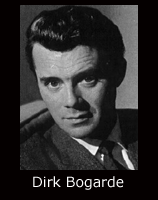 But Rank had its own roster of stars, and prime among them was Dirk Bogarde. While Bogarde certainly had the class to be Bond, Mace didn't think he looked tough enough, and felt that Stanley Baker was more suitable. (Baker could to some extent be described as a proto-Connery, and his Bond might well have resembled Connery's in many respects.)
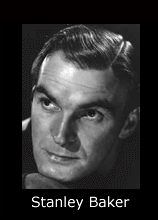 Co-producer Hunter disagreed, and so did the studio. Bogarde might not have been beefcake, but he was big where it mattered - at the box-office. Either they went with Bogarde, or the deal was off. Baker was assigned the lesser role of Bond's police contact, assistant Commissioner Vallance of Scotland Yard.
Ian Fleming, meanwhile, was keeping his distance. Exhausted from the task of writing From Russia, With Love - not to mention somewhat dishearted by the relatively lukewarm critical reception accorded the recently published Diamonds Are Forever - he found himself with "little inclination" to visit the Moonraker set. Though reportedly "excited" that a film-maker of Welles' calibre was involved in bringing Bond to the screen, and "not averse" to seeing Bogarde in the role, the "dreadful hash" that American TV had made of Casino Royale had sown the seeds of a "recurring sense of disillusionment with this whole business of adaptations" that would plague Fleming, on and off, for the remainder of his life.
As for Bogarde himself - at that time perhaps best-known as innocuous medic Simon Sparrow in the popular Doctor series - he leapt at this chance to demonstrate that steely ruthlessness was well within his range. After all, had he not earned his bad-boy credentials as the punk who gunned down avuncular copper George Dixon in The Blue Lamp? And, like Fleming, he had worked in Intelligence during the war. He thought the Bond character "absurd, but fun to play."
And so the spring of 1956 saw Moonraker being lensed on location on the Kent coast; staying remarkably true both to the novel and Fleming's script outline, the Welles/Mace screenplay lacked the travelogue element one associates with the Eon Bonds. Interiors were taken care of at Pinewood. The schedule was insanely short, the budget meagre, the problems unrelenting. Female lead Peggy Cummins (Gun Crazy, Night of the Demon, Hell Drivers) fell ill after two days and a desperate Welles accepted producer Mace's girlfriend, Brenda Bright, as a last-minute replacement. Bright, a former stripper with just one previous screen credit - Mace's own ultra-low-budget pioneering nudie pic Bare With Me - was certainly physically right for the role. But could she act?