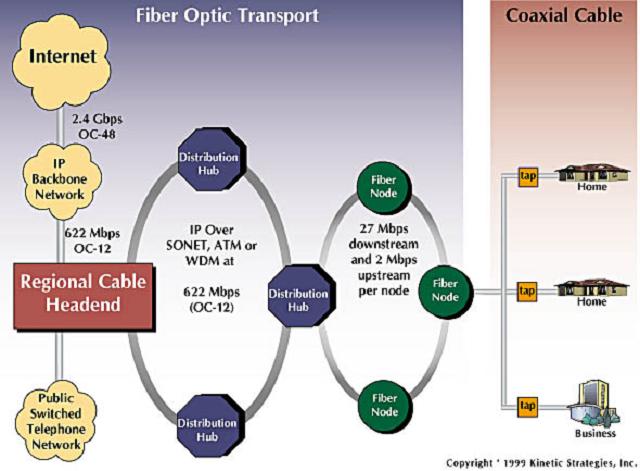
To offer high-speed Internet services, a cable operator creates a data network that operates over its hybrid fiber/coax (HFC) plant. The following diagram provides cable network, including a Regional cable headend which feeds Distribution Hub (each serving 20,000 to 40,000 homes) through a metropolitan fiber ring. At the Distribution Hub signals are modulated onto analog carriers and then transported over fiber-optic lines to nodes serving 500 to 1,000 Homes. From the node, these signals are carried via coaxial cable to Home or business..
The regional cable headend serves as the local data network operations center. A carrier-class IP switch or router interfaces with a backbone data network, such as those operated by @Home or Road Runner, offering connectivity to remote content servers, as well as the global Internet.
This switch/router also connects to cable modem termination systems (CMTS) housed in the distribution hubs (hyperlink). Many cable operators are beginning to deploy high-capacity packet transport solutions over fiber rings connecting the CMTS units in their distribution hubs, such as Packet Over SONET (POS), at up to OC-12 speeds (622 Mbps).
Content and application servers are typically at the regional cable headend, as are network management and operations support systems. If the cable operator were offering IP telephony, voice calls would be directed by the headend router to a IP telephony gateway, and then onto the public switched telephone network (PSTN).