Ethernet
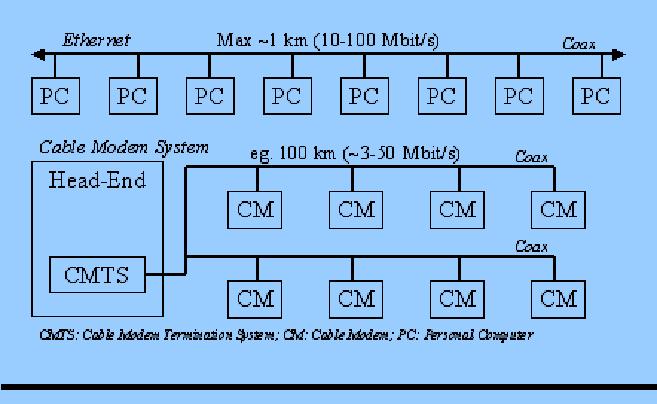
An ethernet (LAN) connection is 10 Mbit/s or 100 Mbit/s, and is used to connect many computers that can all "talk" directly to each other. Normally they will all talk with a few servers and printers, but the network is all-to-all. The distance is normally limited to below 1 km.
Cable Modem
A Cable Modem connection is something in-between. The speed is typically 3-50 Mbit/s and the distance can be 100 km or even more. The Cable Modem Termination System (CMTS) can talk to all the Cable Modems (CM's), but the Cable Modems can only talk to the CMTS. If two Cable Modems need to talk to each other, the CMTS will have to relay the messages.
A CATV network is designed and used for cable TV distribution. With an upgrade of the system, it is normally possible to allow signals to flow in both directions. Higher frequencies flow toward the subscriber (you?) and the lower frequencies go in the other direction. This is done by upgrades to the amplifiers in the cable distribution network etc.
Most CATV networks are Hybrid Fibre-Coax (HFC) networks. The signals run in fiber-optical cables from the Head-End center to locations near the subscriber. At that point the signal is converted to coaxial cables, that run to the subscriber premisses.
One channel of CMTS will normally drive about 1-2000 simultanous Cable Modem users on a single TV channel. If more Cable Modems are required, the number of TV channels are increased by adding more channels to the CMTS.
External Cable Modem
The external Cable Modem is the small external box that connect to your computer normally through an ordinary Ethernet connection. The downside is that you need to add a (cheap) Ethernet card to your computer before you can connect the Cable Modem. A plus is that you can connect more computers to the Ethernet. Also the Cable Modem works with most operating systems and hardware platforms, including Mac, UNIX, laptop computers etc.
Another interface for external Cable Modems is USB, which has the advantage of installing much faster The downside is that you can only connect one PC to a USB based Cable Modem.
Internal Cable Modem
The internal Cable Modem is typically a PCI bus add-in card for a PC. That might be the cheapest implementation possible, but it has a number of drawbacks. First problem is that it can only be used in desktop PC's. Mac's and laptops are possible, but require a different design. Second problem is that the cable connector is not galvanic isolated from AC mains. This may pose a problem in some CATV networks, requiring a more expensive upgrade of the network installations. Some countries and/or CATV networks may not be able to use internal cable modems at all for technical and/or regulatory reasons.
Interactive Set-Top Box
The interactive set-top box is really a cable modem in disguise. The primary function of the set-top box is to provide more TV channels on the same limited number of frequencies. This is possible with the use of digital television encoding (DVB). An interactive set-top box provides a return channel - often through the ordinary plain old telephone system (POTS) - that allows the user access to web-browsing, email etc. directly on the TV screen.