
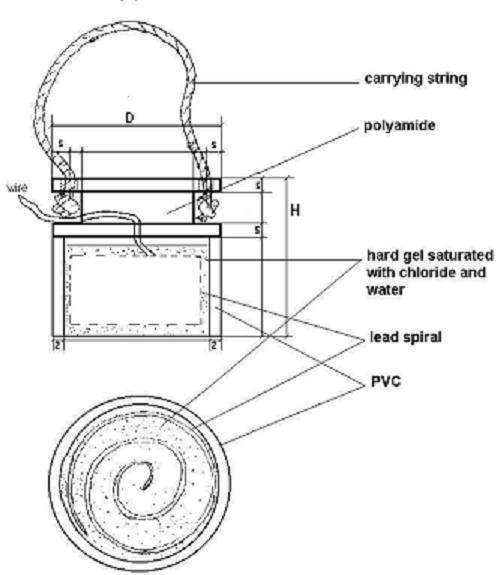
Main fetures
DC potential: a few mV
Contact resistance: 20-300 Ohm (for normal ground)
Surface of the bottom: 114 cm2
Surface of the Pb-spiral: 225 cm2
Mass: about 2 kg
Diameter (D): 125 mm
Height (H): 90 mm
MEDIUM TYPE (Fig. 2.)
Main fetures
DC potential: a few mV
Contact resistance: 30-300 Ohm (for normal ground)
Surface of the bottom: 58 cm2
Surface of the Pb-spiral: 180 cm2
Mass: about 1 kg
Diameter (D): 90 mm
Height (H): 80 mm
LONG TYPE (Fig. 2.)
Main fetures
DC potential: a few mV
Contact resistance: 50-500 Ohm (for normal ground)
Surface of the bottom: 27 cm2
Surface of the Pb-spiral: 180 cm2
Mass: about 0.7 kg
Diameter (D): 64mm
Height (H): 114 mm
SMALL TYPE (Fig. 2.)
Main fetures
DC potential: a few mV
Surface of the bottom: about 3 cm2
Surface of the Pb-spiral: about 0.04 cm2
Mass: about 0. 1 kg
Diameter (D): 25 mm
Height (H): 50 mm
Temperature drift of the electrodes: about 0,66 microvolt/C degree using between 20-50 C).
Their noise level is very low thanks to the relatively large surface of the Pb-spiral.
Working life: 12-16 month (in case of careful using on the ground with normal conditions), not depending on the number of real mesuring days.
Connection: isolated copper wire or tinned copper wire (length 1- 2.5 m, core 0.75-2.5 mm2 - according to the order).
The electrodes can be buried completely in the soil.
According to the laws and regulations concerning the manipulation of lead compounds.
H-1195 Budapest, Hofherr Albert u. 3-15
Hungary
Phone/Fax: (36 1) 282 8881
Email: [email protected]
www.wolf.hu
H-1221 Budapest, Ringl� �t 39.
Hungary
Phone: 36 1 2261870, +36 1 2123517
Fax: 36 1 3637256
Email: [email protected], [email protected]
The unite price of the electrodes:
medium type: 70 EURO/piece
long type: 72.5 EURO/piece
big type: 90 EURO/piece
We deliver always newly manufactured electrodes. The buyer can receive at their address the electrodes within 3-4 weeks after receipt of the order by the distributor.
Transportation, storage
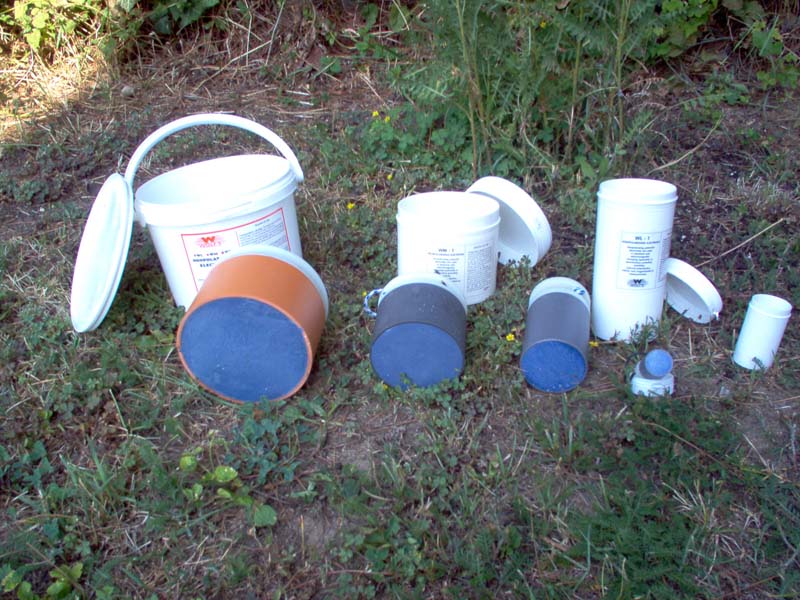
The nonpolarizing electrodes should be transported and stored in their containers. There is an artificial sponge at the bottom of the container saturated with a special solution. The sponge should sometimes be soaked with distilled water (30 to 50 ml). The sponge must not be dried up and should be protected from sunshine.
Setting of the electrodes
It is suggested to choose from the following mode of setting resulting a good contact between the ground and the electrode:
- to put the elctrode onto the plain wet soil
- to dug the electrode into the ground and surround by mud made with salt water
- to place the electrode into a bag filled in with bentonite mud and to dug this bag into the ground.
Start of work
If one start of work by setting of electrodes they reach the stationary (working) condition while the measuring device is prepared.
End of work:
after the work the nonpolarizing electrode should be washed down and put back into the container.
Special circumstances
In the case of sandy soil and long measurements the soil around the nonpolarizing electrodes should sometimes be watered. The soil must not be dry up.
If the soil is strongly sandy it is recommended to put down 2-3 electrodes near each other. The isolation at the end of the electrode cables should be removed and the wires twisted together. The electrodes should be buried and the soil often watered.
In desert area several (2-3) nonpolarizing electrodes should be applied at a depth of several meters and they should be buried. The wires should be twisted together as mentioned afore. Before the measurement the soil should be watered and during the measurement the watering repeated several times.
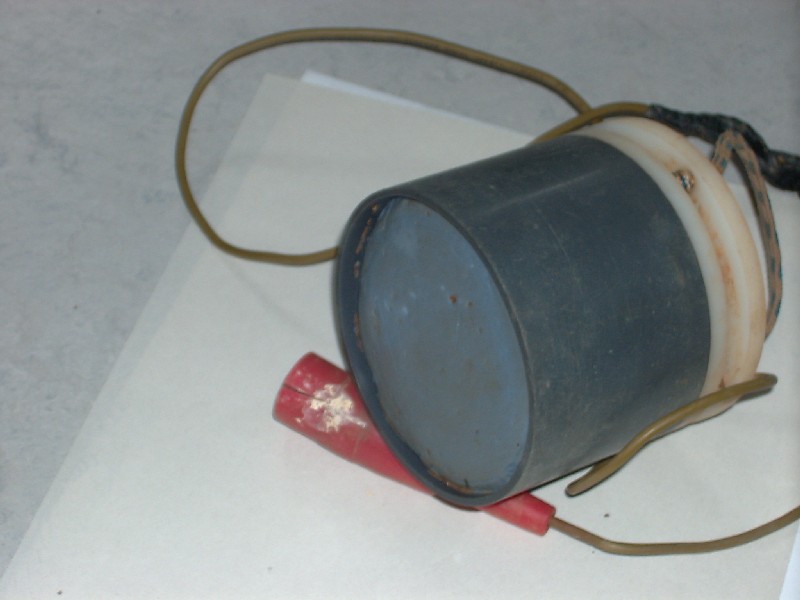
In the last few years our attention has been turned to the phenomenon that the matrix of non-polarizing electrodes (gypsum+PbCl2 material filled in the body of electrode) loses mass during some time of usage, mostly in case of under water use (Figure 3). The reason for this is that the material degrades (like dissolves) from the free matrix-surface (at the bottom of electrode) and gets into the environment where the electrode is placed (watered ground, bag filled in with bentonite mud, water of reservoir, etc.). On this account the matrix loses mass at the bottom of electrode. After some time the Pb-spiral may get out of the matrix-material so the electrode becomes unusable. The duration of this time (in fact the lifetime of the electrode) depends on the mass and the hardness of matrix so may range from several weeks (for small type), up to several months or year ( for the medium, long, big types) depending on the frequency of usage in this period as well.
The degraded material of the matrix getting into the environment may cause some pollution (Pb pollution) mostly in case of use under water. Using the electrodes on the ground surface or placed into �bentonite bag� the part of contaminated ground (considerably less polluted compared to the under water case) can be easily removed.
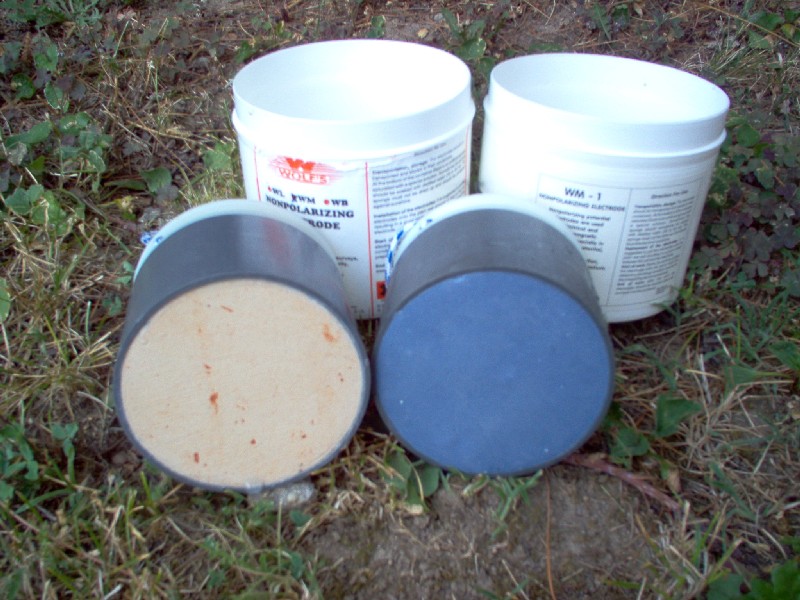
To avoid environmental pollution and to increase the lifetime of the electrodes we have modified their structure by setting a porous ceramic plate (saturated with the same solution than the matrix) at the bottom of the matrix in full contact with it (Figure 4.).
In this way the electrical conductance has been assured between the electrode and the environment but the ceramic plate arrests the degradation of the matrix since this plate does not degrade. At the same time the life-time of electrodes will be longer.
The other features of the electrode (the content of the matrix, Pb-spiral, dimensions) has not been changed.
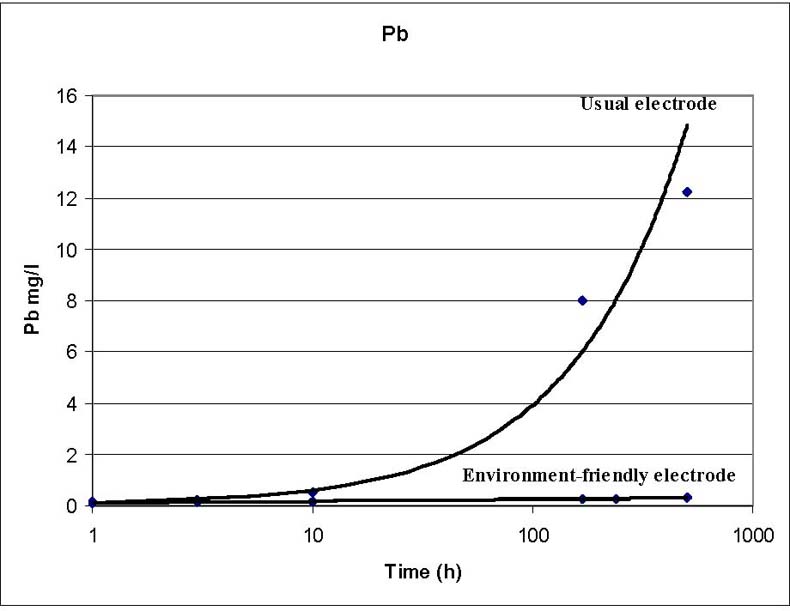
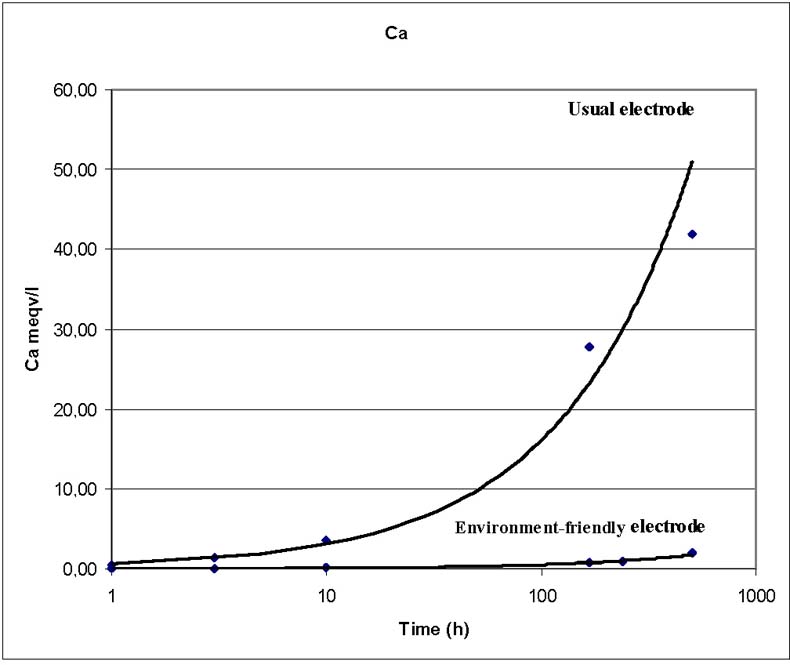
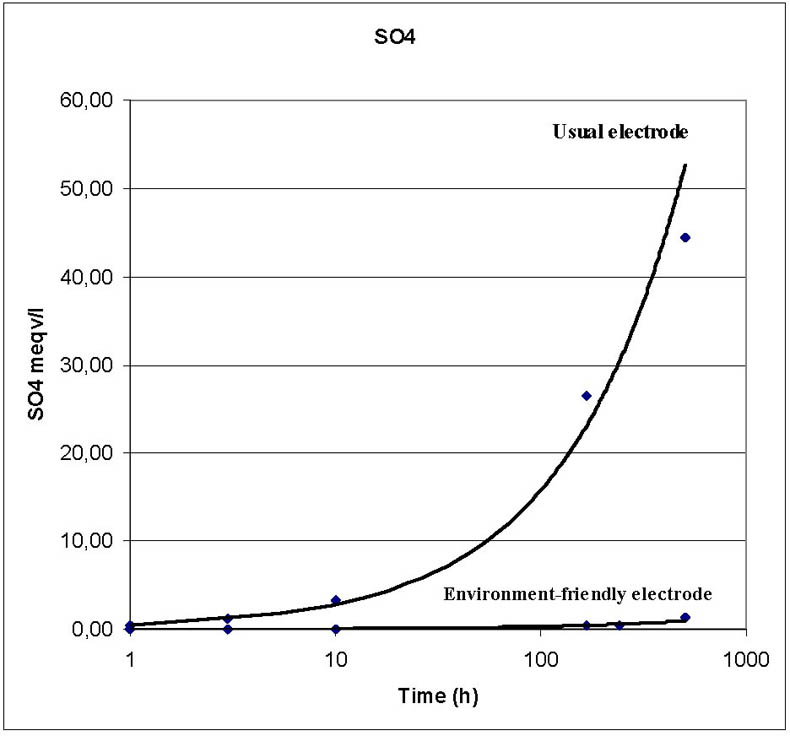
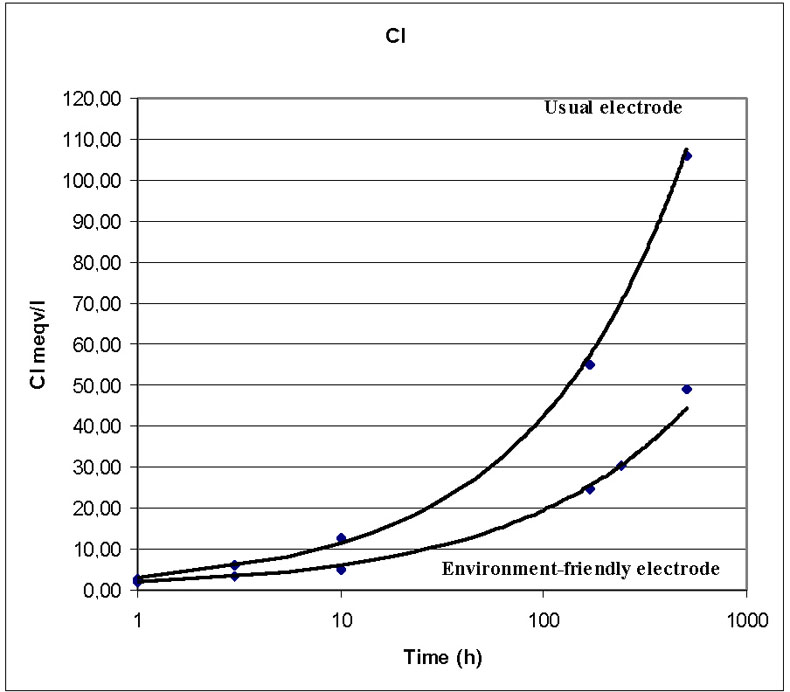
Laboratory analysis has been performed on usual and environment-friendly medium electrodes to investigate the leakage of some ingredient elements, anions, cations into the environment (in this case ordinary water). The analysis was performed (with accredited method and equipment JY ULTIMA 2C ICP-OES) in he laboratory of Geological Institute of Hungary for the Ca, Mg, Na, K, Fe, Mn, Cl, SO4, Pb, Zn, Cu, Ni, Al.
The electrode was placed into a container with 5 l water. Each time a sample was taken for analysis, the water was mixed in advance to ensure that some degraded material gets into it as well. 0,2 ml HNO3 concentrate was added to the sample (making up PH with value 2) for solving out the Pb and Cl components from the degraded material.
One can see in the following graphs the quantity of the materials of interest for us, (anions, cations; see above with bold characters) contained in the samples, plotted against the time.
The main users of our nonpolarizing electrodes
Since more then 10 years
ITALY
Geosystem srl
Geoinvest srl
Instituto di Geoscienze e Georisorse (Pisa)
GERMANY
Metronix Messgerate und Elektronik GmbH
TEXPLOR Exploration and Environmental Technology GmbH
HUNGARY
E�tv�s Lorand Geophysical Institute of Hungary
MOL Hungarian Oil and Gas Co.
PORTUGAL:
Instituto de Ciencias da Terra e do Espaco
Since less than 10 years
GERMANY
Bundesanstalt f�r Geowissenschaften und Rohstoffe (BGR) Geozentrum Hannover
TERRATEC Geophyisical Services
USA
Schlumberger Technology Corp. EMI Technology Center
IRELAND
Dublin Institute for Advanced Studies
INDIA
National Geophysical Research Institute (Hyderabad)
JAPAN
Geothermal Energy Research and Development Co. Ltd
CZEH REPUBLIC
Geofizykaln� �stav AV CR v.v.i.
Other users
Universitat de Barcelona Dept. Geodinamica i Geofisica
BRGR (French Geological Survey)
IRIS (Oregon State University College of Oceanic and Atmospheric Sciences
EMpulse Geophysics Ltd (Canada)
ELTA-GEO Ltd (Russia, Novosibirsk)
Instituto Costarricense de Electricidad (Costa Rica)
Universita Degli Studi di Padova (Italy)
