
October
was a busy month for Sim Gallery's racing projects. The
running of the inaugural 'All American 100' race took
place at the Nashville Speedway promoted by Jimmy
McKinley's - United Shorttrack Alliance (the USA Series).
Sim Gallery was privileged to be the sponsor of this
historic event. The race was for two divisions, the N1
'Outlaws' and the N2 'Late Model' speedway cars. After
the qualifying results were scored a racesave.bin file
was built into a starting grid based on how the human
drivers qualified. Be sure to read the history on the
AA400 (on which the sim race was modeled) and Click
Here! to read JimmyMcKinley's entertaining race
report.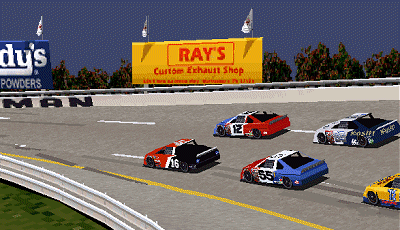
Carl
Culp (#16) and Jimmy McKinley (#12) pace the USA Late
Model Stockcars
for the First Annual All-American 100
by
Jimmy McKinley
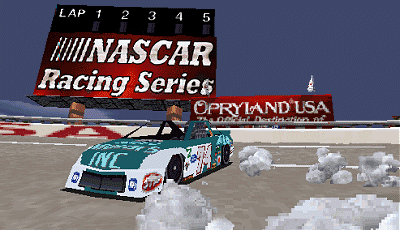
Mike
Gromley loops it in turn three during the All-American
100 in October.
For a full report on the AA100 - Click
Here!
by
Jimmy McKinley
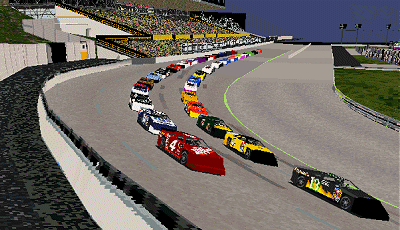
Eddie
Popwell (#13) and Kevin Morgan (#4) lead the Outlaws on
the pace lap
into turn one at Nashville.
by
Jimmy McKinley
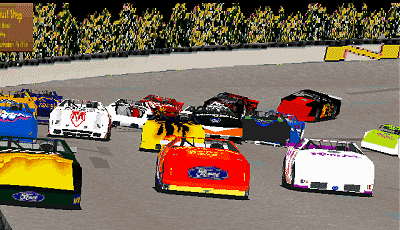
The N1
Outlaws power out of turn two and head down the
backstretch.
Mark Olender's #17x is in the middle of the pack.
by
Jimmy McKinley
The History of the All American 400
by Jimmy McKinley, USA Series Director
The
1998 USA Series All-American 100 is patterned after one
of the
biggest short track Late Model events in the
country: the All-American 400
at Nashville Speedway in Nashville, TN. The
All-American 400 began life in
1981 as an unsanctioned race, attracting names like Dick
Trickle, Mike
Eddy, Butch Miller, Jody Ridley, and Mark Martin among
many other big
names. North Carolina short track legend and 1978
NASCAR Sportsman (now
Busch Grand National) champion Butch Lindley won the
first running of the
All-American 400.
Over the years, guys like Mark Martin, Jody
Ridley, Mike Eddy, Mike
Miller, Dick Trickle, Don Gregory, and Junior Hanley all
tried and failed
to win the biggest asphalt Late Model race in the
country. But there have
been some surprises: in 1989, Jody Ridley and Bobby
Dotter were racing for
the lead with two laps to go. They touched in turn
three, creating a
pile-up of the top five cars at the time. Butch
Miller motored through the
carnage and around the yellow to win the race for the
second straight year.
The race remained unsanctioned until 1984, when it
was added to the
All-Pro Super Series schedule. Then, in 1987, the
American Speed
Association, the All-Pro Series, and the
American-Canadian Tour, the "Big
Three" of short track Late Model racing, joined
forces to create the Stock
Car Connection. This only lasted for one year, as
the ACT had financial
problems and couldn't commit to anything solid for
1988. Since then, the
race has been sanctioned by All-Pro. In 1991,
NASCAR bought out Bob Harmon
and took control of the All-Pro Series and renamed it to
its current name:
the NASCAR Slim-Jim All-Pro Series.
Names that have won over the years: Rusty
Wallace (1985), Darrell
Waltrip (1987), Gary Balough (1984 and 1986), the
legendary "Bluebird", Bob
Senneker (1982), Jeff Purvis, a three-time winner,
Wayne Anderson, Freddy
Query, who made it two in a row in 1998, and Gary St.
Amant. This is just
a partial list of winners.
When I was making up the United Shorttrack
Alliance schedule, I knew that
the BGN Track Pack would be coming out for NASCAR Racing
2, and I knew
Nashville was there. I thought, wouldn't it be
great to simulate one of
the biggest short track races of the year?"
The problem was, we didn't
have a Nashville for NASCAR 1 at the time. I
knew that last year, we used
a North Wilkesboro converted to Nashville in the IDR with
their pavement
division. Then, I found someone who could
convert the N2 Nashville over to
N1. It worked great; it quickly became my favorite
track. I absolutely
love the place in both N1 and N2. I have to thank
Jeff Napier for
converting the track for us. I had to make some
changes to the track text,
but it worked out great.
The reason for the 100-lap length was simple; 400
laps was way too long
for the casual sim racer to sit there based on the
"normal" lengths we run
in the USA Series. so we settled on 100 laps as
being "reasonable", making
it the longest race on our schedule as well, compared to
it being the
longest on the NASCAR Slim Jim All-Pro
Series. This way, the USA drivers
aren't racing for hours and it doesn't take away from the
"short format" of
the United Shorttrack Alliance.
Well there you have it.. the history of the
AA400 and how the race was simulated by the United
Shorttrack Alliance. Thanks Jimmy for the insite and
thanks for one of the best offline series on the net.
Signups are now open for the 'World
Series of Internet Short Track Racing'. Don't miss out -
the 'Curator'


|