| Deities |
 |

|
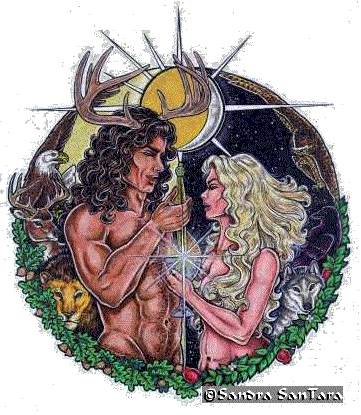
| The exploration of the Gods and Goddess of the world is an exciting and intersting part of Paganism. The reason we explore them is because the worship of ancient Gods and Goddess is the core to our past. You may or may not end up with a personal God or Goddess that you worship exclusively. You may end up worshiping several. And you may end up worshiping none. In Paganism all these path/choices are acceptable. You sould never feel any pressure. If you are ment for a certain divinity then you will know it when the time is right. My only suggestion is try not to ignore your heart or your interestes. Alot of Gods and Goddesses make contact trough starting an attraction through you for them. Listen to your heart. This chapter is strictly ment to introduce you to some of our great Lords and Ladies. Here is just a small sample of the ancient Deities of our Past/Present/Future. |
| Dumuzi had his palace in Kur; he was the husband of Inanna and was given his god status as her wedding gift to him. He had power over fertility of plants and animals, especially grain. He stays in the Underworld six months out of the year Gilgamesh a hero and lesser god. He was given a palace in the netherworld and honored as a lesser god of the dead Inanna The goddess of love and war; she went to the Underworld, ritually stripping at each of its seven gates and was killed there by Anunna. She was rescued and resurrected by Enki, who had to find someone to take her place in the Underworld. At one point, she got Enki drunk to give her more powers Nanna a teaching deity and moon god who fathered Inanna and Utu. He rests in the Underworld monthly and decrees the fate of the dead. Utu the god of Sun and Justice who goes to the Underworld daily and decrees the fate of the dead Ninlil the goddess who bore the moon god, Nanna/Sin Nammu the goddess of the watery abyss; she instructed in the creation of humans Ereshkigal the queen of the underworld who married Gugulanna and killed Inanna for trespassing Ningal Nassan's wife and the mother of Inanna and Utut. She begged Enlil not to flood her city Ndaba the goddess of writing and the patron of archives An the god of heaven; he assigned gods and kings their influence Ninhursag the queen of mountains and the mother goddess/ earth goddess and mother of the gods. she guided the shaping of the first human and bore 8 trees as children Enlil an air god and leader of the pantheon. the father of the gods and the king of heaven and earth Enki the lord of deep waters and sement and an underworld god who ruled water, creation, fertility and who kept the divine laws |
| Sumerian |
| Brahma Creator Lord Brahma, the creator God of the Trinity appears seated on a lotus (a symbol of glorious existence), He has four heads and hands. Each hand is holding a sacrificial tool (sruva), the Vedas (knowledge), a water pot (kamandalu) and a rosary respectively. His vehicle is a swan (hans), which is known for its judgment between good and bad. Lord Brahma's consort is Goddess Saraswati, the Goddess of Learning Vishnu Sustainer The preserver god of the Trinity has four hands. The first holds a conch shell (sankha) indicating spread of the divine sound "Om"; one holds a discus (chakra), a reminder of the wheel of time, and to lead a good life; one holds a lotus (Padma) which is an example of glorious existence and the fourth hands holds a mace (gada) indicating the power and the punishing capacity of the Lord if discipline in life is ignored. His vehicle is the swift-flying bird Garuda which can spread the Vedic knowledge with great courage. The dark color of the Lord represents the passive and formless ether, a great quality for a pervading god. He rests on the bed of the powerful, coiled serpent, Seshanag who represents the sleeping universe. Lord Vishnu is also known as Hari, the remover. Lord Vishnu's consort is Goddess Lakshmi, the Goddess of Wealth. Shiva Destroyer Lord Shiva appears in a meditating but ever-happy posture. He has matted hair which holds the flowing Ganges river and a crescent moon, a serpent coiled around his neck, a trident (trishul) in his one hand and ashes all over his body. The Lord's attributes represent his victory over the demonic activity, and calmness of human nature. He is known as the "giver" god. His vehicle is a bull (symbol of happiness and strength) named Nandi. Shiva-Linga, a sign of the Lord, is adored instead of him. Shiva temples have Shiva-Linga as the main deity. Saraswati Knowledge Goddess Saraswati (Sarasvati) is the wife (consort) of Lord Brahma and possesses the powers of speech, wisdom and learning. She has four hands representing four aspects of human personality in learning; mind, intellect, alertness and ego. She has sacred scriptures in one hand and a lot us (a symbol of true knowledge) in the second. With her other two hands she plays the music of love and life on the violin (veena). She is dressed in white (sign of purity) and rides on a white goose (swan). Lakshmi Prosperity Goddess Lakshmi is the consort or wife of Lord Vishnu and is the goddess of prosperity, purity, chastity and generosity. Her four hands represent four spiritual virtues. She sits on a fully blossomed lotus, a seat of divine truth. Her personal charm is considered par excellence. An aura of divine happiness, mental and spiritual satisfaction, and prosperity always exist around her. Her palm is always extended to bless people. She is adored by Lord Ganesha. Rama Ideal King, Man Lord Rama is one of the most commonly adored gods of Hindus and is known as an ideal man and hero of the epic Ramayana. He is always holding a bow and arrow indicating his readiness to destroy evils. He is also called "Shri Rama". More commonly he is pictured in a family style, (Ram Parivar) with his wife Sita, brother Lakshman and devotee Hanuman who is sitting near Lord Rama's feet. Krishna Love, Destruction of Evil Because of his great Godly power, Lord Krishna is another of the most commonly worshipped deities in the Hindu faith. He is considered to be the eighth avatar of Lord Vishnu. Shree Krishna delivered Bhagwad Gita on battlefield to Arjun. He, like Lord Rama, is also known for his bravery in destroying evil powers throughout his life. The Lord is usually depicted as playing the flute (murali), indicating spread of the melody of love to people. He is also shown with his childhood devotee Radha. The Lord is usually remembered and worshipped as Radha-Krishna. The pair symbolizes the eternal love between people and god. Lord Krishna is also shown with his pet cow, his childhood favorite. Lord Krishna performed many divine sports (leela) as a child. Ganesh Knowledge, Remove Obstacles This God of knowledge and the remover of obstacles is also the older son of Lord Shiva. Lord Ganesha is also called Vinayak (knowledgeable) or Vighneshwer (god to remove obstacles). He is worshipped, or at least remembered, in the beginning of any auspicious performance for blessings and auspiciousness. He has four hands, elephant's head and a big belly. His vehicle is a tiny mouse. In his hands he carries a rope (to carry devotees to the truth), an axe (to cut devotees' attachments), and a sweet dessert ball -laddoo- (to reward devotees for spiritual activity). His fourth hand's palm is always extended to bless people. A unique combination of his elephant-like head and a quick moving tiny mouse vehicle represents tremendous wisdom, intellegence, and presence of mind. Hanuman Devotion, Courage Hanuman is a monkey god. He is a noble hero and great devotee of Lord Rama of the Ramayana. This deity is a provider of courage, hope, knowledge, intellect and devotion. He is pictured as a robust monkey holding a mace (gada), which is a sign of bravery, and having a picture of Lord Rama tatooed on his chest, which is a sign of his devotion to Lord Rama. He is also called Mahaveera (the great hero) or Pavan-suta (son of air) or Bajarangbali. |
| Hindu |
 |
|
|
| Titans Chaos - Chaos is the void which came into being before anything else. It is also asserted that Chaos existed from the beginning, together with Nyx, Erebus (Darkness of the Underworld), and Tartarus, and consequently they consider Chaos to be as Nyx and Erebus: one of "the powers below the ground". Nyx - The goddess Nyx was the personification of Night. Night was the daughter of Chaos, which makes her one of the first creatures ever to emerge from the void. This means that Nyx was the sister to some of the oldest deities in Greece, including Erebus (Darkness), Gaia (the Earth), and Tartarus (the Underworld). From these primeval powers came the rest of the Greek gods and goddesses. And Nyx was responsible for bearing her share of divine children. Some of these children of Night were Eris (Discord or Strife), the Moirai (Fates), Hypnos (Sleep), Nemesis (Retribution), Thanatos (Death), and the Hesperides. While these beings were born from the goddess alone, without a father, Nyx also had children by the god Erebus. To Erebus the goddess bore Aether (Air) and Hemera (Day). Gaia - Gaia is the Earth. She is the offspring of Chaos or comes into being after it and she is also the mother of the Titans. Tartarus - Tartarus is the lowest abyss beneath the earth where all waters originate; all rivers flow into the chasm of Tartarus and flow out of it again. Tartarus is, they say, a gloomy place as far distant from earth as earth is from the sky. Tartarus and the Underworld are the realm of Erebus, which is pure Darkness. Tartarus is, at the same time, a being capable of intercourse. Tartarus is the father of such monsters as Echidna and Typhon, Erebus, the Darkness of the Underworld, possibly existing from the beginning together with Chaos, Nyx (Night) and Tartarus, gave birth, to the Moerae, the Hesperides, Hypnos, Geras (Old Age), Thanatos (Death) and Styx. Eros - Eros is Love, who overpowers the mind, and tames the spirit in the breasts of both gods and men. Despite all representations, in which Love is depicted as a young man or a boy, Eros is believed to have a dual nature, being neither female nor male. He (or she) is regarded as composed of many elements and able to bear different qualities within a single frame. Therefore he may appear audacious or timid, seem wise or stupid, give himself to impetuosity, or choose persistence. Erebus - The personification of darkness. Uranus - Ouranos or Uranus was both the son and the consort of Gaia; he was also the father of the Titans. Kronos - Cronus/Kronos the son of Gaia and Ouranos, who castrated his father; in turn, Kronos was the sire of many of the Olympians Oceanus - Okeanos (Oceanus) was a Titan who personified the Ocean. He appears as the son of Gaia (the Earth) and Ouranos (the Sky). Prometheus - The name of this Titan means "forethought"; in myth, Prometheus was punished for giving fire to humans - he was bound, and daily an eagle would devour his liver. Epimetheus - Epimetheus was the brother of Prometheus. Epimetheus means "afterthought". And as the personification of afterthought, the Titan Epimetheus is often contrasted with his more sensible brother. This contrast between brothers is seen to good advantage in one of the most enduring and familiar stories of Greece, and that is the tale of Epimetheus and Pandora Rheia - Rhea was a mother goddess who bore the deities Hestia, Demeter, Hera, Hades, Poseidon, and Zeus to Kronos Iapetos - Fathered Atlas, Prometheus, and Epimetheus Leto - Leto was a female Titan (or Titaness). She is most famous in for being the mother of the twin Olympians Apollo and Artemis. In relation to her role as mother, Leto is also notorious for playing the part of one of the many paramours of the passionate god Zeus. And it was her affair with the ruler of the Greek gods, in fact, that got the Titan Leto into a bit of trouble with the goddess Hera. Leto was the daughter of two prominent Titans - Koios (also spelled Coeus) and Phoebe. She was also the sister of Asteria. The Olympians Zeus - Zeus overthrew his Father Cronus. He then drew lots with his brothers Poseidon and Hades. Zeus won the draw and became the supreme ruler of the gods. He is lord of the sky, the rain god. His weapon is a thunderbolt which he hurls at those who displease him. He is married to Hera but, is famous for his many affairs. He is also known to punish those that lie or break oaths. Poseidon - Poseidon is the brother of Zeus. After the overthrow of their Father Cronus he drew lots with Zeus and Hades, another brother, for shares of the world. His prize was to become lord of the sea. He was widely worshiped by seamen. He married Amphitrite, a granddaughter of the Titan Oceanus. At one point he desired Demeter. To put him off Demeter asked him to make the most beautiful animal that the world had ever seen. So to impress her Poseidon created the first horse. In some accounts his first attempts were unsuccessful and created a variety of other animals in his quest. By the time the horse was created his passion for Demeter had cooled. His weapon is a trident, which can shake the earth, and shatter any object. He is second only to Zeus in power amongst the gods. He has a difficult quarrelsome personality. He was greedy. He had a series of disputes with other gods when he tried to take over their cities. Hades - Hades is the brother of Zeus. After the overthrow of their Father Cronus he drew lots with Zeus and Poseidon, another brother, for shares of the world. He had the worst draw and was made lord of the underworld, ruling over the dead. He is a greedy god who is greatly concerned with increasing his subjects. Those whose calling increase the number of dead are seen favorably. The Erinyes are welcomed guests. He is exceedingly disinclined to allow any of his subjects leave. He is also the god of wealth, due to the precious metals mined from the earth. He has a helmet that makes him invisible. He rarely leaves the underworld. He is unpitying and terrible, but not capricious. His wife is Persephone whom Hades abducted. He is the King of the dead but, death itself is another god, Thanatos. Hestia - Hestia is Zeus sister. She is a virgin goddess. She does not have a distinct personality. She plays no part in myths. She is the Goddess of the Hearth, the symbol of the house around which a new born child is carried before it is received into the family. Each city had a public hearth sacred to Hestia, where the fire was never allowed to go out. Hera - Hera is Zeus wife and sister. She was raised by the Titans Ocean and Tethys. She is the protector of marriage and takes special care of married women. Hera's marriage was founded in strife with Zeus and continued in strife. Zeus courted her unsuccessfully. He then turned to trickery, changing himself into disheveled cuckoo. Hera feeling sorry for the bird held it to her breast to warm it. Zues then resumed his normal form and taking advantage of the surprise he gained, raped her. She then married him to cover her shame. Most stories concerning Hera have to do with her jealous revenge for Zeus's infidelities. Her sacred animals are the cow and the peacock. Her favorite city is Argos. Ares - Ares is the son of Zeus and Hera. He was disliked by both parents. He is the god of war. He is considered murderous and bloodstained but, also a coward. When caught in an act of adultery with Aphrodite her husband Hephaestus is able publicly ridicule him. His bird is the vulture. His animal is the dog. Athena - Athena is the daughter of Zeus. She sprang full grown in armor from his forehead, thus has no mother. She is fierce and brave in battle but, only fights to protect the state and home from outside enemies. She is the goddess of the city, handicrafts, and agriculture. She invented the bridle, which permitted man to tame horses, the trumpet, the flute, the pot, the rake, the plow, the yoke, the ship, and the chariot. She is the embodiment of wisdom, reason, and purity. She was Zeus's favorite child and was allowed to use his weapons including his thunderbolt. Her favorite city is Athens. Her tree is the olive. The owl is her bird. She is a virgin goddess. Apollo - Apollo is the son of Zeus and Leto. His twin sister is Artemis . He is the god of music, playing a golden lyre. The Archer, far shooting with a silver bow. The god of healing who taught man medicine. The god of light. The god of truth, who can not speak a lie. One of Apollo's more important daily tasks is to harness his chariot with four horses an drive the Sun across the sky. He is famous for his oracle at Delphi. People traveled to it from all over the Greek world to divine the future. His tree was the laurel. The crow his bird. The dolphin his animal. Aphrodite - Aphrodite is the goddess of love, desire and beauty. In addition to her natural gifts she has a magical girdle that compels anyone she wishes to desire her. There are two accounts of her birth. One says she is the daughter of Zeus and Dione. The other goes back to when Cronus castrated Uranus and tossed his severed genitals into the sea. Aphrodite then arose from the sea foam on a giant scallop and walked to shore in Cyprus. She is the wife of Hephaestus. The myrtle is her tree. The dove, the swan, and the sparrow her birds. Hermes - Hermes is the son of Zeus and Maia. He is Zeus messenger. He is the fastest of the gods. He wears winged sandals, a winged hat, and carries a magic wand. He is the god of thieves and god of commerce. He is the guide for the dead to go to the underworld. He invented the lyre, the pipes, the musical scale, astronomy , weights and measures, boxing, gymnastics, and the care of olive trees. Artemis - Artemis is the daughter of Zeus and Leto. Her twin brother is Apollo . She is the lady of the wild things. She is the huntsman of the gods. She is the protector of the young. Like Apollo she hunts with silver arrows. She became associated with the moon. She is a virgin goddess, and the goddess of chastity. She also presides over childbirth, which may seem odd for a virgin, but goes back to causing Leto no pain when she was born. She became associated with Hecate. The cypress is her tree. All wild animals are scared to her, especially the deer. Hephaestus - Hephaestus is the son of Zeus and Hera. Sometimes it is said that Hera alone produced him and that he has no father. He is the only god to be physically ugly. He is also lame. Accounts as to how he became lame vary. Some say that Hera, upset by having an ugly child, flung him from Mount Olympus into the sea, breaking his legs. Others that he took Hera's side in an argument with Zeus and Zeus flung him off Mount Olympus. He is the god of fire and the forge. He is the smith and armorer of the gods. He uses a volcano as his forge. He is the patron god of both smiths and weavers. He is kind and peace loving. His wife is Aphrodite. Sometimes his wife is identified as Aglaia. |
| Greek |
|
| Amun - The hidden one. Early, a god of air and wind. Later, a fertility god. The Creator of all things. During the New Kingdom he became "The king of the gods". He was said to be able to assume any form he wished, with each of the other gods being one of these forms. From the eighteenth dynasty on he was a national deity. Through political means managed to assimilate many lesser gods. Anubis - The jackal. Guardian of the Necropolis (cemetery). He was the guide of the dead as they made their way through the darkness of the underworld. As a patron of magic, it was believed he could foresee a persons destiny, in this role he was the announcer of death. Aten - Lord of all. The Aten gained its prominence during the reign of Akhenaten. The heretic king made an effort it seems, to unite all the peoples of Egypt under one god. He abolished the traditional cults of Egypt and replaced them with the Aten. Unfortunately for Akhenaten, the Egyptians did not wish to be united in this fashion. The king considered the Aten to be the creative force in the universe and the only god worthy of his worship. Bastet - The Tearer. As a sun goddess she represents the warm, life giving power of the sun. Her cult appears as early as the Second Dynasty. Like a cat, she was admired for her agility and strength. Bast defended Ra against the serpent Apep. Geb - Great Cackler. Geb was thought to represent the earth, he is often seen reclining beneath the sky goddess Nut. Geb was called 'the Great Cackler', and as such, was represented as a goose. It was in this form that he was said to have laid the egg from which the sun was hatched. He was believed to have been the third divine king of earth. The royal throne of Egypt was known as the 'throne of Geb' in honor of his great reign. Hathor - Mistress of heaven. Hathor was the goddess of joy, motherhood, and love. She was considered the protectress of pregnant women and a midwife. She was the patron of all women, no matter their station in life. As the goddess of music and dancing her symbol was the sistrum. As a fertility goddess and a goddess of moisture, Hathor was associated with the inundation of the Nile. In this aspect she was associated with the Dog-star Sothis whose rising above the horizon heralded the annual flooding of the Nile. In the legend of Ra and Hathor she is called the "Eye of Ra." Horus - He who is above. The name Horus comes from the Egyptian word Hor, which translates as 'face'. We find him worshipped as Mekhenti-irry which translates as 'He who has on his brow Two Eyes', the sun and moon representing his eyes. On nights when there is no moon we find him worshipped as Mekhenti-en-irty, 'He who on his brow has no eyes', in this form he was considered the god of the blind. Isis - The throne. Isis is one of the earliest and most important goddess in ancient Egypt. She was regarded as the feminine counterpart to Osiris, a role she probably occupied before the dawn of dynastic Egypt. No other Egyptian deity has stood the test of time as well as Isis. Her cult was not extinguished with the other Egyptian gods, but was embraced by the Greeks and Romans; her worship has even lasted into the present day. She was revered by the Egyptian people as the great mother-goddess and represents the maternal spirit in its most intimate form. She is often seen suckling a young Horus. In the Osiris legend she is seen as a dutiful wife, a grieving widow and as a protector of the dead. Isis was a great enchantress, the goddess of magic. Together with Thoth, she taught mankind the secrets of medicine. She was the embalmer and guardian of Osiris. She is often rendered on the foot of coffins with long wings spread to protect the deceased. Maat - The goddess of truth. The goddess Maat represents the ideals of law, order, and truth. The word, Maat translates "that which is straight." it implies anything that is true, ordered, or balanced. She was the female counterpart of Thoth. We know she is a very ancient goddess because we find her in the boat of Ra as it rose above the waters of the abyss of Nu on the first day. Together with Thoth, they charted the daily course of the sun god Ra. She is sometimes called the 'eye of Ra' or the 'daughter of Ra'. Mut - Lady of Heaven. Mut was the divine mother, the queen of all gods. She was the female counterpart of Amun. Mut usurped many of the other Egyptian goddess that exhibited the attributes of motherhood. During the New Kingdom, The marriage of Mut and Amun was one of the great annual celebrations. Amun would be brought from his temple at Karnak, a great following would escort him to visit Mut at her temple at Luxor. In spite of her marriage to Amun, Mut was bisexual, perhaps to reinforce her position as the mother of all things. Her hieroglyphic symbol was a vulture, it was worn on the crowns of Egypt's queens to typify their motherhood. Neith - Great Goddess. Neith was a goddess of the hunt. She may have also been a war goddess. Her worship dates from pre dynastic history. In early times she was called 'mother of the gods' and 'Great Goddess'. She was considered the guardian of men and gods. Later, Neith was seen as a protector of the dead, she is often seen standing with Nephthys at the head of coffins. Or assisting Isis, Nephthys, and Serqet to guard the Canopic jars. As 'Opener of the Ways', she was a guide in the underworld, a female Anubis. In the Eighteenth Dynasty she took on the attributes of Hathor, as a protector of women. As a creative deity she was said to be the wife of Khnum at Elephantine. She was appealed to for her wisdom as an arbitrator during the great quarrel of Horus and Seth. Nut - The Sky. Nut was originally a mother-goddess who had many children. The hieroglyph for her name, which she is often seen wearing on her head is a water pot, but it is also thought to represent a womb. During the day, Nut and Geb are separated, but each evening Nut comes down to meet Geb and this causes darkness. If storms came during the day, it was believed that Nut had some how slipped closer to the earth. She also plays an important role in creation mythology. Osiris - King of the dead. Supreme god and judge of the dead. The symbol of resurrection and eternal life. Provider of fertility and prosperity to the living. Ptah - The Opener. Ptah represents the sun at the time when it begins to rise above the horizon and or right after it has risen. As early as the Second Dynasty, he is regarded as a creator god. The patron of architects, artists and sculptors. It was Ptah who built the boats for the souls of the dead to use in the afterlife. In the Book of the Dead we learn that he was a master architect, and responsible for building the framework of the universe. It was said that Ptah created the great metal plate that was the floor of heaven and the roof of the sky. He also constructed the supports that held it up. Some creation legends say that by speaking the names of all things, Ptah caused them to be. Ra - Father of the gods. From very early times Ra was a sun god. He took on many of the attributes and even the names of other gods as Egyptian myths evolved. A good example of this is the god Ra and Amun merging to become Amun-Ra or Ra and Horus combining to become Ra-Harakhte. Since Ra was a god of great antiquity, there are far to many stories connected with him to relate them all. I will relate some that I find interesting, including the legend of Ra and Hathor. Sekhmet - Mighty One. A sun goddess. She represents the scorching, burning, destructive heat of the sun. She was a fierce goddess of war, the destroyer of the enemies of Ra and Osiris. Her temper was uncontrollable. In the legend of Ra and Hathor, Sekhmet's anger became so great, she would have destroyed all of mankind if Ra had not taken pity on us and made her drunk. Seth - Lord of Upper Egypt. Early in Egyptian history, Seth is spoken of in terms of reverence as the god of wind and storms. He was even known as the Lord of Upper Egypt. Horus being the Lord of Lower Egypt. It was Seth who stood in the front of the solar barque to defended the sun god Ra from his most dangerous foe, the serpent Apep. At this time, he seems to have had no conflicts with the cults of Isis or Osiris. In fact, he was part of the same family of gods, and married to his twin sister, Nephthys. Sobek - He who causes to be fertile. Admired and feared for his ferocity. At the command of Ra, He performed tasks such as catching with a net the four sons of Horus as they emerged from the waters in a lotus bloom. Sometimes identified with Seth when Seth took the form of a crocodile. It is said that in the Osiris legends, Horus takes the form of a crocodile in order to retrieve the parts of Osiris's body that were cast into the Nile by Seth. Thoth - The great measurer. Thoth was a moon god who played an important role in the Osiris legend and the judgment of the dead in the Hall of Maat. Thoth was said to be mighty in knowledge and divine speech. The inventor of spoken and written language. As the lord of books he was the scribe of the gods and patron of all scribes. He is credited with inventing astronomy, geometry, and medicine. Thoth was the measurer of the earth and the counter of the stars, the keeper and recorder of all knowledge. It was Thoth who was believed to have written important religious texts such as The Book of the Dead. In this text, he appears in the Hall of Maat as a scribe holding a writing reed and palette to record the results of the weighing of the deceased's heart against the feather of Maat. |
| Egyptian |
| Aesir - Primary race including Odin, Thor, Tyr and others. They age, but can become young again by eating apples. Their power will be destroyed in that battle that brings the world to an end. Vanir - The second most dominant race, and it is believed that the Vanir and the Aesir did battle at times. Odin - He was of the Aesir race and was their chief god. He had two ravens which would fly throughout the world during the night, and then return in the morning to tell of what they discovered. He had only one good eye, and was the god of poetry, battle and death. He carried a magic spear and rode an eight-legged horse named Sleipnir which could fly and travel to the underworld. Odin is thought to be a god that was not worshiped by many for his name is not well known. Frigga - Odin�s wife. She was the main goddess, and was very wise. She protected warriors which had been neglected by her husband. Both she and her husband had numerous extramarital affairs. Thor - The son of Odin. He was the god of the sky, thunder and fertility. He was the god worshiped most by the common man, and Thursday is named for him. Thor can be associated to the Roman god Jupiter, the German god Donar, and the Anglo-Saxon god Thunor. All of these gods were in control of thunder and weather in some way. Balder - The son of Odin and Frigga. His name meaning "The Glorious," he was depicted as being very handsome and wise. Balder�s wife was Nanna. Loki killed him by realizing he was only vulnerable to mistletoe, and he was the first god to perish. Tyr - He was the god of war. Tuesday is named for Tyr, and he presided over any legal procedure or public gathering. His right hand was bitten off my Fenrir, the wolf, and there is much debate over why he did this. Some believe the right hand is given as a pledge, or it reveals that they are free of weapons, but it has also been said that those who are left-handed are considered evil. Frey - He was the god of weather and fertility, and he ruled over the land of the elves. He owned a ship which was made by elves and could sail through water, air, or land. His name means "Lord," and he married Gerd. Freya - Frey�s sister, and the goddess of fertility, war, and wealth. She lived in a battlefield, and each day she would split the slain soldiers, half-and-half, with Odin. Some say that Friday is named after her, and she was the main goddess of the Venir. Heimdall - He is the watcher of the rainbow bridge, over which the Giants will come when they are ready to take over the world. He is there to sound his horn as warning when and if they arrive. He was give birth to by nine sisters, he can see in the dark, and he never sleeps. Loki - He was the son of a Giant, and was a trickster god who deceived Balder, and therefore killed him. He was bound to a cave by the other gods, but was freed on Rognarok. He was the father of Fenrir and the Midgrad Serpent. Hel - She was the daughter of Loki, and is the goddess of the underworld. She has been depicted as having one side of her face full of human features, while the other side is completely blank. Idun - The keeper of the apples that keeps the gods eternally young. Her name means "The Rejuvenating One," and she was once abducted, but later rescued by Loki when the gods were aging extremely fast. Kvasir - He is the wisest being, and is said to have been created when the Aesir and Vanir mixed their blood together. |
|
| Norse |
| Sumerian Hindu Greek Egyptian Norse |
 |
|
|
|
|