
So what is it?
Myxobolus cerebralis is a parasite which infects numerous fish, espcially rainbow trout. It is also known as "whirling disease". It has been attributed to cause the death of 90% of rainbow trout year classes (Kent et al, 2001).
Whirling disease? Is that like when you are a compulsive carnival ride rider?
Close. It was named afer one of the clinical symptoms which makes the fish swim in circles, just like that tilt-a-whirl ride, but without having to by tickets.
Wait, 90% of the year class can be affected? That's a lot of fish! And I ate some trout last Tuesday!
Yes, it is. While M. cerebralis was once only thought to be a problem in aquaculture, it is now known to be a serious problem for wild fish populations as well. This had led Dr. Hoffman to propose the following label to be placed on trout (1990).
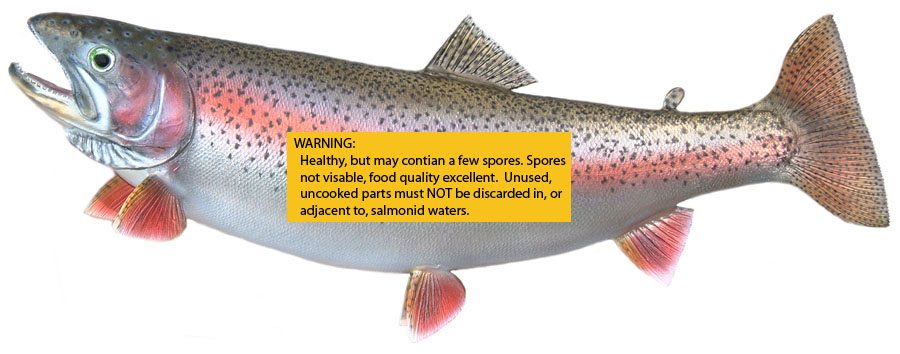
Of course, this measure has yet to be adopted by the FDA. Eating infected fish does no harm to humans... However, most fish that are heavily infected will never get to market, because they look pretty beat up.
Okay, so where did it come from?
It was thought to have originated somewhere in central Europe and was moved to the US from the trout farms that were set up from European stocked fish. The first confirmed outbreak was in Germany in 1903 (Holliday, 1976).
So it's international?
Yes.
Well, how do the fish get sick? Eating the food on the plane?
For the longest time, no one knew how the disease was transmitted. It was not until 1983 that the full life cycle of that trick little bugger, M. cerebralis was known (Markiw). Researchers tried everything to get their laboratory fish sick, but they were heathly while the fisheries just outside were full of sick fish. Turns out M. cerebralis was not faithful to trout, it had another host on the side.
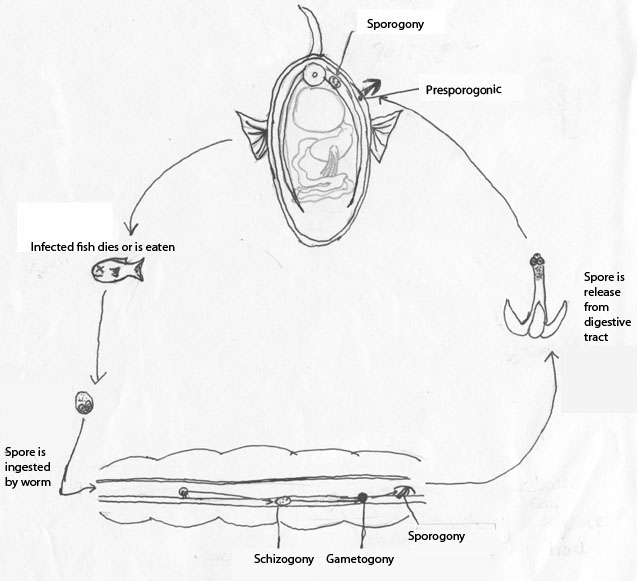
Most of it's life is spent in the gut of a small worm called Tubifex tubifex. While inside the worm, M. cerebralis had most of its fun by asexual reproduction (Schizogony), sexual reproduction (gametogony), and finally by producing the spore that could infect trouts (sporogony). While the worm did not have to die to release its spores, the spores that are produced inside fish are found in the central nervous system. These can only be released by, well, death. The fish's immune system has a hard time attacking its own nervous system, so the parasite is snug and happy, with all the cartilage it can eat.
Central nervous system... isn't that like the brain and spine and stuff?
Yep. That's what causes the whirling... either their backbones get deformed, and blackened and they can't swim right, OR the pressure of having tons of parasites growing in your skull makes you swim in circles.
Umm.. I have a pet trout named Sparkles. How do I know if its got this disease, and what do I do if it does?
Top five ways to tell if you fish might be infected:
1. It has a blackened tail
2. It starts swimming in circles
3. Its tail is twisted
4. Your in-situ probes find traces of the parasite's DNA
5. Its HMO refuses to cover medical bills
Okay, for the last question I have two old sayings for you... the first is about a creek of funny material and being without a paddle. There is no cure for this disease, athough labs around the world are working tirelessly to find one. (If you want to be assured grant money to do research, just go into this field)
The other saying is: a penny of prevention is worth a pound of a cure. The best we can do right now is prevent the fish from getting it. Which means, when your fish is small, keep it in well water or feed it Fumagillin all day (El-Matbouli and Hoffmann, 1991).
So what's its purpose?
A philospher, huh? What's your purpose?
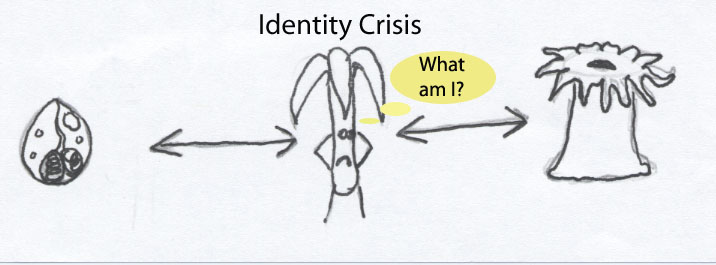
Really, this is quite a confused little critter. For a while it had its own phylum in the Protozoa, but before it could get to be self important it was demoted to a subset for parasitic cnidarians. This move has not stricken M. cerebralis from the protozoan books yet, as some people will always argue against DNA evidence, but the development of their polar capsules closely matches that of cnidocyst development*.
*Cnidocysts are those things that give you a terrible sting when you step on that jelly that washes up on the beach. Polar capsules are like spring-loaded harpoons that help anchor the parasite to the fish's skin, or the worm's gut. Both work on similar principles...
How do you know all this?
I read papers about it.
This page is dedicated to Dr. Miltion Love, whose existance has proved that you don't need to hand in your sense of humor when you get your PhD.
Love Lab
Learn more about whirling disease!
back to main