Short
communication: Examination of the feeding strategies of Opheodesoma
spectabilis (Synaptid sea cucumber) on Coconut Island
Ellen Kosman
Tropical Ecology
Sp 2006
Overview
Opheodesoma spectabilis is a synaptid holothuridian which occurs only in Kaneohe Bay and Pearl Harbor, Oahu (Hoover 1998). Because of its scarcity little is known about the ecology of this organism. In particular, antidotal reports of O. spectabilis feeding from the water column as well as from the benthos exist, but have not been published. The aims of this paper are: to determine if the sea cucumber does feed vertically, compare horizontal feeding efforts with vertical feeding, and finally to try and determine what parameters may cause vertical feeding bouts to occur.
Methods
Locations of vertical feeding bouts on Coconut Island (Kaneohe Bay, Oahu) were recorded. Once locations for vertical feeding were established, these sites were visited at various times and tides to determine what times/tidal cycles favored vertical feeding. To determine if vertical feeding was limited only to those individuals or to the site, the residents of those sites were removed and individuals from other sites were transplanted to the vertical feeding areas.
To compare horizontal feeding and vertical feeding, both feeding bout duration and feeding rates were compared using one-way ANOVAs (MINITAB). Feeding bouts were measured by timing the duration that the feeding tentacles were actively moving towards or away from the oral cavity (see fig. 1). A feeding bout was considered ended when all oral tentacles retracted into the cavity and the animal’s body retracted as well. Feeding rates were defined to be the number of tentacle insertions per ten seconds.
|
a |
b |
||||
|
Fig.
1: A
feeding bout was defined as when oral tentacles were out and moving matter
towards the oral cavity (b). A
feeding bout ended when all oral tentacles and the body wall contracted (a). |
|||||


One of the parameters which may cause vertical feeding, suspended particals, was measured by taking a 296 mL sample of water during 3 horizontal and 3 vertical feeding episodes and comparing amount of suspended particles with a one-way ANOVA. The amount of suspended particles was determined by filtering the samples on a preweighed coffee filters, then re-weighing after the filters had air-dried.
Results and discussion
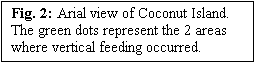
Vertical feeding occurred in only two areas one the Island. One area was by a bridge in a boat channel, the other was by a break wall in an abandoned swimming pool open to the ocean (Fig. 2). Vertical feeding only happened at night during the incoming tides, approximately 2 hours after low tide. Few individuals were observed to vertically feeding during the incoming day tides (less than 6).
Vertical feeding
was not restricted to individuals who were residents of the two areas. Individuals who were transplanted did
vertically feed during the incoming high tide.
Individuals who were transplanted resumed normal feeding patterns within
15 minutes after transplantation, so I presumed that transplantation did not
affect feeding behavior. 
There was no difference in the amount of
suspended particles present during horizontal feeding events vs. vertical
feeding (P=0.469, F=0.638, df= 5). This
may have been due a variety of reasons.
The coffee filters used may have been too porous, allowing many of the
smaller particles that the sea cucumber was feeding on pass through. Another possibility is that the amount of
organic materials suspended was different for those two feeding times. In the future ash-free weight should be
taken to quantify the amount of organic material suspended during vertical and
horizontal feeding bouts.
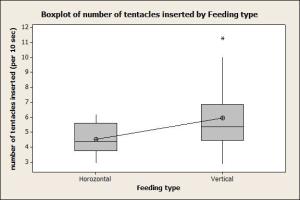
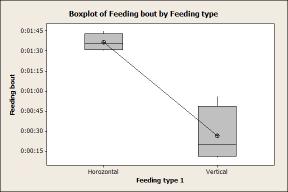
There was a difference in the number of tentacles inserted per 10 seconds (P=0.017, F=6.30, df=33), and in the feeding bout duration (P<0.001, F=41.41, df=7) between vertical and horizontal feedings (Graph 1 and 2). Vertical feeders placed more tentacles in their oral cavity per 10 seconds, and feed for a shorter amount of time when compared to horizontal feeders (approximately 30sec as compared to 1min and 30sec).
Graph 1: Box plot of the differences in feeding rates for vertical feeding
and horizontal feeding bouts.
Vertical feeding bouts had a higher rate of tentacle insertion. The
asterisk represents an outlier.
Graph 2: Box plot of the feeding bout duration for vertical feeders and
horizontal feeders. Vertical
feeding bout duration was much shorter than horizontal feeders.
This difference may be due to the fact that O. spectabilis
is not able to support its body upright long periods of time. With its thin body wall, this explanation
seems highly plausible. In addition, I observed
that when I moved across the bridge to observe the vertical feedings, the
movement caused them to fall over if they were positioned upright.
The question as to why those spots are conducive to vertical feeding remains unsolved. Because both areas are by a large partially or fully submerged object, I hypothesis that the currents in those areas may be contributing factors influencing vertical feeding. To fully understand why vertical feeding occurs, further studies must be undertaken to assess the water patterns of those areas, and a more sensitive measure of suspended organic particles must be obtained.
Literature cited
Hoover, J.P. 1998. Hawaii’s Sea Creatures: A guide to Hawaii’s marine invertebrates.
Mutual Publishing, Honolulu, Hawaii.