 Horses
from Skyros
Horses
from Skyros
Horses
from Skyros
"Alive and well and living in Kanoni"
The Corfiot - July 1998
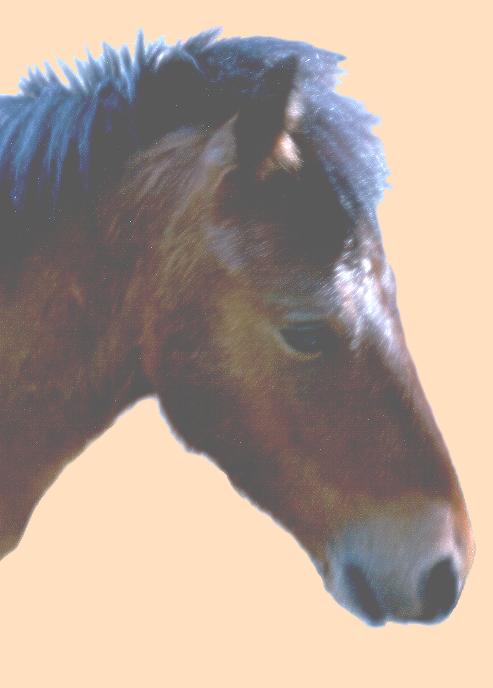
Skyrian Horses may be the ones depicted on the Parthenon Frieze, not carved in small proportion to emphasize the stature of their riders, but naturally diminutive. They are certainly the ponies that facilitated agriculture on the island of Skyros for centuries.
Chameleon and Leonidas, mares Rosie and Lapis and half-bred yearlings Silvi and Sylvester are unconcerned about their speculated and real ancestry, and are quietly enjoying life in Kanoni, Corfu. Nevertheless, they represent hopes for the preservation of their breed - the endangered Skyrian Horses.
Skyros, the largest and most remote of the Sporades islands, has two faces - a fertile north where agriculture dominates, and a mountainous and arid southern section which rises to 792 metres. As elsewhere in Greece, winter rains mean a good crop to feed the horses, while hot summer weather, moderated by the Meltemi, limits their water and grazing in the rocky scrubland of the mountains.
No-one knows how long horses have lived on this island, and no records exist to pinpoint the start of their cooperation with man. During the winter when food and water are plentiful, the horses live wild on the southern mountain. When summer comes, and nourishment is scarce, they migrate north in search of water, and in return allow themselves to be approached by farmers for threshing and other agricultural work.
Threshing of barley, wheat and chick peas was their main task, carried out by groups of five to ten roped together to tread around on packed clay or a circular stone floor to separate the crop from the straw. The threshing season lasted some 50 days to mid-August, and its conclusion was celebrated with festivities which included a horse show with the ponies displayed by young men and boys. Bare-back races, decoration of beasts and riders, and a selection of the best horses were among the competitions.
Traditionally, the ponies voluntarily came in from the mountain with foals at foot in May. They worked all Summer while grazing fallow ground under the supervision of a herdsman, then returned to the mountain for the Winter after the September rains.
This symbiosis came under threat in the mid-1960's, when modern threshing equipment was introduced, and horses were gradually replaced by four-wheel drive vehicles and combine harvesters. At the same time, European Union grants encouraged farmers to keep sheep and goats, resulting in overgrazing of the mountain ground. Now redundant, having lost their habitat and function, on the verge of extinction... the Skyrian horses are in search of a new role.
Amongst those who are helping them find it are Sylvia Dimitriadis - Steen, living on the Silva Estate at Kanoni, Corfu and Alex Copland, formerly a lecturer in Veterinary Anatomy in the Veterinary Faculty of Edinburgh University in Scotland.
Alex has worked with ponies all his life, but it was only in 1994 that he heard about the ponies of Skyros and went to examine the situation.
"My immediate impression of the Skyros ponies," he remembered, "was that in conformation, action and temperment, they resemble miniaturised Exmoor ponies of 10.5 hands high (105 cms.). The bay coloured animals present a mealy muzzle, cingle around the eye, the prominent 'toad' eye, low set tail, and hard black feet."
Subsequent examinations of blood samples indicated that, like the Exmoors, they represent an example of mountain horses of the Speed-Ebhart Type 1, which evolved in America about a million years ago and migrated by way of Alaska and along the Asiatic mountain chain, arriving in south-eastern Europe during the early Holocene period. "If you look at the Lydian ponies of central Anatolia, which were used to pull chariots 2000 years ago, you see that they probably derive from the same breed".
A census taken last September revealed 140 horses left on Skyros, not all pure-bred. Alex is among those who are concerned about their future.
"If you have an outbreak of African Horse Sickness or similar on Skyros, the entire population will be wiped out," he said. "This is the main reason for the Silva project. We need to create refuges of genetic material in sites out of Skyros, not only in Greece, but abroad as well, in order to secure the survival of this breed."
Another aim is to breed back to Type 1 by inbreeding. Pure Skyrian blood has been intermingled with that of the mainland horses, as is shown by the existence of many of grey colour, which was probably introduced between the wars. A hoof that is not black is also an indication that the horse is not pure-bred.
In a wider context, Alex is in the process of establishing a herd book. "The major problem on Skyros is identifying the horses, but by September I expect to have them all microchipped." Eventually it is hoped that, by taking blood and hair from all the existing beasts, it will be possible to produce a dendogram placing the Skyrian horse in its correct place in the equine family tree.
The Silva Project was initiated a year ago, in 1997, on the Silva estate, which is located on the Kanoni peninsula near Corfu Town. As well as her horses, Sylvia Steen offers a real home to a large range of rescued animals, such as owls and other birds, dogs, donkeys, and cats. By profession a teacher of mentally retarded children, she hopes to use the estate for educational visits. The urgently needed new role for the Skyrian horses is less certain. In Skyros, funds once given to the farmers to keep them are no longer available. For the horses to survive, they must provide their keepers with an income. And where once there was work, there is now leisure.
Having grown up on the mountains, Skyrian horses are sure-footed, strong in relation to their height, with a very efficient digestive system and resistant to worm paracites. They are easy to look after, intelligent and generally good tempered. What these characteristics add up to is an ideal mount for children, and there could lie the future for this rare, endangered breed, relations of Chameleon and Leonidas, Rose Quartz and Lapis Lazuli - the unique SKYRIAN�HORSE.
For further information about the Skyrian Horse, please contact:
Mr. Alex Copland
tel.: 004 - 417 - 217 - 20268
E-mail: [email protected]