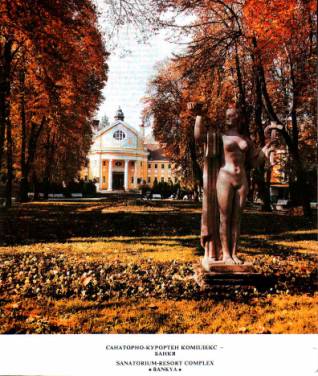
Bankya  - balneological and climatological rehabilitation center of Bulgaria
 

Dr. Silvia Petrova- MD
e-mail: [email protected]


Welcome to photo gallery of Bankya:
Bankya - centrum
St. Petka Paraskeva  Monastery, Klisura -Bankya
Nature around  Bankya
Sightseeing around the city


          1. Historical remarks.
   Bankya is a satellite town, situated only 15 km southwest from Sofia. It is one of the most    famous climatological  and balneological centers of Bulgaria and is considered a rehabilitation center of international importance.
   Located on the banks of the river Banska, surrounded by the hills of Ljulin mountain, with a marvelous view of two other  mountains-Balkan and  Vitosha- and overlooking  Sofia valley  makes it not only sanatorial, but  a famous  tourists’ place  as well.
   The history of Bankya begins in ancient times. It was known and famous place  for Trakian, Roman and Slavic people. This is proved by many of archeological discoveries such as fundaments of buildings, saveges, ceramic and coins. At the Medieval times many monasteries were built around, some still exist.
   During the 500 years long Turkish rule one of the owner of Bankya was  an Army Mayor (Bimbashi)  Muhamed Rashid . He has been well known to the mighty families in Sofia. He obtained the property as a gift from the Sultan for his faithful service. In the middle of the ranch (called “chiflick”) there was a hot spring of mineral water running and a bath with special wooden swimming pool was built there.
   After the Liberation  (1878) a Bulgarian, Rashko Neshev, built the first new public bath with two departments for each sex and a separate department for patients with skin diseases.
   At 1910 the “Big Bath” - located at the central beautiful King’s park was finished. It was built according to the project of prof. Hocheder- an architect from Munich. With it’s remarkable architecture it is still considered a symbol of Bankya. (pict.1)
   During the last century many sanatoriums, hotels and villas were built in Bankya. Local population is around 30 000 citizens. The law forbids any industrial activity there. Good transportation set connects Bankya with Sofia.

2. Climatological and mineral water qualities.
   Bankja is unique place thanks to its specific microclimate and the mineral water.

  A. Climat:

Tabl.1. Microclimatic parameters of Bankya
 

Elavation 630 to  750 m
Mean annual temperature 9,6 C 
-at January - 2,3 C 
-at July - 20,4 C
Mean annual atmospheric pressure 705 mm.
Relative air humidity 74%
-winter-spring - up 83%
-summer - 63%
Mean  annual  rain amount per sq.m  682 ml

   One of the typical signs of Bankya are so called  “local winds “- a combination of mountain breeze, valley wind, foen and forest wind.
   The mountain breeze is generated at night when the air on the hills cool and descends into the valley. At daytime the “valley” wind is generated to the opposite direction –from the town uphill the Ljulin mountain. Additional “forest “ wind is generated from the south hills where pine trees produce huge amount of phythoncids. It was found that up to 100 m aside the pine tree forest of Bankya the air is practically free of germs. (B.P.Tokin).
   Another special feature of Bankya is the ionization of the air. The atmosphere is a colloidal system with dissolved aerocoloids - neutral and electrically charged ions. It was established that when breeze is blowing, downhills negatively charged ions prevail and the electric field changes to negative. This air-electrical complex influences the organism through the light ions, stimulate vital processes and the general energy of the body. Ionization has a catalytic effect on biochemical processes and improves the pathological processes. (Kochankov, Iliev, 1972 ). The aerosol is almost free from allergenes and that gives additional therapeutic benefits to the resort.
   During the summer weather is relatively cool with a fresh air because of the breeze. Winters are moderately cold, without strong winds and storms, for Bankya is protected by the Vitosha and Ljulin mountains.
   The transparency of the air is very high and vizability reaches tens of kilometers. Practically there is no fog in Bankya. The landscape is extremely beautiful, open and calming and acts as additional powerful therapeutic factor of the resort.
 

   B.  Mineral water.
   The first time water of Bankya was studied in 1891 by A. Najdenovich, later on – in 1906 by Kr. Rusev,    in 1939 by A. Azmanov, in 1953 and 1956 –by Kusitaseva and J. Melamed.
   Mineral water in Bankya is clear, transparent, very tasty, without smell, homothermal (36,5 C) and  alcaline (pH>9). Radioactivity is low-1,5 eman per liter, as measured by prof. Penchev in 1911.

  Tabl .2. Physico-chemical values of Bankya mineral water (as measured at 31.3.1953 –Kochankov, 1972 and  at 1983  by D. Konstantinova).

Contents in one liter of water - mg
1953
mg
1983
mg/l
2000
mg%
1953
mg%
1983
equiv.%
1953
equiv. %
1983
Anions F*
Cl*
J*
SO4**(sulphat)
HCO3*(hydrocarbonat)
CO3**(carbonat)
NO3*(nitrat)
HPO4**(hydrophosphat)
Hydrosilicat
1,60
9,02
traces
65,43
26,19
35,01
no
0,18
-
1,8
10,2
-
60,7
30,5
39,0
-
-
3,9
1,7
11
-
60
49
30
-
-
5
0,0840
0,2540
-
1,3620
0,4130
1,1670
-
0,0040
-
0,095
0,290
-
1,264
0,500
1,300
-
-
0,051
2,56
7,73
-
41,47
12,57
35,54
-
0,13
-
2,71
8,29
-
36,11
14,29
37,14
-
-
1,46
- Total: - - - 3,2840 3,500 100,0 100,0
Cations Na*
K*
Ca**
Mg**
Fe**
Mn**
Al***
70,32
4,06
2,45
traces
no
no
no
78,0
traces
2,2
traces
traces
-
-
77
0,3
3
0,2
0,1
-
-
3,0580
0,1040
0,1220
-
-
-
-
3,390
-
0,110
-
-
-
-
93,12
3,17
3,71
-
-
-
-
86
-
3,14
-
-
-
-
- Total: 214,26  226,4 - 3,2840 3500 100.00 100.00
- H2SiO3(methasilicat acid
HBO2 (methaboric acid)
H2S and other sulphits
Free CO2
52,65
4,47
no
no
39,0
0,8
-
-
48
-
-
-
-
-
-
-
-
-
-
-
-
-
-
-
-
-
-
-

 
             Other parameters T- 36,5 C
Sediment- 0,28 g/l 
 PH- 9,6

Reaction:
a/ phenolphthalein – alkaline
b/ methylorange – alkaline

Radioactivity 1,5 emana (1911)1,0 åmana (1983)Radon – 3,7 Bq/l (2000)


Characteristics: homothermal, low mineralized, hydrocarbonat-sulphat-sodium water
 
3. Indications.
   Sanatorial treatment in Bankya is recommended for several groups of diseases:

   A/ Cardio – vascular  such as arterial hypertension, coronary disease, cardial postoperative conditi-
ons, atherosclerosis, rheumatic diseases etc.

  B/ Neurological diseases: radiculitis, plexitis, lumbago.

  C/ Musculo-sceletal diseases: arthritis, posttraumatic conditions, ostheoporosis.

  D/ Endocrinopathic conditions:  diabetes mellitus, climacteric disturbances, obesity.

  Bankya is mainly considered a rehabilitation center for cardiovascular diseases: postinfarct  and postoperative conditions and arterial hypertension. Best effect on these conditions was found at June, July, August and October.
   A lot of studies of complex rehabilitation programs’ effect on cardiovascular system have been made. Most of them concern therapeutic doses or quantitive evaluation of rehabilitation parameters (Dorosiev etc.). Balneological sitting bath effect of Bankya mineral water (by the method of Karakolev,1981) shows a normotonic dynamics conserning cardiac frequency and  blood pressure. The role of hydrostatic effect was studied by A. Daysky. According to his studies it was shown that mineral bath (Bankya) is not energic and haemodynamic overburden for the body and that allows it’s more frequent application to patients with cardiovascular diseases. Zahariev at all had shown the favorable effect on different neurological syndromes and on sexual function of post infarct patients treated by a complex rehabilitation programs.
   Most of the studies concern effect of mineral baths on blood pressure. Positive results were found for the patients with I and II gr AH  (by Lang) and that was explained by the soft irritating effect  of homothermal (36,5 C) light mineral water on the skin receptors and its  relaxation effect on central nervous system. Parallel to the subjective improvement also was found an improvement of electrocardiological parameters – normalization of ST segment, increase of T wave, delay of cardiac frequency that can be considered as an improvement of throfic processes in the myocardium. Increased excretion of 5-hydroxiindolacetic acid, considered the main methabolite of serotonin, was found and that is considered as a positive reaction. The possible explanation of that reaction is increase of oxidative dezamination of the serotonin..
     Bankya water is low mineralized , homothermal, hydrocarbonat-sulphat-sodium water, but as the mineral components are dissolved in it, they are acting as ions with a stronger biological effect on the organism. Important role has nitrogen, which is 90% of dissolved gases in the water. According to German and EU criteria presence of Fluor (1,6 to 1,8 mg/l) makes it a “fluorid containing natural mineral water”. Methasilicat acid is considered a protective factor against atherosclerosis. Trace elements as iron, cuprum, molibden, thitanium, argentums, stroncium, germanium, gallium are presented in a very low concentration, but they are considered a “metal vitamins” that increase the therapeutic effect of Bankya water.
   There are a lot of questions about the effect of mineral water and microclimate in Bankya, still waiting their investigation and explanation. The last decade, because of economical problems in Bulgaria there was not enough support for rehabilitation programs and some of sanatoriums in Bankya were closed. Increasing need of health care and protection in the period of globalization and integration of the world requires investments in study and development of sanatorial rehabilitation complexes. From economical point of view support and development of such unique climatological and balneological resort  as Bankya would be quite reasonable and cost effective investment.
 
  01.06.2002
 Sofia


[email protected]


For more info: mobile:00359(0)886632654
Hosted by www.Geocities.ws

1