Sadly the only written material about St. Mungo dates from the 12th century so sorting fact from fiction is difficult. Two accounts exist one by a monk Jocelin of Furness and one which may be earlier which is incomplete and anonymous.

St. Mungo or less commonly know as St. Kentigern was a very important figure in the church in the 6th and early 7th century. According to legend he knew St. David of wales and possibly St. Columba and was even related to King Arthur, apparently his great-nephew.
Both stories of his life say that he was the son of Tenew (later to become St. Tenew) daughter of the King of Llew or Loth after which the region of Lothian is named. Mungo's father is said to be one of two people, either Owain son of Urien the Prince of Rheged, or Urien himself, who in fact was Loths brother and Tenew's Uncle. According to Jocelin of Furness, Tenew had an affair. When her father found out she was pregnant he had to follow the laws of the land and sentence Tenew to death. (sex outside marriage was a capital offence). He decided to throw her of a large hill just outside Edinburgh called Traprain Law. However she survived and was set adrift in a coracle.
The vessel drifted to the coast of Fife and landed at Culross where St. Serf ran a religious establishment. There on the beach she gave birth to St. Mungo. They where found by St. Serf who took them in and there St. Mungo was raised and educated.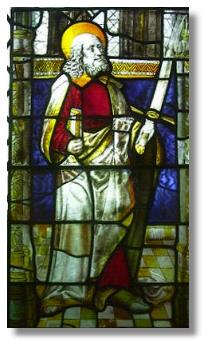
Stained Glass Window of St. Mungo
St. Mungo is said to have arrived in Glasgow in 540AD and was elected the Bishop of Strathclyde. Glasgow Cathedral along the Molendinar Burn is the fourth to be built on the site of St. Mungo's original wooden church. Tradition states that the site for the church was chosen for St. Mungo when he found St. Fergus dying by the roadside. St. Mungo placed Fergus in an ox cart and asked the oxen to take the cart wherever God wanted. The oxen stopped at a site that had been blessed by St. Niniann about 200 years before, so St. Mungo buried Fergus here and built the church on the same site.
Some of the main legends of St. Mungo are represented in the coat of arms of Glasgow
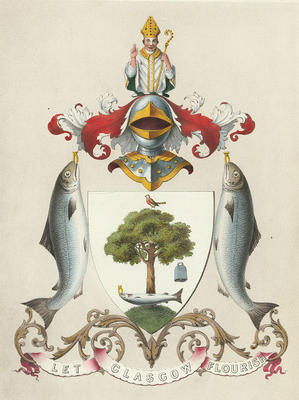
Glasgow Coat of Arms
There's a tree that never grew
There's a bird that never flew
There's a fish that never swam
There's a bell that never rang
There's a tree that never grew
In the coat of arms is an oak tree, legend has it as a branch of a Hazel tree. One night St. Mungo was left in charge of a fire, some other boys jealous of Mungo's friendship with St. Serf, waited for Mungo to fall asleep and then put the fire out. When he woke Mungo had seen the fire was out, he broke of some branches from a frozen hazel tree and prayed over them. They burst into flames and the fire was alight again.
There's a bird that never flew
Legend had it that St. Serf's pet robin was killed by some young hooligans. When Mungo had seen what had happened he held the bird in his hands and prayed over it and restored it to life.
There's a fish that never swam
This legend tells of how Mungo helped Queen Languoreth. It is said the Queen was distressed at having lost her husbands ring, one story has it that she gave it to a lover and the King retrieved it in the dead of night whilst the knight slept he then tossed the ring into the river and told his wife to attend court wearing it. He had hope to humiliate her for her infidelity. The Queen confessed all to St. Mungo who promised to help he asked one of the monks to go fishing and catch one fish. He returned with a Salmon and in its mouth was the ring.
There's a bell that never rang.
The original bell that was given to St. Mungo by the Pope vanished into history it was replaced in 1641 this bell can still be seen and is housed in the Peoples Palace Glasgow.
It is said that St. Mungo lived well into his eighties.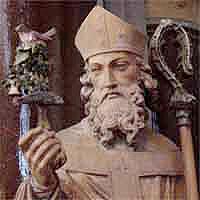
Statue of St. Mungo.
 |
 |
 |

For some lovely web graphics visit Eos just click the link above
for some lovely Celtic designs visit Aon just click the link above