
Whose On: James Hay
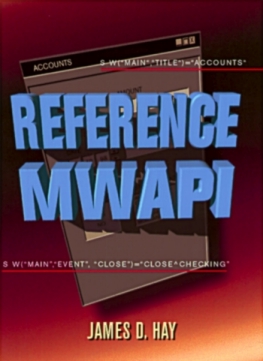
MWM talks to James Hay, author of the book Reference MWAPI. You can order this book directly from MWM from the link at the bottom of this page. To order James's latest book, click here.
Who is James Hay?
I have been developing and maintaining M applications since
1991, and with the M Windowing Application Programming Interface (MWAPI) the past five
years. I am employed with Uniband, Inc. working on a contract to supply programming and
technical support to the Indian Health Service. I have been working as a Uniband employee
and living in Albuquerque, New Mexico since late March of this year. My prior home was in
Temecula, CA, and work was with Science Applications International Corporation. My
professional programming career has been in the healthcare field and as an M user, and
previous work was in production and inventory control. 
I started writing with an M article for a local business periodical. Reference MWAPI is the first book length work I have done. I plan to continue writing books, articles and other forms of media.
Reference MWAPI is the first M GUI book on the market. Tell us a bit about how it came into being, what audience it addresses, and its purpose.
Reference MWAPI came into being to address the lack of documentation for the MWAPI. My first interest in the M Windowing Applications Programming Interface (MWAPI) came when I received a draft proposal on the subject. That was five years ago, and since then I have been studying the language extension. I saw in the MWAPI all the things I love in the M language including ease of use with industrial strength, quick prototyping capabilities, a platform independent development environment with effortless portability -- all with a Graphical User Interface capability.
The technology addressed by Reference MWAPI opens the target audience up to GUI developers as well as the M community. The book is a learning and reference tool for use of the MWAPI. The MWAPI offers the GUI developer the power, simplicity and portability M has to offer with a fresh approach to developing windowing applications.
How important is the GUI specification to the M world?
The MWAPI offers the world a GUI development tool with the power and robustness databases benefit from M. Developing MWAPI interfaces by hand, without the aid of a GUI builder tool, is a snap. The interpretive nature of M implementations permit MWAPI development from the command line. Windows and elements created at the command line are instantly displayed. If you are not happy with a characteristic of one of the created objects, assign a new value to the attribute -- the modification is immediate. This simplicity of manual development is demonstrated in the programs and resulting objects shown throughout Reference MWAPI.
Will MWAPI be effected given the recent acquisition of Micronetics by InterSystems?
It is too early to tell for sure, but let me offer some indications of MWAPI use. Use of search engines to search on MWAPI brings up an impressive numbers of links to sites using the MWAPI. Many of the URL's appear to be from Europe, Asia and South America. The Intersystem links were, to a certain extent, surprising because I thought they abandoned the technology years ago. Both DTM and DSM had implemented the MWAPI into their product lines.
At the heart of MSM Workstation is also MWAPI, but the workstation differs in its completeness, evolution and customer base from that of DTM's and DSM's implementation. The MWAPI too has evolved since DTM and DSM implementations. Improvements to the MWAPI dismiss the then arguments of sluggish speed and complete definition. The MWAPI is fully robust and defined, and continues to be enhanced by a user development committee. MSM Workstation is a well evolved product that uses all the best MWAPI continues to offer; offers a GUI development tool capable of competing with VB, Delphi and Powerbuilder; and has an established customer base developing enterprise level applications. Will InterSystems dismiss a winner? Lets hope they appreciate the golden egg.
Given your expertise in this area, what are your recommendations to an M programmer who has for a considerable time been programming in CHUI fashion and is "afraid" to take the plunge (maybe because he does not know what to expect)?
The learning curve is quite flat for learning to use the MWAPI. Syntax of the MWAPI has a design so familiar to M programmers they should see it as only an extension to what is already known. Structured System Variable Names (SSVNs) introduced in the 1995 M standard are the structures that hold object data. These SSVNs have the side effect of creating windowing objects when the minimum number of attributes are assigned. Attributes are logical and easy to remember: COLOR for a color attribute and SIZE for the object's size. Settings defined for visual interface characteristics in the operating system are assigned to MWAPI objects automatically, so no concern is needed.
The next issue of M Computing is scheduled to contain an article I wrote on this very question. In my mind, the real learning curve is the event model used by windowing systems.
How do you seem M evolving in the next 10 years with respect to Windowing and other areas?
I see MWAPI enhancements keeping abreast with, and incorporating the best of, windowing technologies. The demand for MWAPI technology will drive its standardization processes in an expeditious manner so it will keep current and competitive. MWAPI development will continue despite the recent InterSystems purchase and ensuing rumors because the MWAPI offers a powerful and simplistic approach for GUI development to window's developers as well as to the M community. There is too much potential for development on the MWAPI to be ignored.
What are your plans for the future (are your working on any other books?)
I am currently working on the proposal for a book on software engineering. I enjoy writing on technical subjects, and plan on continuing with the endeavor. Omega is one thought due to its possibilities. Teaching is one interest I plan to pursue and fit into my writing and employment somewhere.
Click here to order Reference MWAPI from Amazon.com
Use the form below to search for any book available at Amazon.
