
MFreeZone:Connie Bonnici
Good Friday
(Il-Gimgha l-Kbira)
by
Connie Bonnici
Our Lady of Sorrows (Id-Duluri)
Celebrations related to the Holy Week start on the Friday before Good Friday. The feast of Our Lady of Sorrows is very popular and considerable crowds are attracted to the various processions, carrying the statue of Our Lady under the cross, held throughout Malta and Gozo. It is believed that the oldest and most popular one of all is the one held in the capital city i.e. Valletta. Records show that in 1646 funds were collected for this celebration by the Fraternity of the Crucifix.
Palm Sunday (Hadd il-Palm)
On Palm Sunday the Catholic Church celebrates the triumphant entry of Christ into Jerusalem.
In some villages a procession is held on Sunday morning whereby the parish priest, representing Christ, is carried on a donkey to church while other men dress up as apostles. People wave olive branches and palm leaves and these are blessed. Some of the olive branches are churned and their ashes put aside for the next year's celebration of the beginning of lent.
Up to some time ago people used to fumigate their houses on Easter Sunday by burning some of the blessed olive branches in a pot and run about the house to scare away evil spirits.
L-Erbgha tat-Tniebri
The Wednesday before Good Friday is known as L-Erbgha tat-Tniebri (literally meaning Wednesday of the darkness) and refers to the victory of darkness on the death of Christ. Psalms are sung by the priests and three brown candles are lighted. The are put out on three successive days, the last one on Good Friday. Up to some years ago, during this celebration the congregation present used to bang their chairs and on the doors to represent the earthquake that took place when Jesus died.
Maundy Thursday (Hamis ix-Xirka)
On Maundy Thursday the Roman Catholic Church commemorates the Last Supper of Christ, when Jesus gave his body and blood to the Apostles and established the Holy Eucharist, and the washing of the Apostle's feet by Jesus himself. The ritual held in the evening incorporates the washing of the feet of 12 men by the priest. The main churches all over the islands decorate the Sepulkru with flowers and candles for the adoration of the Eucharistic Host which starts just after the commemoration of the Last Supper and ends the next day at noon. This adoration is referred to as Il-Visti tas-Seba' Knejjes, which literally means The Visits to the 7 Churches. The local tradition insists that the exposed Host is visited for seven times in seven different churches (or in the same church if there is only one in the vicinity). This tradition started during the reign of the Knights of Malta. The most beautifully decorated Eucharistic Host is that of the Cathedral at Mdina - the old capital.
No church bells are rung from this day up to Easter Eve's celebrations so a wooden rattle, nowadays powered by electricity, is used instead to call the faithful to church and to enhance the atmosphere of solemnity connected with these events.
Good Friday (Il-Gimgha l-Kbira)
 A commemoration known as Il-Priedka tat-Tliet Sighat (the
Sermon of Three Hours) is held in the afternoon reflecting mostly on the last seven
sayings of the agonized crucified Christ. Then the body of Christ is removed from the
crucifix and held so that the congregation can approach and revere it. This is referred to
as the Adoration of the Cross. This commemoration dates back to the Knights of St. John.
Records show that way back in 1657 a Crucifix was brought over from Kandja for this
purpose.
A commemoration known as Il-Priedka tat-Tliet Sighat (the
Sermon of Three Hours) is held in the afternoon reflecting mostly on the last seven
sayings of the agonized crucified Christ. Then the body of Christ is removed from the
crucifix and held so that the congregation can approach and revere it. This is referred to
as the Adoration of the Cross. This commemoration dates back to the Knights of St. John.
Records show that way back in 1657 a Crucifix was brought over from Kandja for this
purpose.
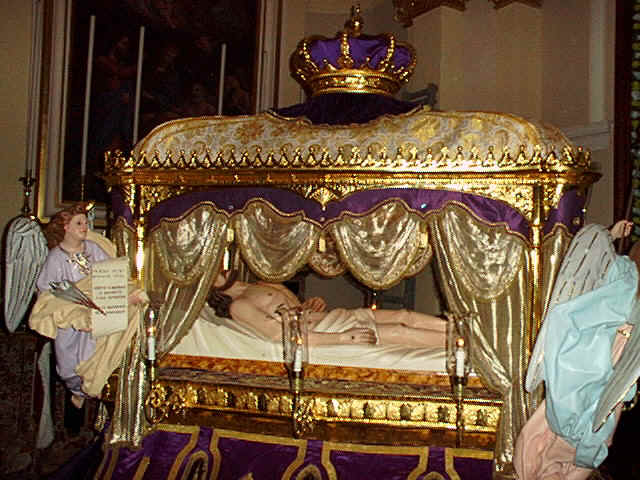
Later on processions are held in various localities to commemorate the Way of the cross. One of these processions dates back to 1575 and was held in Valletta. In 1686 a statue representing the Crucified Christ was used for the first time, also in Valletta. Throughout the years more statues were added representing various stages from the Way of the Cross both in the Valletta processions and in other held in various villages throughout Malta and Gozo. Children dressed up as angels used to accompany the statues. During the past twenty years people started dressing up as the biblical figures connected with the death of Christ like Apostles, Prophets and Roman Soldiers. Even female characters are nowadays present. Horses are also being used in the procession held at Zebbug, Malta. The Zebbug procession has the largest number of participants which totals 750.
References:
Bonnici, B., Il-Gimgha l-Kbira f'Malta, S.K.S.
(Malta), 1998.
Zarb, T., Folklore of an Island: Maltese Threshold Customs, PEG (Malta), 1998.
(c) Connie Bonnici 1998
Connie welcomes your comments and is happy to provide you with more information about pottery skills in Malta.
Connie Bonnici |
