Caribbean Music Expo - A young producer's view
ON
my first visit to CME in 2000, I carried my laptop computer - intending to
play and collect MP3s. Luckily for me, some friends of mine - Terence "Farenheit"
Harold of Mystic Urchin music, Kareem of Phat Black and Aaron Johnston - set
up a computer-based digital studio in their booth. I hooked up my laptop to the mixing board and we ran the two computers as a live recording studio, CME's first. The booth was visited by everyone and considered one of the favourite and most innovative booths.
Since that time I have been involved in a lot of production, especially digital
music with Damion "Teflon" Forbes and "Scatta" and "Eva"
Burell of Kings of Kings music. I also witnessed the production of a lot of
great digital music, namely the "Martial Arts" Number one rhythm,
and "Famine" both produced digitally by these aforementioned producers.
I have witnessed the birth of a few careers and been there with them, artists such as "Turbulance" and "Jagwa", young artistes who are both making waves in the dancehall right now and who seem to be the new wave of pioneers in today's music.
, I
have been building my own beats and one by one been building up a small group
of artists who have been voicing some songs and lyrics on them. My artists
are "Scrum Dilly", "Plumzel", "Damie D", "Movado"
and "Hollow Point". Listen out for us. We are all young, and we
think this is an advantage because we make music that people like us like
to hear. This is why I believe Damion "Junior Gong" Marley is so
popular, because he and his brothers have that link to the youth which makes
them create music youth like. Big Up, Grammy yout!!!
I
have been building my own beats and one by one been building up a small group
of artists who have been voicing some songs and lyrics on them. My artists
are "Scrum Dilly", "Plumzel", "Damie D", "Movado"
and "Hollow Point". Listen out for us. We are all young, and we
think this is an advantage because we make music that people like us like
to hear. This is why I believe Damion "Junior Gong" Marley is so
popular, because he and his brothers have that link to the youth which makes
them create music youth like. Big Up, Grammy yout!!!
So this year I went to CME to learn as much as I could about the BUSINESS
of music and make a valuable time investment in my ambition to be a music
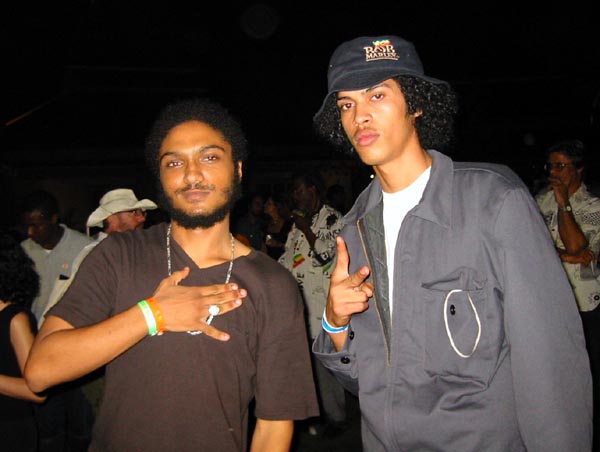
producer. 'Scrum Dilly' (with me at left), one of my artistes, was
determined enough to find his way to Ocho Rios and hang out with me to learn
as much as he could. After his second day, organiser Lloyd Stanbury was impressed
enough to grant him day passes for the remaining two days, and we both will
be eternally grateful for all we learned this year at CME.
The questions many wanted the seminar panelists to answer were: What is the best way to get our music to the market? How do we get noticed?
In a seminar I really enjoyed, we learned how to make a music website, a really useful promotional tool, rather than just a place to sell music. A team of two from Holland divided us into two teams to analyse two music websites and discuss how they served their objectives. Mr Paul Barendregt explained that the three most important things for a successful music Website were: easy navigation, simplicity and reliability.
On another panel we learned that perhaps giving away some music might be a good way to win a following and create a fan base for future releases. Websites like Mp3.com offer space for building artiste websites and offering music either for free for sale.
Robert Livingston, Shaggy's manager who heads the Big Yard music company, advised us to be ready to do anything necessary to captalise on even the smallest beginnings of success. He said that when he and Shaggy heard that a radio station in Hawaii was playing It wasn't Me, they cancelled all engagements, flew there and spent a month contacting radio stations and promoting themselves and the song until it went to Number one in that state.
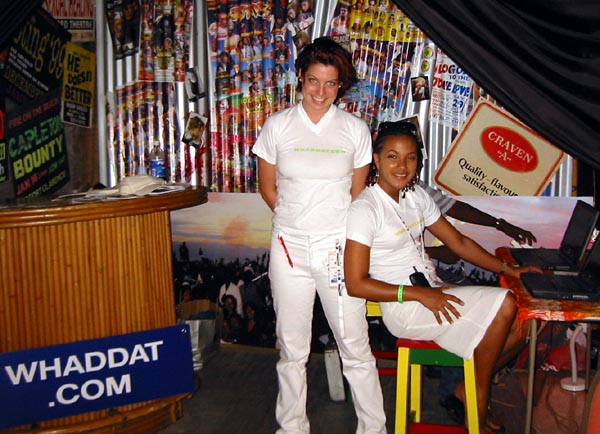 Quiz & Rebecca at their Whaddat,com booth
Kendal Minter, the entertainment lawyer, advised us to be careful in the beginning and put in writing how the creative inputs of a song or collaboration will be shared. He told of how disputes about who wrote what part of the song, can hold up the payment of royalties - which are then held by record companies who use the interest accruing for their own purposes.
Tom Silverman of Tommy Boy Records advised us to form our own independent labels and promote our stars ourselves, without waiting for some big label to come along and discover us. This was real encouragement to youth like us, because we believe in ourselves and that we can make our own success happen. CME gave us lots of instruction in how to do this.
Best part of CME was linking with Jon Baker of Gee Jam Studios in Port Antonio, which has perhaps the best digital recording facilties in Jamaica, and where No Doubt and Bounty Killer recorded their smash hit Hey Baby!
At CME this year Jon was promoting Gee Jam in collaboration with Jade Productions and showing a lot of interesting videos of artistes who have recorded at the studio. Jon has been working with a new group called 'Adelante' - a reggae-Latino fusion which includes my friend 'Farenheit', but sadly they didn't get to perform at CME this year. Wyclef Jean and India.Arie are also recording at Gee Jam, so we can expect some more good music soon.
GeeJam also had a team from Florida demonstrating the latest version of ProTools -- the best music production software on the market today. This is a complete solution for your digital studio which only needs a Macintosh laptop and the ProTools kit to operate.
I was also impressed with some of the new acts we saw and heard at CME, especially the artistes who won the CME Star Search such as Nadz, Marcus I from Jamaica and Courage Band from Bahamas. Big up also to my friends, ace webmasters 'Quizz' and Rebecca from leading entertainment Website Whaddat.com, who had the best looking booth at CME.
Overall, what I learned this year at CME was that if we keep on being proud of our own music and looking to ourselves instead of outside, we can take the success of Jamaican and all Caribbean music even further than it has already reached. There are some good leaders in the Jamaican music industry who want to help us.
People like CME's Lloyd Stanbury, Sharon Burke and Josanne Leonard, and GeeJam's Jon Baker, Florida-based Winsome Charlton who helps to represent us on radio in the USA, and Chris Blackwell, whose Island Village gives young producers and artistes like us a beautiful stage as an objective for our musical aspirations.
 Bounti
Killer gave the best encouragement in his much-applauded speech, saying that
promoters should give opportunities to the youth, not just the established
artistes, because it's the youth who are going to bring back the music. The
Killa said that this is why he endorses the ghetto youth, because they are
trying to promote a positive message. In the words of Wayne Marshall (right),
who is one of the shining examples of Bounti's message: "It's not about
the hype, it's what the people really like."
Bounti
Killer gave the best encouragement in his much-applauded speech, saying that
promoters should give opportunities to the youth, not just the established
artistes, because it's the youth who are going to bring back the music. The
Killa said that this is why he endorses the ghetto youth, because they are
trying to promote a positive message. In the words of Wayne Marshall (right),
who is one of the shining examples of Bounti's message: "It's not about
the hype, it's what the people really like."
CME was an invaluable experience for us all.