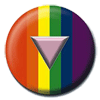

The rainbow flag has become the easily-recognized colors of pride for the gay community.
The multicultural symbolism of the rainbow is nothing new.Jesse Jackson's Rainbow Coalition
also embraces the rainbow as a symbol of that political movement. The rainbow also plays a part
in many myths and stories related to gender and sexuality issues in Greek, Native American,
African, and other cultures.
Use of the rainbow flag by the gay community began in 1978 when it first appeared in the San Francisco
Gay and Lesbian Freedom Day Parade. Borrowing symbolism from the hippie movement and black civil rights
groups, San Francisco artist Gilbert Baker designed the rainbow flag in response to a need for a symbol
that could be used year after year. Baker and thirty volunteers hand-stitched and hand-dyed two huge prototype
flags for the parade. The flags had eight stripes, each color representing a component of the community...

The next year Baker approached San Francisco Paramount Flag Company to mass-produce rainbow flags for the
1979 parade. Due to production constraints, such as the fact that hot pink was not a commercially-available color,
pink and turquoise were removed from the design, and royal blue replaced indigo. This six-color version spread from
San Francisco to other cities, and soon became the widely-known symbol of gay pride and diversity it is today.
It is even officially recognized by the International Congress of Flag Makers. In 1994, a huge 30-foot-wide by
one-mile-long rainbow flag was carried by 10,000 people in New York's Stonewall 25 Parade.
 |
PRIDE: >Pronunciation: 'prId Function: noun. Etymology: Middle English. 1 : the quality or state of being proud. 2 : a reasonable or justifiable self-respect. 3 : delight or elation arising from some act, possession, or relationship. 4 : a showy or impressive group (glsen) 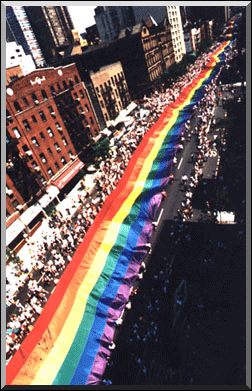 |
|
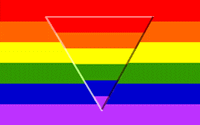
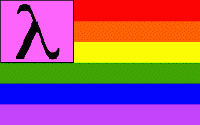
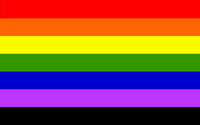
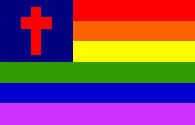
There are plenty of variations of the flag ...
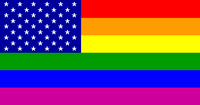
The American Flag
The Triangle Pride Flag
The Lambda Pride Flag
The AIDS (victory) Pride Flag
The Christian Pride Flag
The Leather Pride Flag
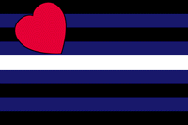

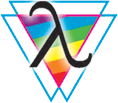

The lambda symbol seems to be one of the most controversial of symbols in regards to its meaning. There are
several differing opinions as to why the lambda was chosen as a gay symbol and what it really means. However,
most sources agree on a few things:
The lambda was first chosen as a gay symbol when it was adopted in 1970 by the New York Gay Activists Alliance.
It became the symbol of their growing movement of gay liberation. In 1974, the lambda was subsequently adopted by
the International Gay Rights Congress held in Edinburgh, Scotland. As their symbol for lesbian and gay rights, the
lambda became internationally popular.
But where history ends, speculation begins. No one seems to have a definitive answer why the lambda was originally
chosen as a gay symbol. Some suggest that it is simply the Greek lower-case letter l for liberation. Others disagree,
citing the use of lambda in physics to denote energy (the energy we have when we work in concert) or wavelength (are
gays and lesbians on a different wavelength?). Lambda may also denote the synergy of the gay movement, the idea that
the whole is greater than the sum of its parts. The lambda also may represent scales and balance, and the constant force
that keeps opposing sides from overcoming each other -- the hook at the bottom of the right leg signifies the action needed
to reach and maintain balance. The ancient Greek Spartan's regarded the lambda to mean unity, while the Roman's considered
it "the light of knowledge shed into the darkness of ignorance."
Whatever the exact meaning and origin, the lambda originally embodied a fairly militant connotation. Today, the symbol
generally denotes lesbian's and gay men's concerns together. Although the lambda was never intended to be linked to any
specific gender or orientation such as other symbols may be, historically this is not so: In the early 1970's the Los Angeles
gay community created a flag with a lavender lambda on a simple white background. They hoped the flag would catch on to other
cities, but their hopes were not realized because some saw the lambda as a male symbol only.


As most everyone knows, the pink triangle is a symbol taken directly from the Nazi concentration camps. Usually when
concentration camps and Nazis are mentioned, most people tend to think of Jews and the Jewish Holocaust (for good reason).
But the fact that a large number of homosexual prisoners were in those same camps is an often ignored or overlooked fact of history.
The real story behind the pink triangle begins prior to World War II. Paragraph 175, a clause in German law, prohibited homosexual
relations (much like many states in the U.S. today have laws against "crimes of nature"). In 1935, during Hitler's rise to power,
he extended this law to include homosexual kissing, embracing, and even having homosexual fantasies. An estimated 25,000 people were
convicted under this law between 1937 and 1939 alone. They were sent to prisons and later concentration camps. Their sentence also
included sterilization, most commonly in the form of castration. In 1942, Hitler extended the punishment for homosexuality to death.
Prisoners in Nazi concentration camps were labeled according to their crimes by inverted colored triangles. "Regular" criminals were
denoted by a green triangle, political prisoners by red triangles and Jews by two overlapping yellow triangles (to form the Star of
David, the most common Jewish symbol). Homosexual prisoners were labels with pink triangles. Gay Jews, the lowest form of prisoner,
had overlapping yellow and pink triangles. This system also created a social hierarchy among the prisoners, and it has been reported
that the pink triangle prisoners often received the worst workloads and were continually harassed and beaten by both guards and
other prisoners.
Although homosexual prisoners were not shipped en mass to the Aushwitz death camps like so many of the Jewish prisoners, there
were still large numbers of gay men executed there along with other non-Jewish prisoners. The real tragedy though occurred after the
war. When the Allies defeated the Germany and the Nazi Regime, the political and remaining Jewish prisoners were released from the
camps(the regular criminals- murderers, rapists, etc.- were not released for obvious reasons). The homosexual prisoners were never
released though because Paragraph 175 remained West German law until 1969. So these innocent men watched as their fellow prisoners
were set free, but remained prisoners for 24 more years.
In the 1970s, the pink triangle started to be used in conjunction with the gay liberation movement. When people, especially public
figures such as law makers, were confronted with such a symbol, they risked being associated with the Nazis if he or she were to
attempt to openly limit or prosecute gays. In the 1980s, when the triangle's popularity truly began to take off, ACT-UP (AIDS
Coalition To Unleash Power) adopted the it as their symbol, but turned it upright to suggest an active fight rather than passive
resignation. I've also been told that some people wear their triangles pointing up if they personally know somebody who has tied
of AIDS. In any case, the pink triangle is definitely a symbol very closely connected to oppression and the fight against it, and
stands as a vow never to let another Holocaust happen again. Like the word "queer," it is a symbol of hate which has been reclaimed
and now stands for pride.
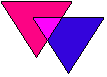
Somewhere in all this excitement with gay and lesbian symbols, bisexuals appear to have slipped through the cracks. It
has only been within the last decade or so that bisexuals have begun actively organizing and fighting for equal voices.
One of the many good things to come out of this movement is a symbol that bisexuals can call all their own: the interlocking
pink and blue triangles, sometimes referred to as the "biangles."
I have e-mail many organizations and still have yet to get a reply from the local Pittsburgh GLSEN.
If anyone knows the origin or why the colors were chosen please feel free to e-mail me at [email protected].
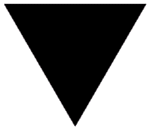
The Pink Triangle was used exclusively with male prisoners- lesbians were not included under Paragraph 175. However,
women were arrested and imprisoned for "antisocial behavior," which include anything from feminism, lesbianism, and
prostitution to any woman who didn't conform to the ideal Nazi image of a woman: cooking, cleaning, kitchen work, child
raising, passive, etc. These women were labeled with a black triangle. Just as the pink triangle has been reclaimed, lesbians
and feminists have begun using the black triangle as a symbol of pride and sisterhood.

Adopted in Australia for the bisexual movement,
is the yin-yang combined with the gender symbols.
The South Australian Bisexual Network was formed in November
of 1992 and developed the symbol the following year. |
freedom rings- six metal rings
in each of the flag's six colors on a chain,
usually worn as a necklace, bracelet or keychain.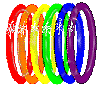 |
The purple rhino made its first
appearance in December 1974. It was created by two Boston gay rights activists.
The rhino started being displayed in subways in Boston, but
became too expensive for the activists to handle.
The ads disappeared, and the rhino never caught on anywhere else.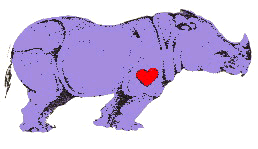 |
 Magazines and Entertainment:
 the Advocate Out Magazine
Data Lounge
Planet Out
Pittsburgh's Out
Planet Q
Gay.com
Commercial Closet
People With a History
Organizations: Human rights Campaign
Lambda Legal Defense and Education Fund
National Gay and Lesbian Task Force NGLTF
Gay and Lesbian Alliance Against Defamation GLAAD
Gay, Lesbian, Straight Education Network GLSEN
Parents, Famalies, and Friends, of Lesbians and Gays PFLAG
Day of Silence Project
National Coming Out Project
Local Organizations: Gay and Lesbian Community Center
Western Pennsylvania Freedom to Marry Coalition
Pittsburgh AIDS Task Force
Health: GayHealth
YouFirst.com
StopHIV.com
SaferSex.org
University Groups: Cal U Rainbow Alliance
Carnegie Mellon University's cmuOUT
University of Pittsburgh's Rainbow Alliance
West Virgina University's Bisexual, Gay, and Lesbian Mountaineers
Pennsylvania State University
Indiana University of Pennsylvania