MINANGKABAU
 |
Minangkabau the greatest name of the Western of Sumatera (Sumatera Barat) to the most of people in another name of Pariangan Kingdom, established in the middle of twelve Century (1339), situated in the Southern East Slope of Merapi Volcano. This cannot be argued since the history of Minangkabau nature itself is a "Tambo" which is comfirmed by the Minangkabau people up to this time. Most people said that "Tambo" of Minangkabau contained only fiction and so too said that it is only |
|
contained 2% the truth, while 98% is a mythologi. Most people nowadays interprets that, the name of Minangkabau formally derived from the Bull Fighting tradition, which was begun with the fight of two buffalos, one from Swarnadwipa (Java) and the other from Pariangan, Swarnabhumi (Andalas). At that time the winner was the buffalo from Pariangan, there fore the land was named Minangkabau. "Minang" was interpreted as Menang or Win and "Kabau" is the name for buffalo in West Sumatera word. Principally, the name of Minangkabau was existed for more than the existence of Pariangan Kingdom whose king was Adityawarman (1339 - 1376), than it was believed that the name was existed at the first time the fore parents stepped on the land arround the slope of Merapi Volcano. This could be proved by the spreading of religious in Minangkabau ;
This is can be proved either by the founding of an ancient inscription in Sriwijaya, which is written to be said; Swasti Cri Cakrawarsita
605 Eka Dacicu congratulation on the
leaving of caka (saka) year 605 on the date of 11 At the inscription was
clearly written the holly mission from Minanga Tamwan to Sriwijaya.
Minanga means Binanga which is means River, while Tamwan or Temon is
the founding, therefore the words "Minanga Tamwan" means the
estuary two twin rivers, Left Kampar and Right Kampar which is well
known as Muara Takus. The existence of Minangkabau is predicted to exist since the 2nd - 3rd Century. This could be seen from the development of religious in Minangkabau. The first religion which firstly came to Minangkabau was Budhish (Hinayana) 6th - 7th Century. While Islamic firstly came on the 6th Century, and after that was vacoom since the trading monopoly between Khalifah Umayyah (670 - 730) and China Tang Dinasty (604 - 908).
THE
FORE FATHER OF MINANGKABAU
Based on the believe of the fore parents stated in "Tambo",
news and ancients proverbs, it can be said that to judge "Tambo"
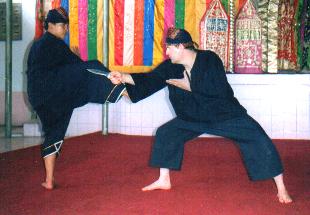
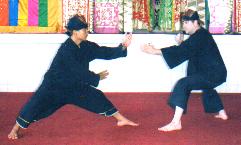
was containing 2% the truth and 98% mithology is trully reasonable. And according to "Tambo" of Minangkabau, the fore father of Minangkabau was Sultan Maharajo Dirajo. Who had sailed with his followers Cati Bilang Pandai which was well known with the name Tukang Sibak Ulai, and the four skilled escort in self defence, Kuciang Siam, Harimau Campo, Kambiang Hutan and Anjieng mualim. The had sailed along the Lakadewa Island passing Serindit and Langgapuri or Ceylon straight to Gold archipel and harboured in the Merapi Volcano. Sultan Maharajo Dirajo was the son of Iskandar Zulkarnain (Alexander Grote). Alexander Grote or the Great Alexander was the greatest kingdom's king in Masedonia (Athen) 365 - 323 Bc. He was the pupil of Aristoteles 384 - 323 Bc. While Aristoteles was the pupil of plato 427 - 347 Bc. Alexander Grote married to a prnces of Ruhum (East Rome). From this married he was inherited three sons, named; Sultan Maharajo Alif, Sultan Maharajo Depang (Dipang) and Sultan Maharajo Dirajo. |
|
 |
Before the death of Iskandar Zulkarnain (Alexander Grote), he has assigned his son Sultan Maharajo Alif to leave for Ruhum (East Rome) to govern it, while Sultan Maharajo Dipang had been assigned to China to govern it and Sultan Maharajo Dirajo had been assigned to came to an island in the southern of Equator.As it had stated earlier, Sultan maharajo dirajo was set with his followers along Lakadewa passing Serindit or Langgapuri straight to the Gold Island or Jawa Alkibri which is now is named Sumatera (Andalas). |
|
Among the followers there were Cati Bilang Pandai or named Tukang Sibak Ulai, and the four escort Kuciang siam, Harimau Campo, Kambiang Hutan and Anjieng Mualim. The four were the champion of self defence from their own region. They were not animal although were named with animal Kuciang (Cat), Harimau (Tiger), Kambiang (Goat) and Anjieng (Dog). They were totally human being that were named is accordance to their style of skill in self defence. After
harbouring to the Andalas island the journey was straighted to the slope
of Merapi Volcano and this was the beginning of the dwelling of Sultan
Maharajo Dirajo in the slope of Merapi. And the first home of theirs
was named Galundi Nanbaselo.
THE PRINCIPAL THROUGHT (WAY OF LIFE) OF MINANGKABAU PEOPLE Rumah basandi Batu house is foundationed
with stone From the above principe it could be
seen that With the interpretation as follows;
Adat Bajanjang Naiak Batanggo Turun
(custom in applied structurally) Kamanakan barajo kamamak = nephew obeyed
the uncle From the above statement, it could
be seen how democratic is the law of custom "Bajanjang Naiak Batanggo
Turun", created by the two Datuk, Dt. Perpatiah nan Sabatang and
Dt. Ketumanggungan.
|
|