Enhancing Women’s Representation in Legislatures
An
Alternative to the Government's Bill for Women’s Reservation
Madhu Kishwar (CSDS/Manushi,
• Yogendra Yadav (CSDS,
THE ugly scenes and
stalemate over tabling the Women’s Reservation Bill in parliament have had a
very beneficial effect. They have finally brought the grim truth into sharper
focus that politics has proven to be very inhospitable for women in independent
Most countriies in the world have failed to give
due space and representation to women in their political life. Women are moving
in the direction of near equal participation in only a handful of countries,
such as
In
ð While in many other countries women are
inching forward bit by bit, in
ð Government
and politics are more important factors in the economic, social, and power
structures in India than in most other countries with stronger civil societies,
and so, the effect of women’s marginalisation in
politics is even more detrimental here.
ð The increasing
violence, sexual harassment and victimisation of
women at the ground level in many of our political parties has made their
participation extremely hazardous now.
There were many more
outstanding women leaders and workers in the Congress Party at all levels
during the freedom movement than are at present in all parties put together. In
states like Maharashtra and
The set backk to women’s participation is even
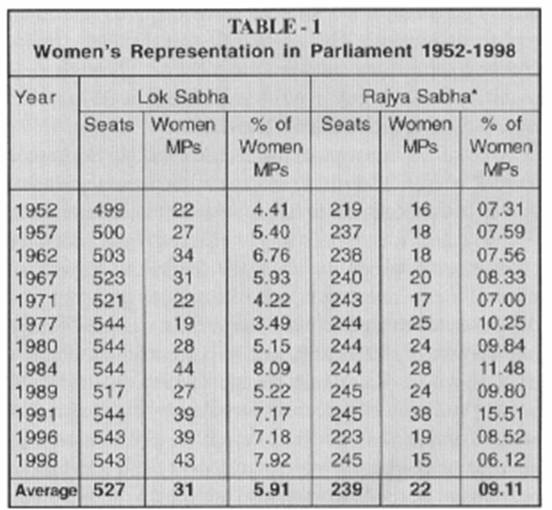
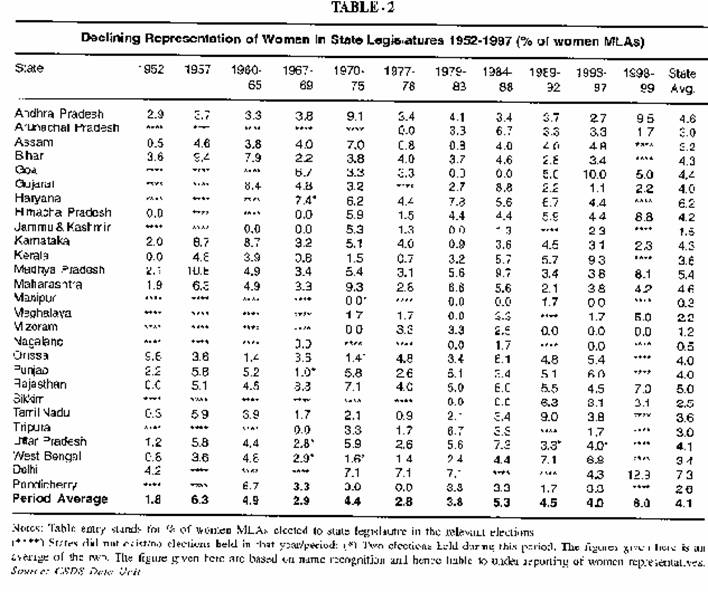
more severe at the state level than in Lok Sabha (See Tables 1 and 2). This is clearly
evident in
The represenntation of women in the Lok Sabha has basically remained
stagnant. It reached a “high” of 8 percent in 1984. This figure has not been
crossed since then. Thereafter, it has showed some decline rather than register
an increase. This despite the fact that every major national
party in recent years has declared through their manifestos that they would
implement a 33 percent reservation for women in all legislatures.
One of the mmost puzzling features of this
depressed level of women’s political representation in our legislative bodies
is that it seems to have no direct correlation with literacy and other
seemingly related indicators. A comparison between the states of Kerala and Rajasthan, whose literacy rates are at opposite
ends of the spectrum, demonstrates this clearly. In Kerala,
the overall literacy rate is reportedly 90 percent, with 86 percent female
literacy. By contrast, in Rajasthan, female literacy is a mere 20 percent and
only 12 percent of females are literate in rural areas. Kerala
has a matrilineal tradition in which women have a much larger measure of autonomy
and freedom of movement. Kerala’s women also tend to
marry at a much later age compared to women in other states. Most women in
Rajasthan live far more restricted lives in aggressively patriarchal
communities that still practise purdah
and perform child marriages. But the cultural and educational advantage
that women in Kerala have, does not translate into
higher political participation as compared to Rajasthan. The percentage of
women in the legislative assemblies of both states is low. In Kerala it rose from less than one percent in 1967 to six
percent in 1991. However, in Rajasthan, the representation of women was four
percent in 1967 and reached eight percent in 1985-90, slightly more than in Kerala, but not significantly greater. Since then it has
been going down.
Similarly, the state of Manipur, which has a tradition of
women playing a dominant role in both the family and the community (again due
to a matrilineal heritage), never produced a single woman legislator till 1990
— when it elected its first. Nagaland and other
North-eastern states which have less repressive cultures for women have
similarly low levels of women’s representation. By contrast, take the
proportion of women in politics in UP,
In independent
It is significant that stagnation and/or decline in women’s
political participation rates run contrary to trends in many other fields.
Women in
All these trends indicate that women’s representation in
politics requires special consideration, and cannot be left to the forces that
presently dominate our parties and government. Today, even the best of our
female parliamentarians feel sidelined and powerless within their respective
parties. The few women in leadership positions have not been able to encourage
the entry of greater numbers of women in electoral and party politics, and are
an ineffective minority within their own respective political groupings.
The very same male party leaders who compete with each other
in announcing their support of special reservations for women have shown little
willingness to include women in party decision-making, or even to help create a
conducive atmosphere for women’s participation in
their own organisations. In fact, women’s marginalisation is even more pronounced in the day-to-day
functioning of almost all political parties than in the Lok
Sabha. Therefore, it is urgently required that we
take special measures to enhance women’s political participation in ways that
help them influence decision-making at all levels of our society and polity.
Our democracy will remain seriously flawed if it fails to yield adequate space
to women.
Given this worrisome scenario, the national debate and
efforts to provide constitutional and legal mechanisms to enhance women’s
participation in legislatures are welcome and long-overdue.
Problems with the
Present Bill
THE 85th constitutional
Amendment Bill, introduced .L in Lok Sabha in December 1999, includes the following key
provisions:
ð
One-third of all seats in Lok Sabha
and Vidhan Sabhas shall be
reserved for women. Such reservation shall also apply in case of seats reserved
for Scheduled Castes (SCs) and Scheduled Tribes (STs).
ð There shall be
rotation of seats so reserved for women.
ð Such rotation shall be
determined by draw of lots, in such a manner that a seat shall be reserved only
once in a block of three general elections.
This Bill is seriously
flawed, insofar as it mechanically provides for entry of women members to fill
one-third of vacancies in Lok Sabha
and Vidhan Sabhas. Such
mechanical reservation and rotation suffers from serious defects:
1. One-third seats are
reserved, and such reserved seats are rotated in every general election. This
rotation will automatically result in two-thirds of incumbent members being
forcibly unseated in every general election; the remaining one-third will be
left in limbo until the last moment, not knowing whether or not their
constituency will form part of the one-third randomly reserved seats and thus
require them to scramble at short notice to find another seat to contest.
2. There is already resentment about reserved seats for SCs and STs being frozen in the
same constituencies over a long period of time. Inevitably, there will be
vociferous and justified demands for rotation of seats reserved for scheduled
castes, and in some cases scheduled tribes, where their population may not be
very large. This will trigger off further instability in our polity.
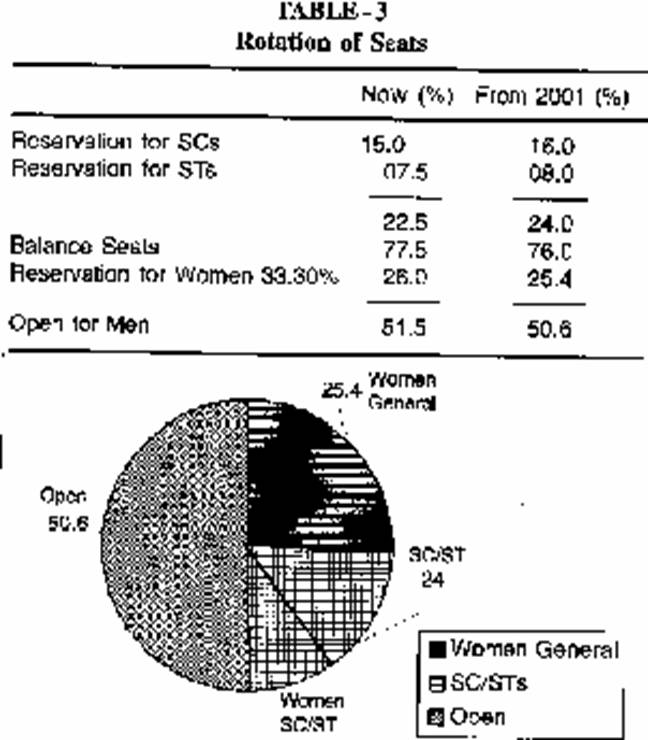
3. The population of scheduled casts and scheduled tribes is now estimated to be around 16
percent and 8 percent respectively, on an all
4 Such compulsory unseating violates the very basic principles of
democratic representation. It jeopardizes the possibility of sensible planning
to contest and nurture a political constituency for both male and female
candidates.
5. As legislators do not have the incentive to seek re-election from
the same constituency, plunder will increase, and politics will be even more
predatory and unaccountable. This will contribute to a more unstable political
process, and make it difficult for women to build their long term credibility
as effective representatives, since they will not be able to contest twice from
the same constituency.
6.
If seats are reserved
exclusively for women in every election through territorial constituencies,
voters in such reserved constituencies would have no choice but to elect women
only, violating the basic principles of democratic representation.
7.
In such a situation, there is
likely to be greater resentment against women, undermining the very objective
of the Bill. Those men who get pushed out of their constituencies or who see
their allies sidelined will either sabotage female contenders in revenge, or
spend much of their political capital helping their own female relatives in
cornering these reserved seats. Such proxies would be expected to keep the seat
“safe” for the men until the next election, when they would again try to reclaim
their seats. Such women would lack legitimacy in the eyes of the voters.
8.
Women elected in reserved
constituencies will be contesting against other women only, and will lack the
legitimacy and opportunity needed to prove their ability and acceptability. Leadership
acquired in such a manner will be seen as unnatural, artificial and foisted.
9.
Women legislators, when elected,
will not be able to nurse their constituencies on a long-term basis, and thus
will be deprived of a strong political base and will forever be regarded as
lightweight politicians. This in effect will make their presence in
legislatures ornamental, and will not lead to a more effective participation in
politics.
This Bill does not
address the more fundamental issue of inadequate participation of women in
politics and their much greater marginalisation
within the political parties.
The experiennce of fixed quotas in a few
countries where it has been tried, such as
While this BBill provides for election of SC and
ST women as legislators, it does not adequately address the issue of
participation of backward castes (BCs) and
minorities. As parties have no choice about the seats reserved for women, they
will be unable to nominate women candidates from these under represented
sections in constituencies where they stand a reasonable chance of success.
Even though there will be no legal bar on women
standing from general constituencies, it is highly unlikely that any women will
obtain party tickets to run for office outside the reserved constituencies.
This same pattern is evident with SCs and STs who have been permanently ghettoised
to fixed reserved constituencies.
This Bill is completely silent about women’s representation in Rajya Sabha and Legislative Councils. Given these serious infirmities, it is necessary to design better models for enhancing women’s representation in legislatures. Therefore, we present an alternate model which will address many of the flaws listed above.
The Proposed Alternative Women’s
Reservation Bill
The important provisions
of the proposed Alternative Bills are as follows.
1. A law should be enacted amending The Representation of the People Act,
1951, to make it mandatory for every recognised
political party to nominate women candidates for election in one-third of the
constituencies.
2. Each party can choose where it wishes to nominate women candidates, duly taking local
political and social factors into account.
3. Among seats reserved for SCs and STs also, one-third of the candidates nominated by recognised parties shall be women.
4. To prevent a party from nominating women candidates only in
states or constituencies where the party’s chances of winning election are
weak, and to ensure an even spread of women candidates, the unit for
consideration (the unit in which at least one out of three party candidates
shall be a woman) for the Lok Sabha
shall be a state or union territory; for the State Legislative Assembly, the
unit shall be a cluster of three contiguous Lok Sabha constituencies.
5In the event of any recognised
party failing to nominate one-third women candidates, for the shortfall of 5. very
single woman candidate, two male candidates of the party shall lose the party
symbol and affiliation and all the recognition-related advantages.
6. A law amending Articles 80 and 171 of the Constitution should be
enacted providing for women’s reservation of one-third of the seats, elected or
nominated, to Rajya Sabha
or Legislative Councils. Corresponding amendments need to be made in the Fourth
Schedule of the Constitution and, the Representation of the People Act, 1950.
Advantages of this Model
1. Parties will be free to choose their female candidates and
constituencies depending on local political and social factors. Parties will
nurture women candidates where they can offer a good fight rather than in
pre-fixed lottery based constituencies, where they may or may not have viable
women candidates. Thus there is flexibility and promotion of natural
leadership.
2. Though seats are not reserved, there will be a large pool of
credible and serious women candidates in the fray. This is so because the real
contest in elections is only among candidates nominated by recognised
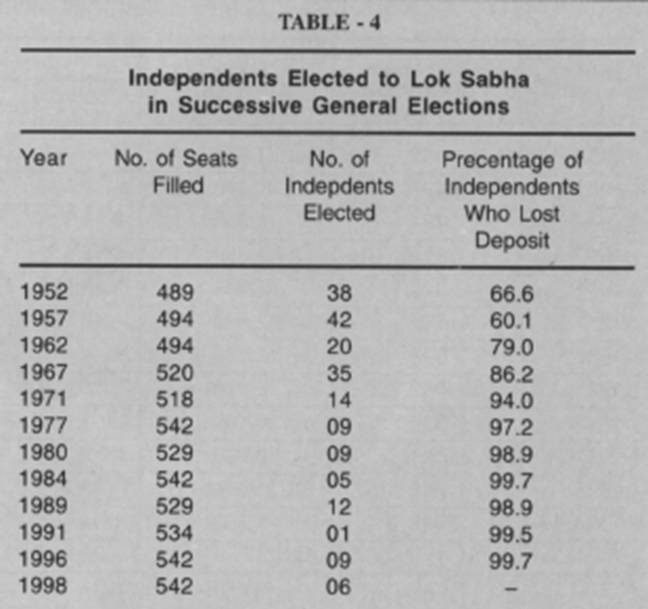
parties. Table 4 clearly shows that the role of Independents in our
elections is marginal and declining. In Lok Sabha elections, as many as 99.7 percent of Independents
are in fact losing their caution deposits.
3. A woman candidate will be contesting both against female and/or
male candidates of rival parties. Therefore, the democratic choice of voters is
not restricted to compulsorily electing only women candidates.
4. As women members are elected in competition with other candidates
- without reserving seats - they
will be seen
as legitimate representatives in
the eyes of the public and not just beneficiaries of charitable measures.
5. A winning woman candidate will have been elected on her own
strength, backed by party support. She will not be a mere proxy or political
lightweight.
6. There will
be no need
for rotation of reservation.
Therefore the elected women and men can nurture their constituencies and emerge
as major political figures in their own right, with an independent power base.
7. At the same time, in the absence of reserved seats, there will be
healthy competition for nomination for a particular seat between male and
female politicians.
8. Parties will be able to nominate women from BCs,
minorities and other communities for elective office in areas where there is
electoral advantage to them. This obviates the need for a quota within quotas -
an issue which has blocked the existing bill. Those who are concerned about BC
representation need not settle merely for one-third quota for BC women within
the 33 percent women’s quota as they are demanding now. They can field as many
BC or minority women as they think appropriate.
9. This method is mostly likely to find favour
with political parties and incumbent legislators, as there will be no fear of
being uprooted at short notice by draw of lots. Both compulsory reservation and
regular rotation are avoided.
10. Unlike with the lottery system of reserved
constituencies, in which women’s presence is likely to get ossified at 33
percent since there would be resistance to letting women contest from
non-reserved constituencies, this model allows for far greater flexibility in
the number and proportion of women being elected to legislatures. If women are
candidates for one-third of all seats contested by each party, theoretically
they could even win the vast majority of seats - all on merit.
11. This model also provides for reservation of
seats for women in the upper houses. However, given the present state of affairs,
it is likely that, to begin with, about one-third of the contested seats will
be won by women. But this percentage is likely to grow over time as women gain
more confidence and strength. It also ensures that their presence in
legislatures more nearly reflects their actual electoral strength so that they
are not seen as mere recipients of charitable measures.
Plugging Possible Loopholes
ð A party
may be tempted to nominate women from constituencies where it is weak. However,
by making the unit of consideration the state or union territory for Lok Sabha, and a cluster of three
Lok Sabha constituencies
for the Legislative Assembly, this risk is avoided. Parties will be compelled
to nominate women in all states and regions. No serious party seeking power can
afford to deliberately undermine its own chances of election on such a large
scale. It is also mandatory to nominate women in one-third constituencies
because otherwise twice the number of male candidates of the party will lose
party nomination.
ð
In the absence of actual reservation of seats, there
could be fears that women may not be elected in one-third constituencies, as
the voters may prefer a male candidate over a female candidate on account of
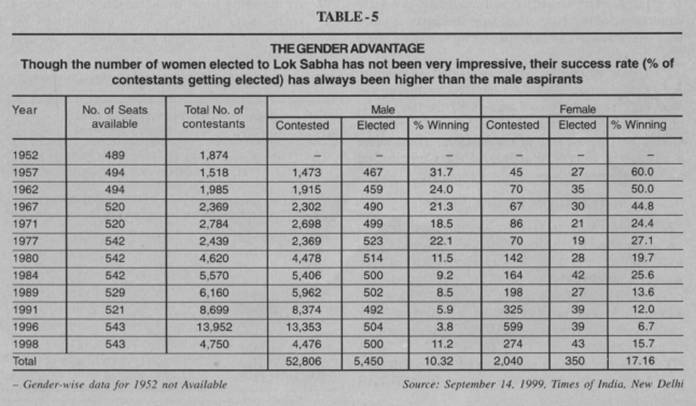
gender bias. However, evidence so far suggests that women candidates of parties
have not suffered any gender discrimination at the hands of voters. In fact,
very often, the percentage of success of woman candidates is higher than that
of male candidates. Table 5 shows that the success rate of women candidates
in Lok Sabha elections has
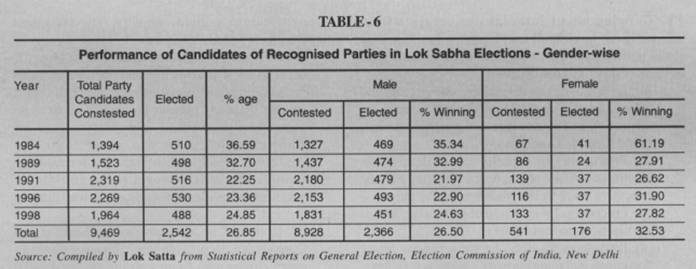
been uniformly higher than that of their male counterparts in every general elections. It is possible to argue that the few women who
contest are more often party candidates, and therefore, their success rate is
exaggerated. However, Table 6 clearly shows that even among candidates
of recognised political parties, the success rate of
women candidates is higher than that of men. While 32.53 per cent of women
candidates of recognised parties have been elected to
Lok Sabha since 1984,
the
success rate of male candidates is only 26.50 percent. This trend is seen in
all general elections since 1984, except in 1989. Therefore, it is reasonable
to assume that women will be elected in large numbers, and that, in fact, their
presence in Lok Sabha will
exceed one-third in many cases. In any case, past evidence suggests that in at
least a quarter of the constituencies, women are likely to get elected if recognised parties nominate them in at least one-third
constituencies.
It is noteworthy that women’s participation has
increased dramatically, to near equal or even higher than equal participation,
only in countries like
Other Necessary Measures For Enhancing Women's Participation
WHILE it is
necessary to institute a system of reservation for women as spelt out above, this or
any other system of ensuring women’s presence in legislatures is not by itself
sufficient if our objective is to make women equal partners in democratic
politics. The problem is not just that women in the political arena are denied
tickets by political parties. The fundamental problem is that given the nature
of electoral politics today, the system itself creates insurmountable obstacles
for women. Proposals for reservation for women must therefore be a part of a
larger package of general reforms in electoral politics.
The following general measures of
electoral reform would go a long way towards making politics less intimidating
for women.
Measures
to check criminalisation of politics:
(a)
The list of offences where a conviction leads to disqualification from
contesting election should be expanded as per the recommendations of the Law
Commission.
(b)
Disqualification should not be conditional upon final conviction. It should
come into operation as soon as the judge has framed charges with references to
offences specified above.
(c)
A candidate should be required to make a declaration of all the cases pending
against him or her, involving charges of criminal conduct or corruption, at the
time of filing nominations. This declaration should be made public. False
declaration should be a ground for disqualification.
To bring about internal
democracy within political parties; all the recognized (national or state)
political parties should be required to include in their respective
constitutions:
(a) Rules gooverning the membership of party and
a Register of Current Members that is open for inspection by any member or the
representatives of the Election Commission of India.
(b) Provisioons for a periodic and democratic
election of all the office bearers and the highest executive body by the
members of the party.
(c) Procedurres for selection of party’s candidates
for elections to legislatures.
(d) Procedurres for deciding upon various policy
documents including the party’s election manifesto.
(e) Internall mechanism for adjudicating any
dispute, including those concerning the interpretation of the party constitution.
(f) The Elecction Commission shall review the
party constitutions for their compliance with the above mentioned requirements,
and also serve as a court of final appeal against any decision of the internal
adjudicating authority in every party. The failure to comply with the Election
Commission’s instructions or decisions will invite de-recognition of the party.
Measures to curb the influence of black money
in politics:
(a) Every caandidate shall make a declaration of
his/her income and property at the time of nomination. False or incomplete
declaration shall invite disqualification.
(b) All citiizens and corporations shall be
exempted, upto a certain limit, from paying income
tax on donations made to registered political parties.
(c) The canddidates and political parties shall
be required, after the completion of election, to file a detailed statement of
account. Non-disclosure or false declaration should result in disqualification
for candidate and de-registration for political parties.
(d) While the current ceiling on electoral expenses needs to be revised, certain items of expenditure (direct inducements in cash or kind to the voter, or expenditure to bribe officials or hire hoodlums) shall be considered illegal.
(e) Every caandidate who secures 2 percent or
more of the valid votes polled in a constituency shall be reimbursed a
reasonable sum of, say Rs.10 for each vote secured.
(f) It shalll be compulsory for all registered
political parties to get a statement of income and expenditure audited
annually. The statement shall be a public document.
Measures to curb electoral malpractices:
(a) The locaal post-office shall be in charge of
maintaining and revising electoral rolls on a regular basis. At present most
citizens have no access to electoral rolls, and the procedure for additions,
deletions and corrections are ineffective in reality, though the law is
eminently sensible. There is evidence to suggest that in urban areas the
electoral rolls are flawed upto 40 percent.
(b) It shoulld be mandatory for the Election
Commission to provide voter Identity Cards to every citizen who figures on the
electoral rolls. Once this process is completed, the voter identity card or
other means of identification should be made compulsory for voting.
(c) If the proportion of “tendered” votes in a polling booth is greater than one percent of the total electorate, a repoll shall be ordered in the booth. A tendered ballot is given to a voter in whose name a false vote was already cast, and who establishes identity. Therefore, a tendered vote is indisputable proof of personation and rigging. At present a tendered ballot is kept in a separate cover and is not counted, while the false vote cast is counted! If this repoll provision is incorporated and publicised, people will then avail the facility of tendered vote, and rigging will be self-limiting for fear of a repoll.
Provisions of the Alternative Bill
A Bill To
Amend The Representation of People’s Act -1951
(New Sectionn 34)
Notwithstandding anything contained in this act,
every recognised political party shall nominate women
candidates on behalf of that party, as nearly as may be, in at least one-third
of the constituencies in which the party is contesting, in every general
election.
Provided thaat for an election to Lok Sabha, the State shall be the
unit for such nomination, and for an election to Legislative Assembly, a
cluster of three parliamentary constituencies shall be the unit as nearly as
may be.
Provided thaat for Lok
Sabha election, in case of States with less than 3
seats, a cluster of States to be defined by the Election Commission shall be
treated as a unit.
(For removall of any doubt, these provisions
will apply in all States and union territories for recognised
national parties, and in the respective State or
States for recognised State parties)
Provided thaat in respect of seats reserved for
scheduled castes and scheduled tribes, the State shall be the unit for
nomination of women for all general elections; and one-third of all candidates
nominated for the reserved constituencies shall be women.
Provided thaat in case of by-elections, the
party shall nominate as nearly as may be one-third women candidates for the Lok Sabha and Legislative
Assembly, with the nation as unit for Lok Sabha and State as unit for Legislative Assembly. Provided further that, in respect of State parties, this provision
will apply for State as unit for Lok Sabha.
In the eventt of a recognised
political party not complying with these provisions, for the shortfall of every
woman candidate while nominating candidates for elective office, two male
candidates of the party in the State or cluster of parliament constituencies,
as the case maybe, as decided by the party shall be deemed to be Independent
candidates for all purposes including allotment of symbols.
The Electionn Commission or the officials authorised by it at the State or
Provided thaat the candidates so disqualified
shall be from reserved vacancies in case the shortfall is in reserved
vacancies.
Part B - Connstitution Amendment Bill
(Amending Articles 80 and
171)
In the Counccil of States, as nearly as maybe
one-third of all seats, whether elected or nominated, shall be reserved for
women.
In the Statees in which Legislative Councils
exist, as nearly as maybe, one-third of all seats filled from each category,
whether elected or nominated, shall be reserved for women;
Provided thaat in case of members elected by
members of local authorities, graduates, and teachers, the seats reserved for
women shall be rotated, and decided by draw of lots.